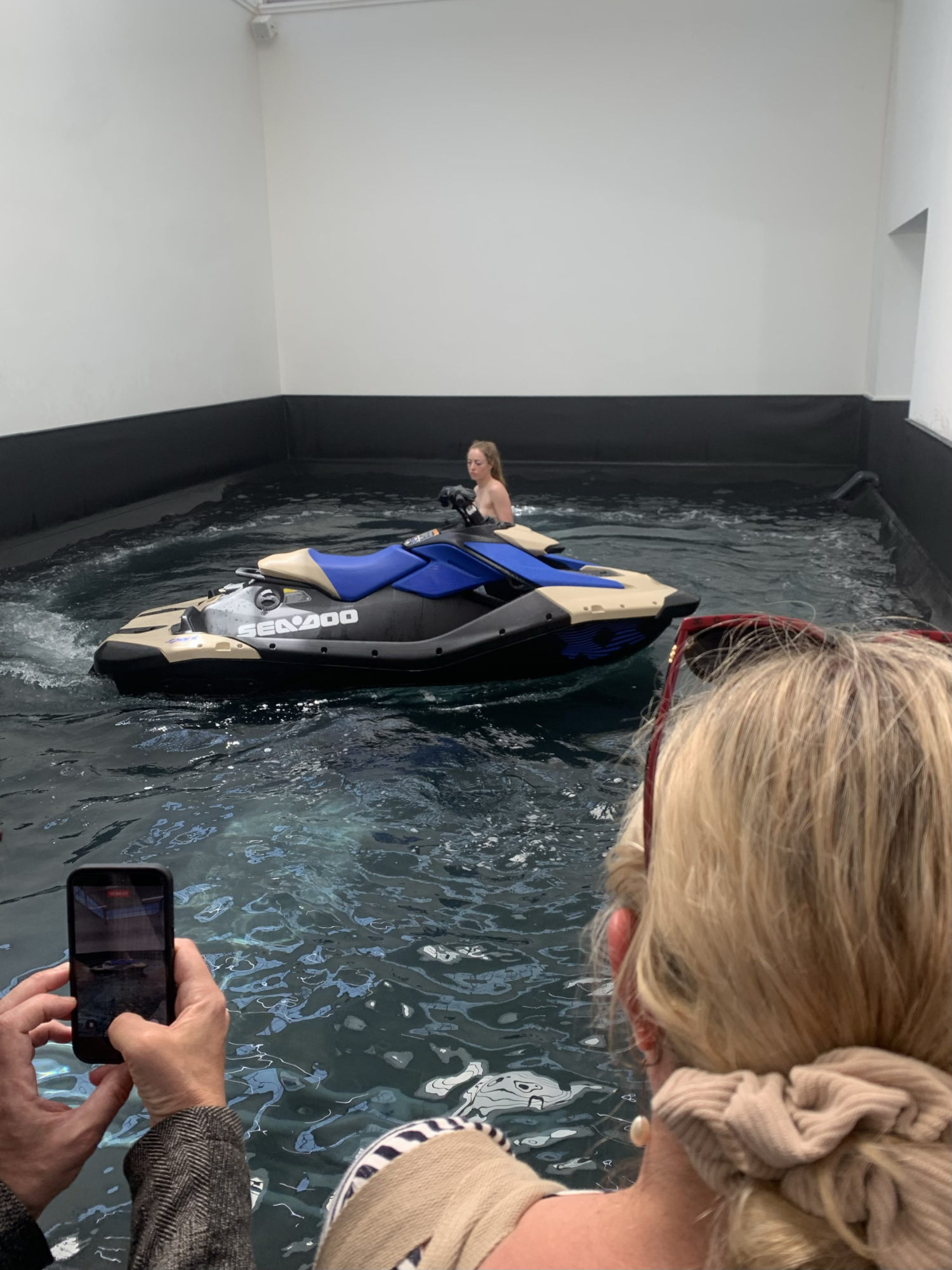
Austrian Pavilion. Photo by Anke Dyes.
|
|
|
We are all here as someone else. I’m a friend who’s 11 years younger (ask me if I dye my hair), and another is the father of yet another friend. After attending the opening of the German Pavilion (for which I actually have an invitation), I run into a few people I didn’t expect to see here and get caught up in a tour group dynamic, where I no longer decide for myself what I see and when, yet am regularly supplied with coffee, snacks, and prosecco. Still, the first day (which is the second for almost all my companions) is terrible. Never have so many people been left standing, and then left me standing somewhere else. And then there are the more personal moments.
Central themes, at least in the pavilions, are sperm count and water levels, both as global readings. Florentina Holzinger’s casts of her performers are less convincing, but her other sculptures, the water tank studded with rivets to the point of overkill, and the Theaterkläranlage as a whole serve as a good commentary on the concept of the “national pavilion.” She intertwines two realms: the water cycle of wastewater treatment with the entertainment value of SeaWorld. I don’t know what the situation is regarding water scarcity in the land of Vöslauer, and Austria, of all places, is unlikely to be underwater in the near future, but that’s not what national means here either. The reference is art-historical: something is being processed, recycled from the waste of national identity and performance art history into something we can live with, something that somehow continues, that intelligently deals with the dirt that naturally arises.
|
|
|
The German Pavilion is also well curated, even if without any jocularity. I particularly like Henrike Naumann’s three-dimensional murals, showing the post-GDR interior as an accumulation of all the ideas of the past, including the bad ones. The aggressively lively green on the walls, the deep interest in what it actually looks like out there in the functional spaces and living rooms, and the ideology that speaks through these design decisions, translate well into the gardens. This is not about art necessarily but about form. As in most of the pavilions I see, the presentation questions not so much art itself as its present, what lies outside the Giardini, rather than what happens within them.
Sung Tieu’s mosaic on the pavilion’s exterior facade also brings something in from the outside, or rather brings one outside to another: she transfers the façade of her former home in East Berlin onto the German pavilion. The prefabricated building does not actually match onto the Nazi-architecture, and it shouldn’t, but the various ways this material comparison doesn’t work are what make it an interesting art piece.
Three days after my visit to the pavilion, I’m standing in line at the security checkpoint at “Marco Polo” airport before my departure. Behind me are two men whose valuable watches are the only things I see as they pack their luggage into the plastic bins. One of them explains to the other, in a somewhat touching way, what he knows about East Germany and how incredibly great he thinks Sung Tieu is. Not that I disagree, but the way he repeats “It is all Mosaic” and “She is an amazing artist” and “She was in the Whitney Biennial,” and again, as if he could hardly believe it: “It is all Mosaic”—suggests that these pieces of information somehow follow one another, are linked logically, as if the Mosaic on the wall also formed the Mosaic of a career.
|
|
|
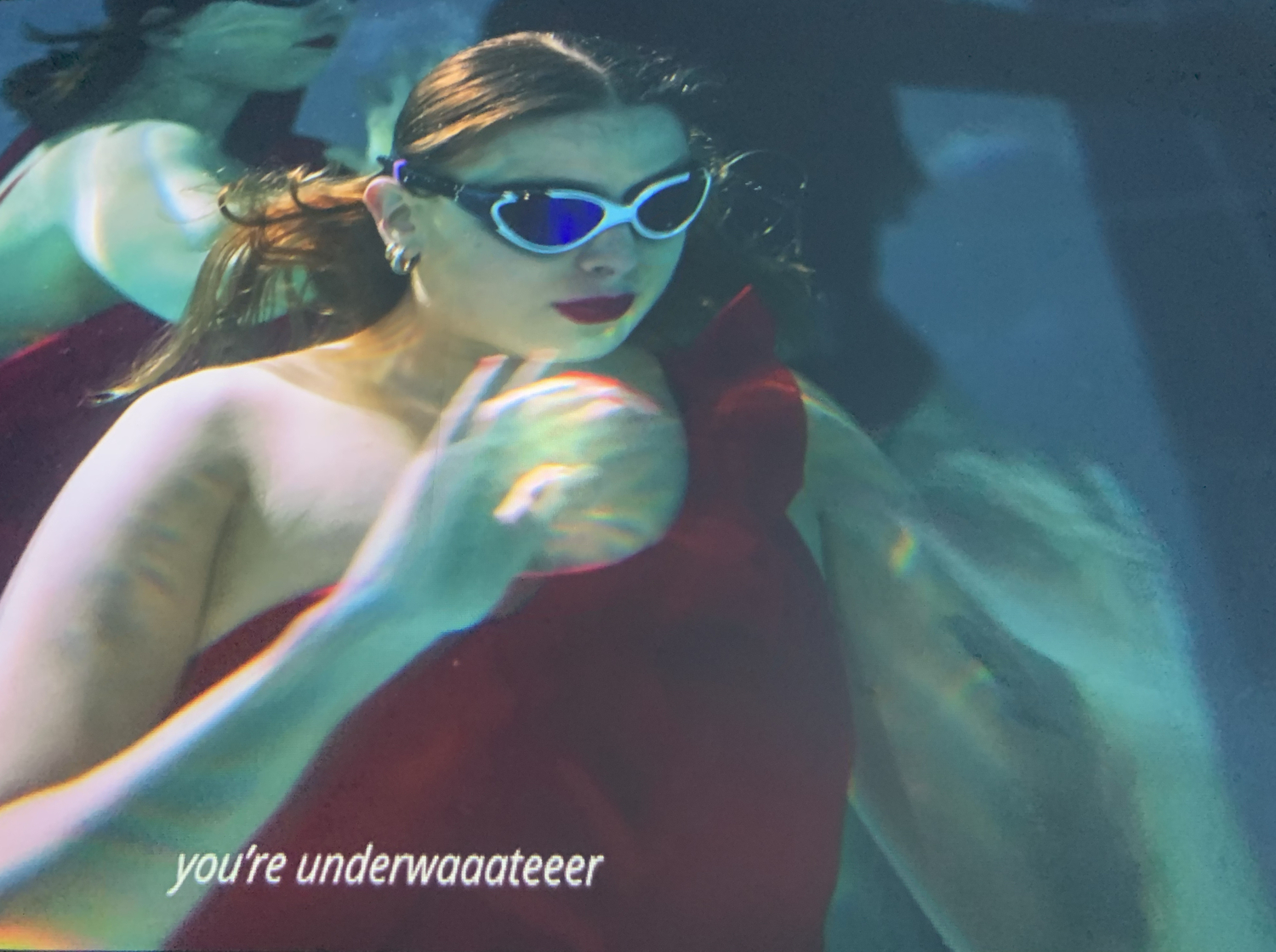
So, while the mandate here was fulfilled—to narrate national identity as a rupture, as inclusion and exclusion, as a problem, and in the form of works that clash with the Giardini’s general organization by national pavilion—others speak of home without any sense of problem. I haven’t actually seen the Russian contribution, but I’d argue that the U.S. pavilion does something similar, invoking some type of folklore and patriotism: American landscapes and American extractivism with a strangely positive connotation. In the wall text, a reference to the country’s 250th anniversary; in the galleries and in front of them, abstract yet sculpted chunks of landscape: wood, stone, ore, materials of the earth, of vastness and conquest, weighing tons. A quick internet search reveals that the sculptor Alma Allen actually lives in Mexico. I like that. Every text about the biennial is a travel log, saying that the author was there with their own body and experienced something they try to convey in its complex, layered reality, in which art and the weather play equal parts. It seems I can’t help it either, but perform the authenticating ritual, which used to be class distinction (and that would have excluded me as well), and now is a half-hearted rejection of Instagram. I move on. I drink prosecco: I am enchanted by the reenacted lesbian flirtations in the Swiss Pavilion. I delight in the whale songs in the Polish Pavilion, and the questions about when a sign is a sign: when others understand it as a sign, even without it being clear what it signifies. For the signs thus become a sign of the ability to produce signs. The water ballet by Bogna Burska and Daniel Kotowski traces an enthusiasm for whale songs that helped to curb whaling. This fascination of the 1970s touches on the still-relevant question of what forms might make us understand that the climate catastrophe has already begun, and thus, more broadly, on the aesthetic problem of the Anthropocene.
The Spanish Pavilion reminds me of a discussion with the very kind librarian at the Academy in Munich, where I currently work, who debated with me whether “artistic writing” (that’s not how I named my class but what it is nevertheless called) belongs more to “ceramics,” that is, material and technique, or to “performance art,” that is, the trends and movements of 20th- and 21st-century art, and where she should therefore make some room on the shelf for the things I’d like to acquire. I’m also amused by the fact that the pavilion, even if it wasn’t created by unpaid interns but by qualified art handlers who were paid fairly, most likely was incredibly inexpensive. I mean that as a compliment. The sorted postcards are flea-market finds and are each attached to the wall with small magnets, arranged by color, objects, animals, rocks, other subjects, by symbols, numbers, animation, and history—from two little birds to the Twin Towers. Discovering these leaps is fun, just as wandering through library aisles is fun, or when you notice that something becomes its own category, a hashtag or meme that takes hold and reorganizes meaning in a way that is visible and understood as well as arbitrary.
In the Japanese Pavilion, Ei Arakawa-Nash performs that friendly intrusiveness that has long defined their staged and other works. I see acquaintances and strangers running around with the charged, baby-heavy dolls. Like the friend who only starts holding her baby by the feet, upside down, when she notices I’m photographing her, performing an aversion to babies that neither of us actually feels.
Babies seem a good match for Arakawa-Nash’s practice, which constantly shifts the conditions, claims one thing, and then does something else, in a gentle yet unambiguous dissolution of boundaries, of one’s own jurisdiction, of the role one is assigned, of the agreement regarding when a situation begins or ends. Anyone who has ever made plans with people who have small children knows exactly what I’m talking about.
|
|
Polish Pavilion. Photo by Anke Dyes.
|
|
|
I visit all the main exhibitions and run into all the problems that this type of event presents—issues of national categorizations and national budgets that push themselves to the forefront. Because a friend recommends it, I go to the very crowded opening of the Latvian Pavilion in the Arsenale. And I’m somewhat disappointed by the empty clothing racks of the staged backstage of a fashion show that apparently didn’t take place there.
The archival videos of the fashion shows, on the other hand, are fantastic. Timeless and yet so specific to a time when fashion people from the Eastern Bloc of the early ’90s arrived seemingly later to what was going on, and yet knew how to do something interesting with the rules and trends, their lateness, and the difference their backgrounds made. Their eccentricity and references remind me of another, older work by Henrike Naumann about the Sapeurs, enthusiasts of Japanese fashion in the Congo of the late 1980s. The videos show a play with identity and locality, site-specific and on one’s own body, yet still addressing the rest of the world; no national pavilion and no need to destroy one either. We are all here, and we are all looking at each other. I briefly regret that this event, the Venice Biennial, which is rarely fashionably exciting, is one of the main events of my professional field, and not Riga Fashion Week, ca. 1992.
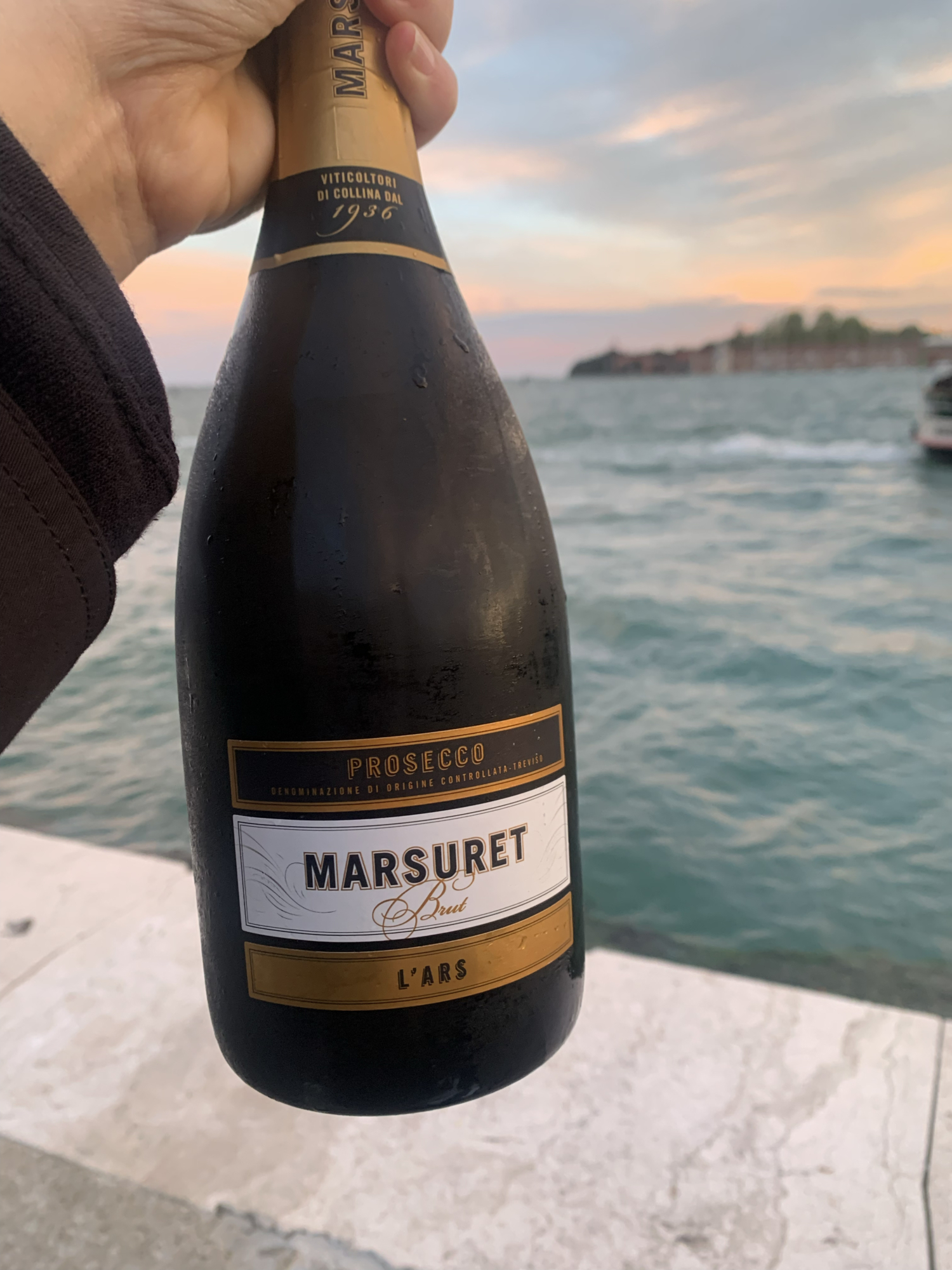
In the evening, we sit on a bench and look out at the water. We drink Prosecco from the plastic cups that our accommodation had actually provided for brushing our teeth. We need to have a very serious discussion. We need to talk after the day at the amusement park. Discussing the art and, of course, the constant little indignities that this kind of trip provides: standing in line, recycling other people’s wristbands for drinks that we could just as easily buy ourselves. There is always more than we saw, and most of our judgments are tentative. It is too much, and we saw too little. And yet, some things are very clear: this is not our event, actually. Too few artists, too many people sent by councils and authorities, offices and dignitaries to hold or attend a biennial event that still functions well even when protests spill into it, when people strike for Gaza and boycott Russia. It’s astonishing that these gardens don’t completely blow up every two years. Why just smoke bombs, Pussy Riot? Briefly, I recall someone once saying that Pussy Riot managed to get the words “pussy” and “riot” read out on every news broadcast in the world, but back then, we didn’t yet know how bad things already were in Russia, and that playing electric guitar meant the Gulag, and that the mad germophobe was just the beginning of something. The fact that all this matters now for the Biennial has a lot to do with the scale of the event. We, too, are part of mass tourism, flying on budget airlines and staying in damp accommodations. Like a huge swarm of locusts that doesn’t see itself as a plague, we clog up the cafes and drink the bars dry. And we bring our troubles. Just when it’s all actually becoming too much, we head to a performance program on Saturday with our expired Provence press passes. While everyone tries to stand at least a little in the shade—which is difficult on the roof of the building—Paul Preciado speaks about the perhaps unpleasant task of having to defend institutions, given the by now established old-men-fascism that Pussy Riot saw coming earlier than most. The solution can’t be therapy, he replies to his conversation partner’s question. But yes, if you’re feeling bad, if it helps, then, by all means, go to therapy.
Later, during the setup after the talk, Preciado and Jack Halberstam stand along and chat with a third person whom I somehow recognize, but not well enough to know if their books are also on my shelf. We’re all waiting for a performance by the Austrian choreographer Doris Uhlich, performed by Ann Muller and Vera Rosner. And it’s actually astonishing how well this performance then works, next to the open bar. It should be unbearable to watch an earnest exploration of the range of motion of two naked bodies here, their physical abilities and inabilities, the wheelchair covered in the same slime as the body, overemphasizing boundaries and transitions—between people and the things that expand them, and the other people who also do just that. They pull it off with stone-cold intensity and super softness. I was glad I was there.
|
|
|
|
|
|
|