|
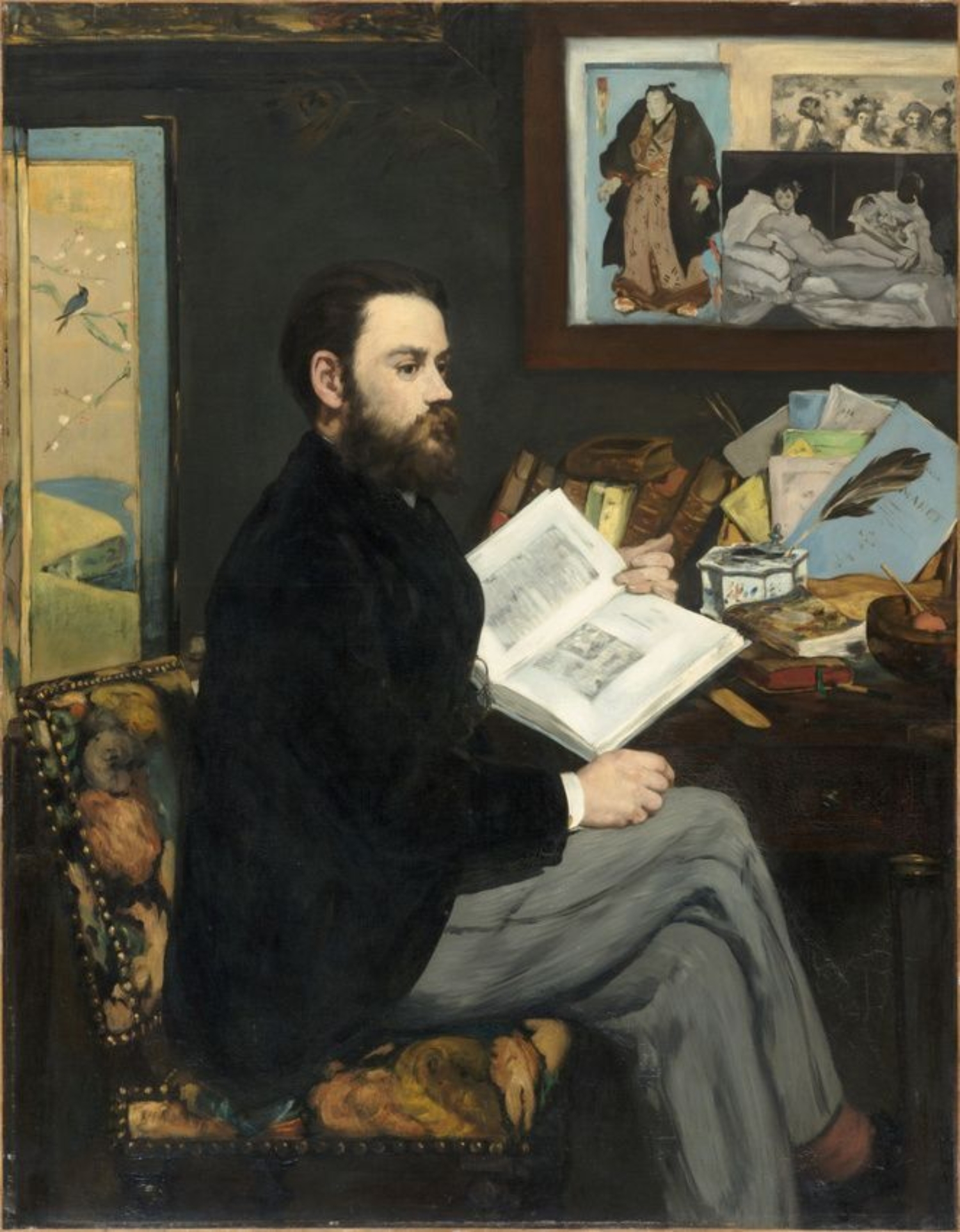
As writers and curators, we wield the latent yet profound privilege of reshaping meaning, often recasting artists’ intentions and bending their voices to the contours of our own narratives. After all, the art world is a terrain of asymmetrical desires, misplaced projections, excessive generosity, and disappointments that somehow fail to discourage us from returning. On 7 May 1866, Émile Zola came to Édouard Manet’s defence in L’Événement, following the rejection of Manet’s paintings by the Paris Salon jury. Zola’s writing provoked a backlash, and his work for the publication came to an end. The following year, he expanded his defence into a pamphlet. In 1868, Manet thanked him with a portrait.
|
|
Édouard Manet: Émile Zola, 1868. Photo: GrandPalaisRmn (Musée d’Orsay) / Patrice Schmidt
|
|
|
7 May 1866 If we French enjoy a good laugh, we also possess, on occasion, exquisite courtesy and perfect tact. We respect the persecuted; we defend with all our strength the cause of those who struggle alone against a crowd. Today, I come to offer a sympathetic hand to the artist whom a group of his fellow painters has turned away from the Salon. Even if I did not admire his talent so greatly that I could praise it without reservation, I would still take his side because of the position he has been assigned: that of an outcast, an unpopular and grotesque painter.
Before speaking of those whom everyone can see, those who display their mediocrity in full view, I consider it my duty to devote as much space as possible to the man whose works have deliberately been excluded, and who has not been deemed worthy of joining the fifteen hundred or two thousand ineffectual artists welcomed with open arms.
And I say to him: “Take comfort. You have been set apart, and you deserve to live apart. You do not think like all these people; you paint according to your heart and your flesh. You are an individual who asserts himself boldly. Your canvases are ill at ease among the foolishness and sentimentality of the age. Stay in your studio. That is where I shall seek you out and admire you.”
I shall explain my position on Monsieur Manet as clearly as possible. I do not want any misunderstanding between the public and myself. I do not accept, and never shall accept, that a jury has the power to prevent the public from seeing one of the most vital individualities of our time. Since my sympathies lie outside the Salon, I shall enter it only when I have satisfied my need for admiration elsewhere.
Apparently, I am the first person to praise Monsieur Manet without reservation. This is because I care little for all those boudoir paintings, those coloured pictures, those wretched canvases in which I find nothing alive. I have already declared that temperament alone interests me.
People stop me in the street and say: “You’re not serious, are you? You’re only just starting out, and you want to cut your dog’s tail off. Come now, since nobody is watching you, let’s have a little laugh together at the great comedy of The Luncheon on the Grass, Olympia and The Fifer.”
So this is where we have arrived in art: we are no longer even free to admire what we please. I am now regarded as someone who lies to himself for the sake of calculation. My crime is that I want, at last, to tell the truth about an artist whom people pretend not to understand and whom they drive away like a leper from the little world of painters.
|
|
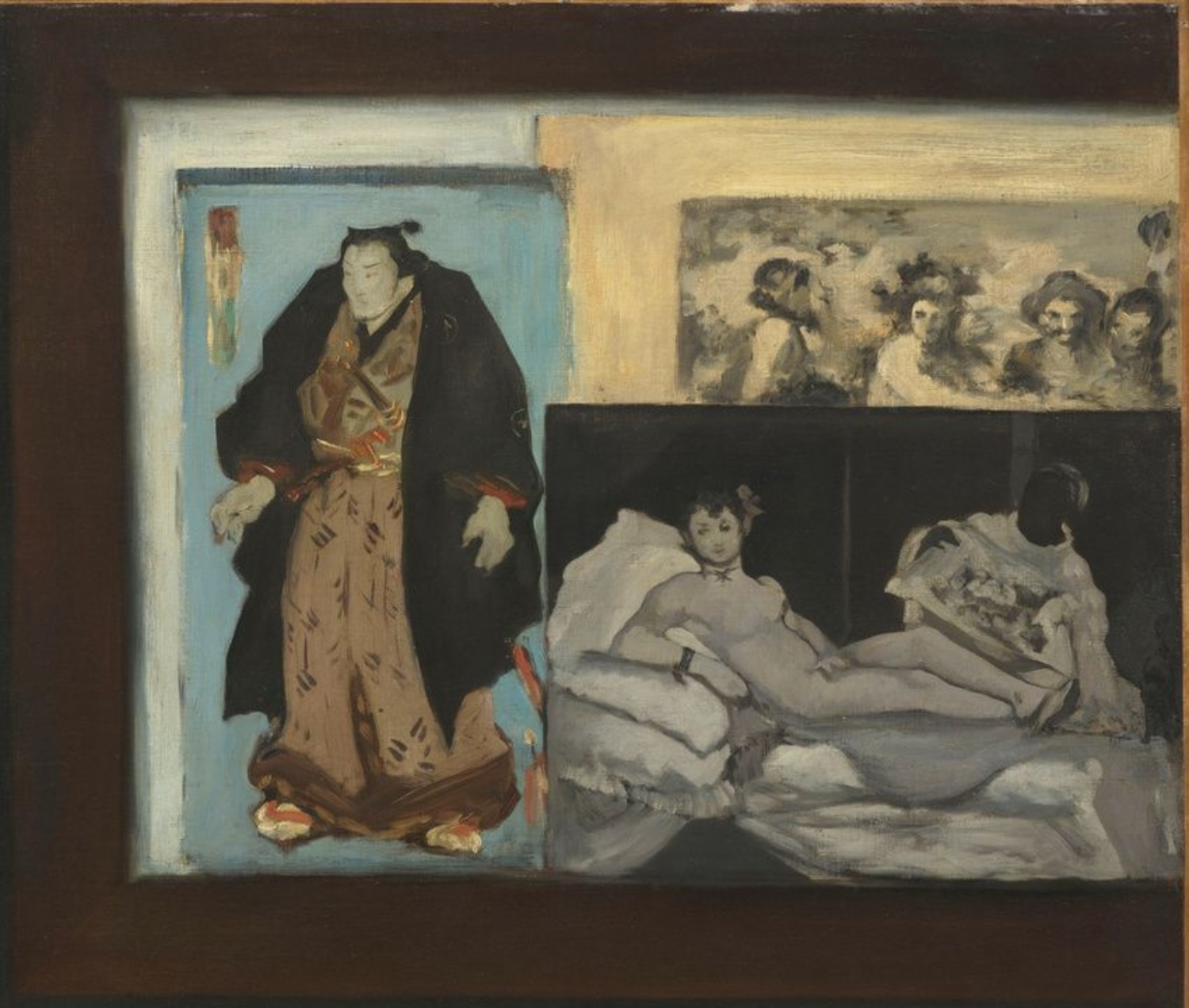
Édouard Manet: Émile Zola, 1868 (detail). Photo: GrandPalaisRmn (Musée d’Orsay) / Patrice Schmidt
|
|
|
The majority opinion of Monsieur Manet runs as follows. Monsieur Manet is a young bohemian painter who shuts himself away to smoke and drink with young rascals of his own age. Once they have emptied barrels of beer, the painter decides to produce caricatures and exhibit them so that the crowd will laugh at him and remember his name. He sets to work, creates the most outrageous things, laughs himself to pieces in front of his own paintings, and dreams of nothing but making fun of the public and establishing a reputation as a grotesque figure.
Good people! I can tell an anecdote here that perfectly captures the attitude of the crowd. One day, Monsieur Manet and a very well-known writer were sitting outside a café on the boulevards. A journalist arrived, and the writer introduced him to the young master. “Monsieur Manet,” he said.
The journalist rose onto his toes and looked to the right, then to the left. At last, he noticed the artist sitting modestly in front of him, occupying very little space. “Oh, pardon me!” he exclaimed. “I thought you were a giant, and I was looking everywhere for a grimacing, sinister face.” That is the public in a nutshell. Even artists themselves—his colleagues, the people who ought to see the matter clearly—do not dare make up their minds. Some, the fools, laugh without looking, making merry over these powerful and deeply felt canvases. Others speak of incomplete talent, deliberate brutality and systematic violence. In short, they allow the public to make its jokes without even thinking of telling it: “Do not laugh so loudly, unless you want to appear foolish. There is not the slightest thing here to laugh at. There is only a sincere artist, obeying his own nature, feverishly searching for truth, giving himself completely and possessing none of our cowardice.”
Since nobody else says this, I shall say it. I shall shout it.
I am so certain that Monsieur Manet will be one of tomorrow’s masters that, if I were wealthy, I would consider it an excellent investment to buy all his paintings today. In fifty years, they will sell for fifteen or twenty times their present price, while certain paintings now valued at forty thousand francs will not be worth forty. One does not need much intelligence to predict such events. On the one hand, there are fashionable successes, Salon successes and the triumphs of artistic cliques. There are artists who cultivate a little speciality of their own, exploiting some passing public taste. There are elegant, dreamy gentlemen who, with the tips of their brushes, paint pallid images that a few drops of rain would wash away.
On the other hand, there is a man who confronts nature directly, who has called the whole of art into question, who seeks to create from within himself and to conceal nothing of his own personality.
Do you really believe that paintings made by a powerful and convinced hand are not more durable than ridiculous popular prints?
If you like, we can go and laugh at the people who make fools of themselves and their public by shamelessly exhibiting canvases that have lost their original value beneath smears of yellow and red. If the crowd had received a sound artistic education, if it knew how to admire individual and novel talent, I assure you that the Salon would be a place of public amusement: visitors would not be able to walk through two rooms without becoming sick with laughter. What is so extraordinarily comic about the exhibition is the collection of banal and brazen works on display, laying bare their own wretchedness and stupidity.
For a disinterested observer, the sight of those foolish crowds gathered in front of Monsieur Manet’s paintings was distressing. I heard any number of platitudes there. I asked myself: “Will we always remain such children? Will we always feel compelled to put on a display of wit? Here are people laughing with their mouths wide open, without knowing why, simply because their habits and beliefs have been offended. They find it funny, and they laugh.
“They laugh as a hunchback might laugh at another man because that man has no hump.”
|
|
“Here are people laughing with their mouths wide open, without knowing why, simply because their habits and beliefs have been offended”
|
|
|
I have visited Monsieur Manet’s studio only once. The artist is of medium height, rather short than tall, fair-haired, with a slightly flushed complexion. He appears to be about thirty. His eyes are lively and intelligent; his mouth is expressive, occasionally touched by a hint of mockery. His face as a whole is irregular and expressive, with a certain quality of refinement and energy that I cannot quite define. In his gestures and voice, the man is, moreover, exceedingly modest and gentle.
The man whom the crowd treats as a cheeky, mocking bohemian lives quietly with his family. He is married and leads the orderly life of a bourgeois. He also works relentlessly, constantly searching, studying nature, questioning himself and pursuing his own path.
We spoke together about the public’s attitude towards him. He does not joke about it, but neither does he seem discouraged. He has faith in himself. He calmly lets the storm of laughter pass over his head, certain that applause will come.
At last, I found myself face to face with a determined fighter: an unpopular man who did not tremble before the public, who did not try to tame the beast but rather sought to master it, imposing his own temperament upon it.
It was in this studio that I came to understand Monsieur Manet completely. I had liked him instinctively; from that moment on, I penetrated his talent, which I shall now attempt to analyse.
At the Salon, his canvases cried out beneath the harsh light, surrounded by the penny prints that had been pasted onto the walls around them. At last, I could see them in isolation, as every painting ought to be seen: in the very place where it was made. Monsieur Manet’s talent is founded on simplicity and accuracy. No doubt, confronted with the extraordinary artifice of certain fellow painters, he decided to question reality directly, face to face. He rejected all acquired knowledge and inherited experience; he wanted to begin art anew, with the exact observation of objects.
He therefore placed himself courageously before his subject. He saw it in broad patches of colour and forceful contrasts, and painted each thing as he saw it.
Who dares speak of petty calculation here? Who dares accuse a conscientious artist of making fun of art and of himself? The mockers ought to be punished, for they insult a man who will become one of our glories. And they insult him miserably, laughing at a man who does not even deign to laugh at them. I assure you that your grimaces and sneers trouble him very little.
|
|
“No doubt, confronted with the extraordinary artifice of certain fellow painters, he decided to question reality directly, face to face.”
|
|
|
I have seen The Luncheon on the Grass again, that masterpiece exhibited at the Salon des Refusés, and I defy our fashionable painters to give us a broader horizon, more filled with air and light. Yes, you are still laughing, because Monsieur Nazon’s violet skies have spoiled you. Here is nature built on solid foundations, and that is precisely what displeases you. Nor do we have Monsieur Gérôme’s plaster Cleopatra, or Monsieur Dubuffe’s pretty pink-and-white ladies. Unfortunately for you, we find here only ordinary people, who have the disadvantage of possessing muscles and bones like everyone else. I understand your disappointment and your amusement in front of this canvas. What you really wanted was something to tickle your eyes with images suitable for decorating glove boxes.
I have also seen Olympia again. Its serious fault is that it resembles many young women you know. And what a strange obsession it is to paint differently from everyone else! If only Monsieur Manet had borrowed Monsieur Cabanel’s powder puff and applied a little rouge to Olympia’s cheeks and breasts, the young woman would have been presentable.
There is also a cat in the painting, which has greatly amused the public. Indeed, that cat is enormously funny, is it not? One must be mad to put a cat in a painting. A cat—can you imagine it? And a black cat, at that! How amusing! Oh, my poor fellow citizens, admit it: you are easily entertained. The legendary cat in Olympia is a sure indication of what you hope to find when you visit the Salon.
You go there looking for cats, admit it. And your day has not been wasted when you find a black cat that makes you laugh. But the painting I prefer above all others is certainly The Fifer, the canvas rejected this year. Against a luminous grey background stands the young musician, dressed in his uniform, with red trousers and a military cap. He faces us directly as he blows into his instrument.
|
|
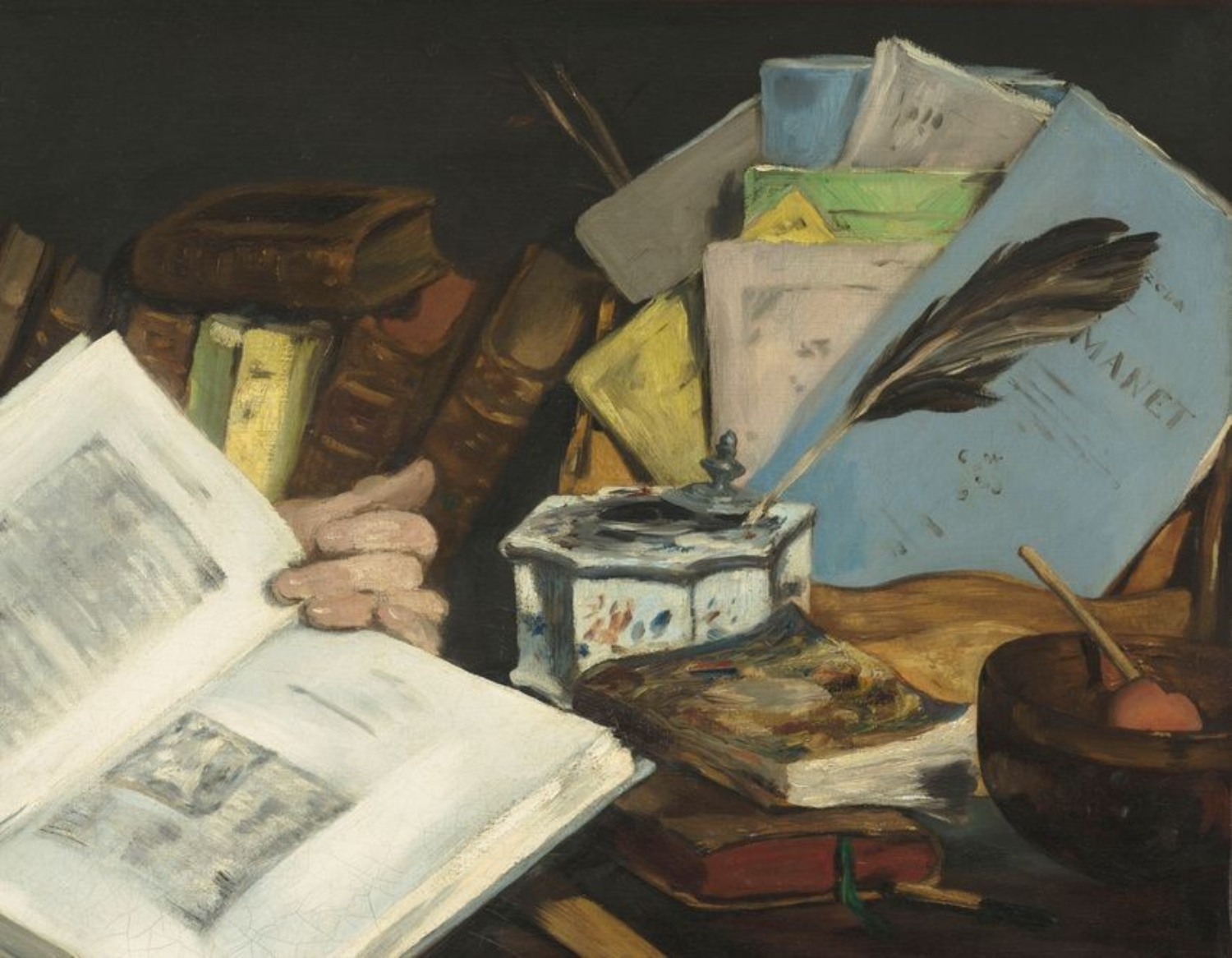
Édouard Manet: Émile Zola, 1868 (detail). Photo: GrandPalaisRmn (Musée d’Orsay) / Patrice Schmidt
|
|
|
I said earlier that Monsieur Manet’s talent consists of accuracy and simplicity. It is above all the impression left on me by this painting that comes to mind. I do not believe it is possible to achieve a more powerful effect with simpler means. Monsieur Manet’s temperament is a dry, decisive one, one that gets straight to the point. He defines his figures sharply and does not shy away from the abruptness of nature. He renders objects in their full force as they stand out against one another. His whole being inclines him to see in patches, in simple and energetic fragments. One could say that he is content to search for accurate tones and then place them alongside one another on the canvas. The result can be a painting of great solidity and strength.
In this painting, I recognise a man who is curious about truth, and who draws from within himself a living world, endowed with a distinctive and powerful life.
You know the effect Monsieur Manet’s paintings produce at the Salon. They simply burst through the wall. All around them spread the sugary softness of fashionable art: trees made of candied sugar, houses made of pie crust, little men made of gingerbread and women made of vanilla cream. The sweetshop becomes ever pinker and softer, while the artist’s living canvases acquire a certain bitterness amid this river of milk.
One should see the grimaces of the grown-up children passing through the room. You will never persuade them to swallow even a few sous’ worth of real flesh, with the substance of life in it. Yet they gorge themselves, like wretches, on all the nauseating sweets served up to them. Stop looking at the neighbouring paintings. Look instead at the living people in the room. Study the contrasts of their bodies against the floorboards and the walls. Then look at Monsieur Manet’s canvases: you will see that truth and power reside there. Now look at the other paintings, the ones smiling foolishly all around you. You burst out laughing, do you not?
|
|
“Stop looking at the neighbouring paintings. Look instead at the living people in the room.”
|
|
|
Monsieur Manet’s place is marked out at the Louvre, just as Courbet’s is, and that of every artist endowed with a strong and original temperament.
There is, moreover, not the slightest resemblance between Courbet and Monsieur Manet. If these artists are consistent, each must reject the other. It is precisely because they have nothing in common that each can live according to his own distinct vision. I have no comparison to draw between them. I follow my own way of seeing by refusing to measure artists against an absolute ideal, and by accepting only unique individualities—those that assert themselves through truth and power. I know the answer: “You mistake strangeness for originality. So you believe that doing something differently from everyone else is enough to make it good?”
Go to Monsieur Manet’s studio, gentlemen. Then return to your own and try to do what he does. Have some fun imitating this painter who, according to you, has made a business of public hilarity. You will discover that making the world laugh is not so easy. I have tried to restore Monsieur Manet to the place that belongs to him: one of the foremost places. Perhaps people will laugh at his advocate just as they laughed at the painter. One day, both of us shall have our revenge. There is an eternal truth that sustains me as a critic: only temperaments endure and dominate the ages. It is impossible—impossible, do you hear?—for Monsieur Manet not to have his day of triumph, and for him not to crush the timid mediocrities surrounding him. Those who should tremble are the manufacturers of art, the men who have stolen a semblance of originality from the masters of the past; those who painstakingly calligraph trees and figures, who know neither what they themselves are nor what the people they laugh at truly are. These are the dead men of tomorrow. Some have been dead for ten years already, even as they are being buried; they continue to haunt the world, crying out that the dignity of art is being offended whenever a living canvas is introduced into the great common grave of the Salon.
|
|
|
|
|
|
|