|
Olga Hohmann and David Karl Max
|
|
Travis MacDonald's "Autoluminescent"
|
|
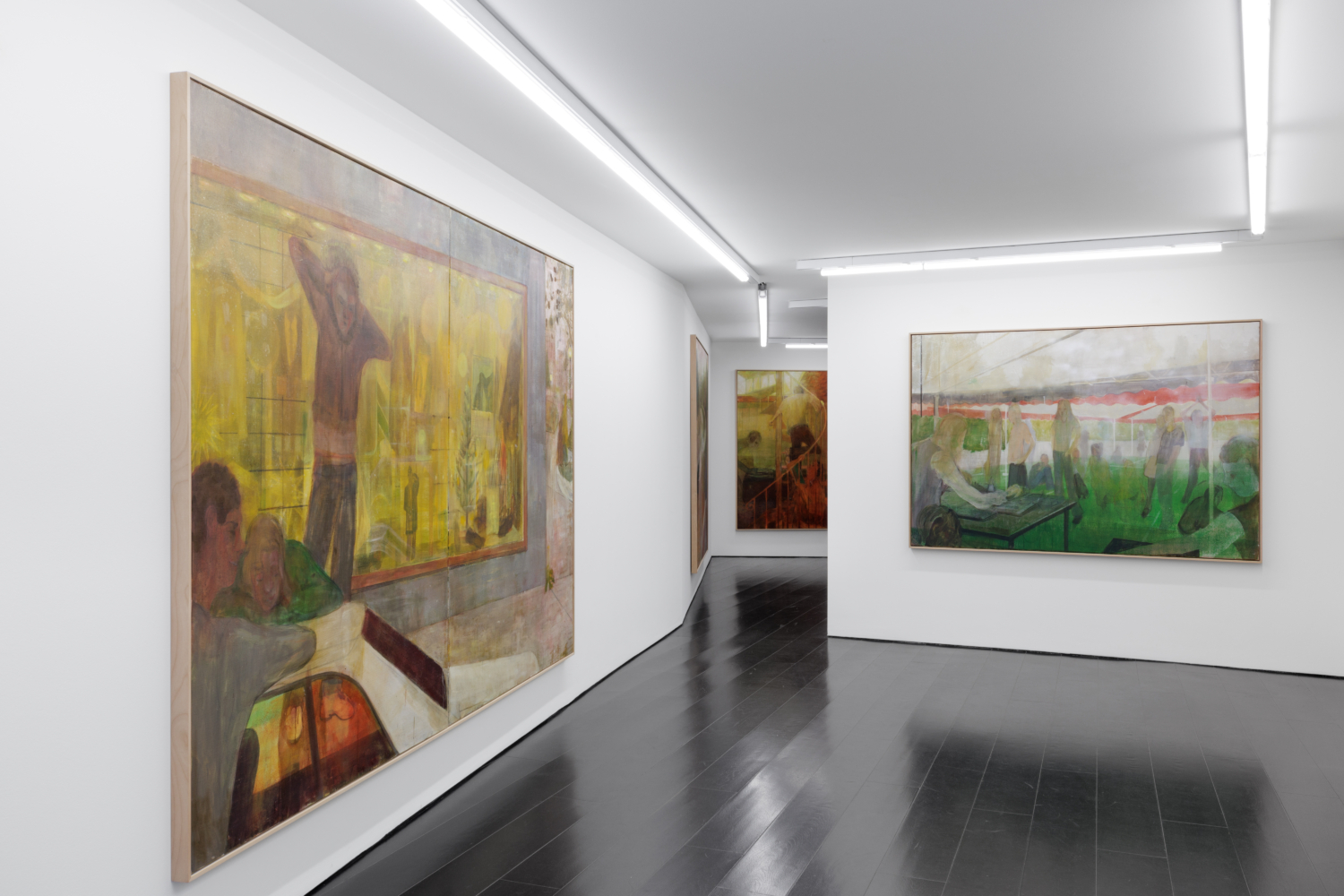
Installation View: Midland Formal and Harsh Noise, Travis MacDonald, 2025. Courtesy Contemporary Fine Arts. Photo: Gina Folly.
|
|
|
OH: Travis MacDonald’s works tell stories without punchlines. Behind these motifs sit concrete narratives—closer to myth than fairy tale. Take, for example, the story behind one of the works that shows the “baby man.” It’s an Irish myth from the family history of the MacCools, Travis’s mother’s maiden name. The village where the MacCools lived was to be destroyed by an evil sovereign. The MacCools’ response was to threaten him with a giant who would overwhelm the ruler. This giant was, of course, an invention of the cunning MacCools. Because he didn’t exist, they looked for the man in the village who most resembled an enormous giant baby: bald, with baby fat in all the right places. They found him in a bar. They diapered the giant baby, set him in a custom cradle, and presented him to the aggressor. They said, “His father is out hunting right now, but he asked us to tell you he’ll be back soon.” Sucking his thumb, the big drunken man in baby form beamed at the sovereign—who froze in fear and never again threatened the village’s existence.
Maybe Travis isn’t really a MacDonald at all, but—as a painter—a “MacCool”?
I wonder whether we can also find a MacCoolian ruse, a mythological trick—in Travis’s painterly strategy.
Perhaps the longing for origin stories—and for forms that themselves appear, in a way, primordial, like painting—comes naturally to a (territorial) biography like Travis’s. Painting crosses a temporal boundary; it points back into the past and, precisely in that gesture, becomes present.
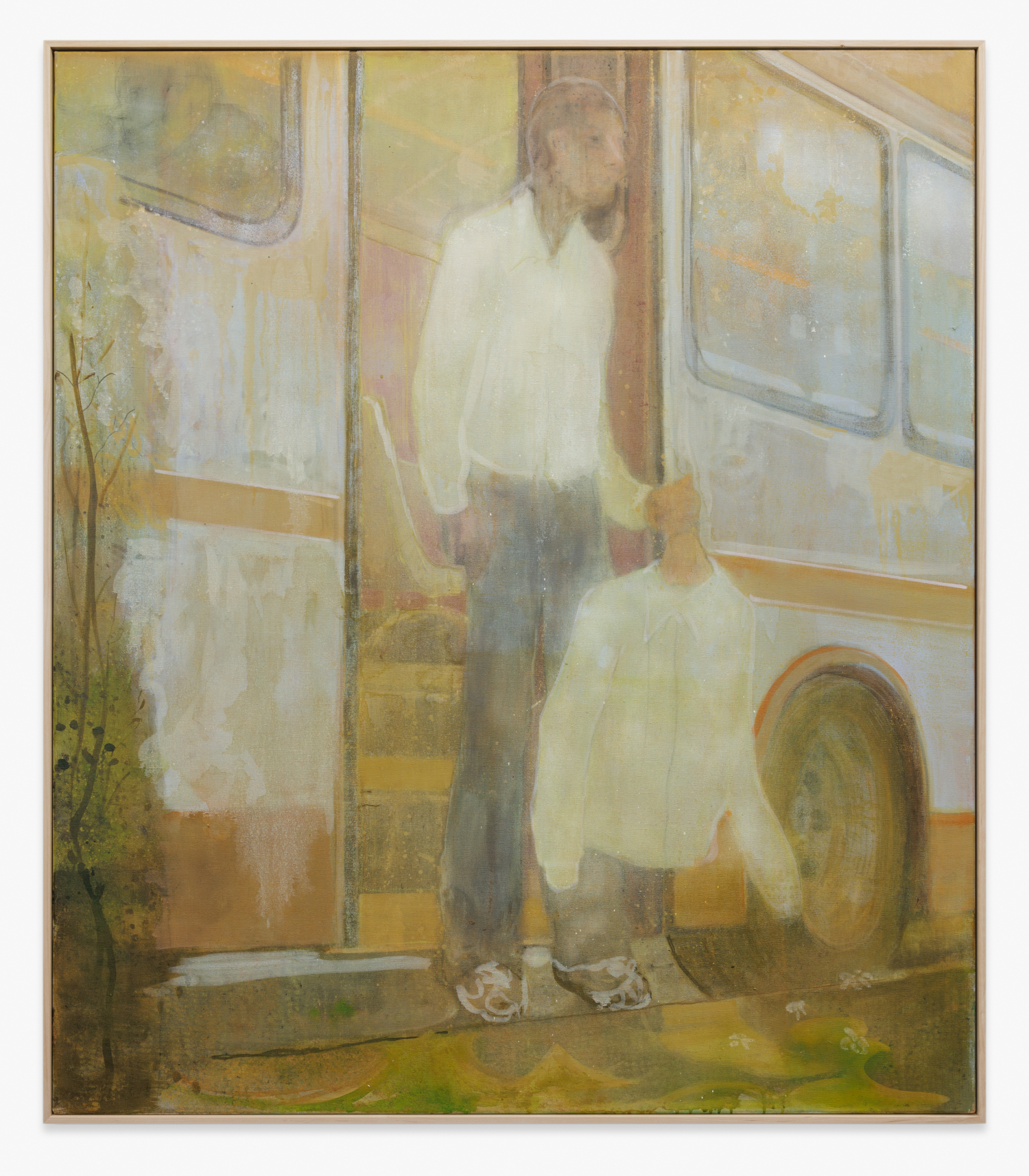
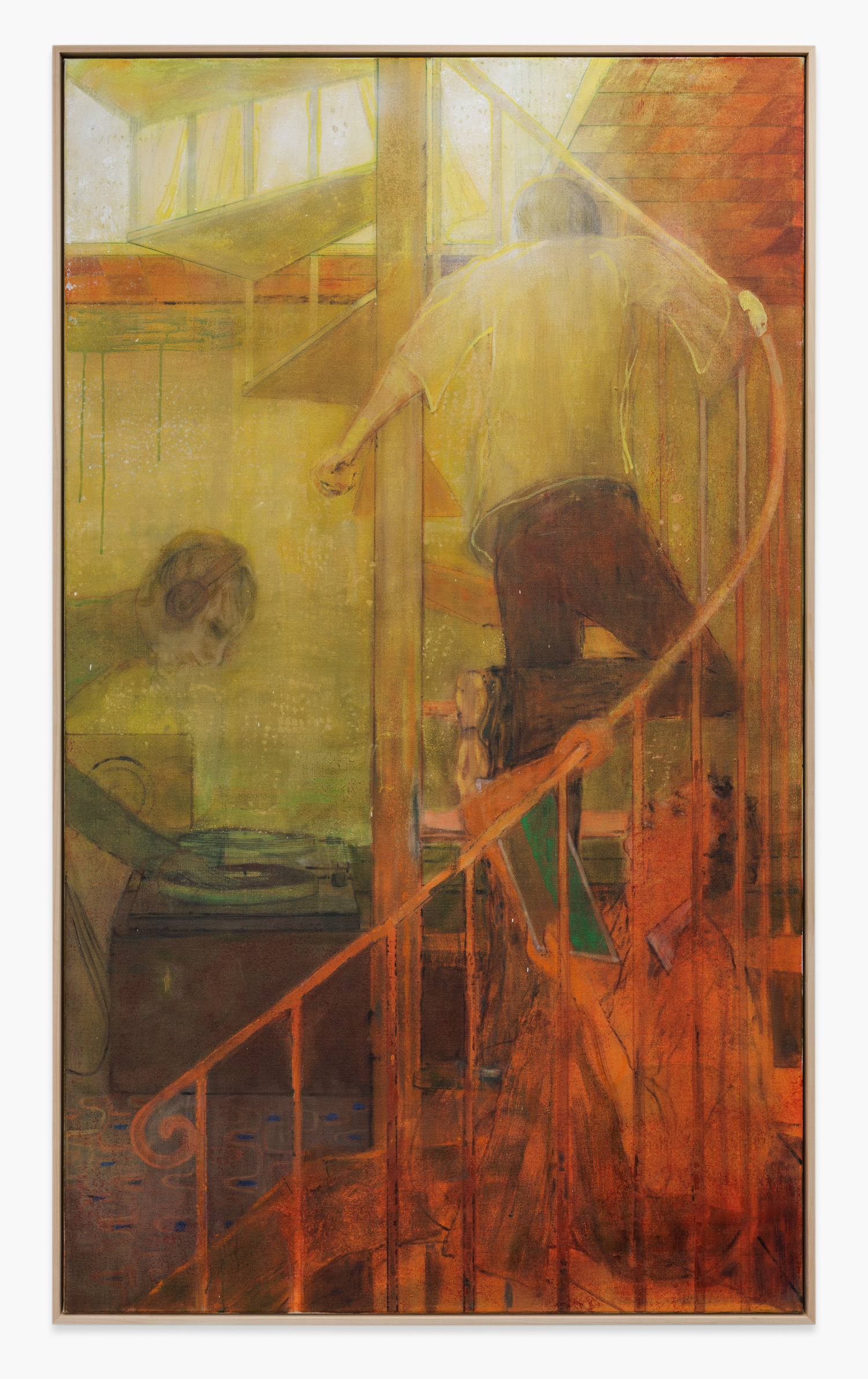
DKM: Yes, the baby man is cool. But in which painting does he actually appear? I can’t really tell. The figures seem somewhat ageless—or age-confused. There’s a clear reference to adolescence in the settings—the concert, the basement, the street corner, but the lanky figures that inhabit these spaces are ghostly presences, silhouettes, shadows of themselves. Maybe there’s nothing but hot air inside the clothes. Look at the person exiting the bus in Behold. The extra shirt they’re holding almost seems to contain more body than the person. Everyone is extremely thin; no one reads to me as a “fat, old baby man.”
|
|
Travis MacDonald: Behold, 2025. Courtesy Contemporary Fine Arts. Photo: Gina Folly.
|
|
|
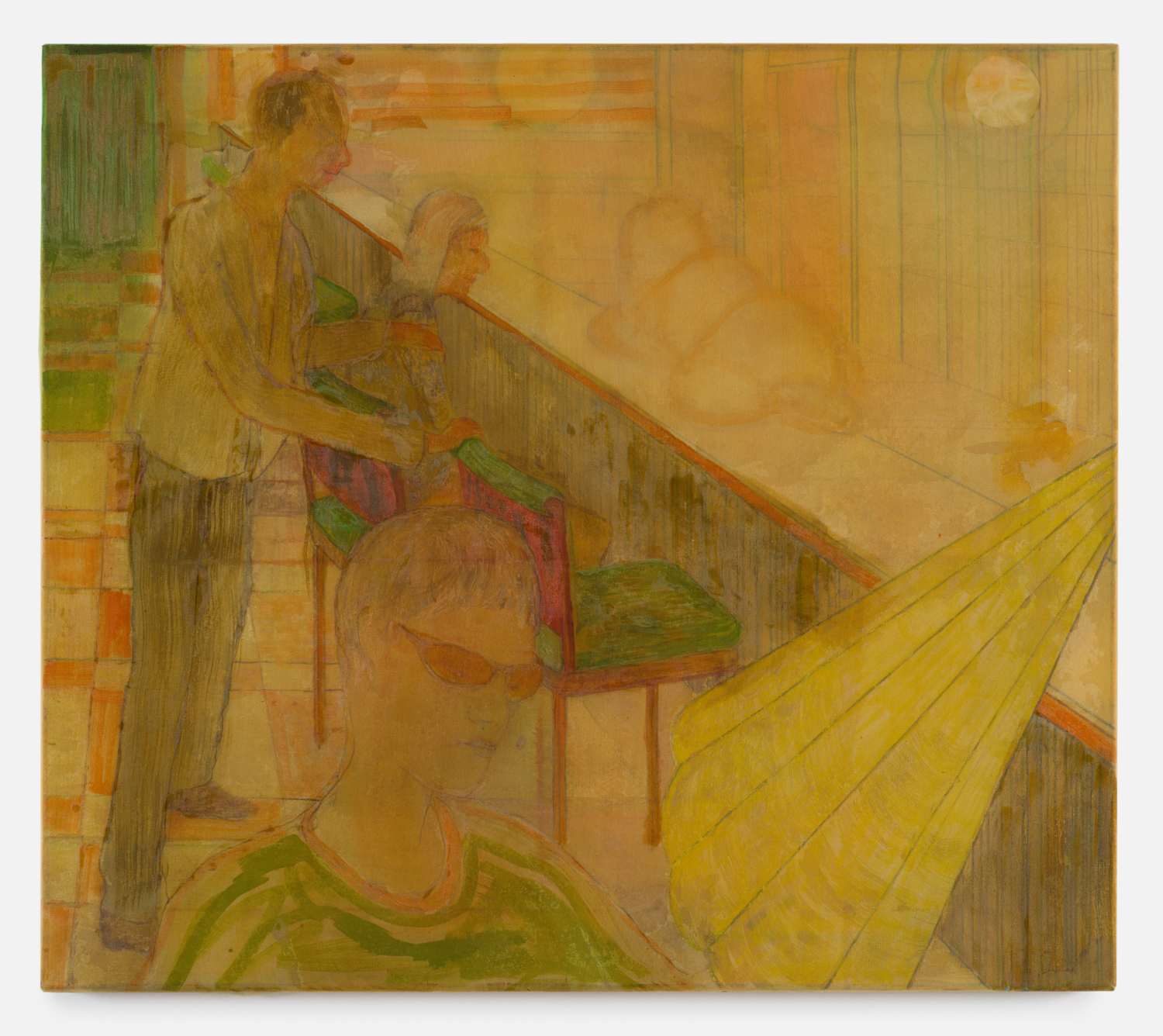
OH: True, the “baby man” is hard to find—also because the works are so socially anchored in the present that it’s difficult to see historical narratives or, as in this case, mythologies in them. I think the “baby man” is the creature lying on the bar in Silkbar. Bars keep showing up, places of pleasurable idleness. I picture Irish pubs where every wooden surface is slightly sticky. The “baby man” lies on the counter like a vague sculpture made of down. A textile again—here the body has completely dissolved into its clothing, as if there were no difference between the puffed-up material and baby fat. Down jackets, like jeans, appear again and again in the paintings. In a way, the figures’ “lying in their clothing” is a kind of surrender—much like stage diving.
|
|
“Painting crosses a temporal boundary; it points back into the past and, precisely in that gesture, becomes present.”
|
|
|
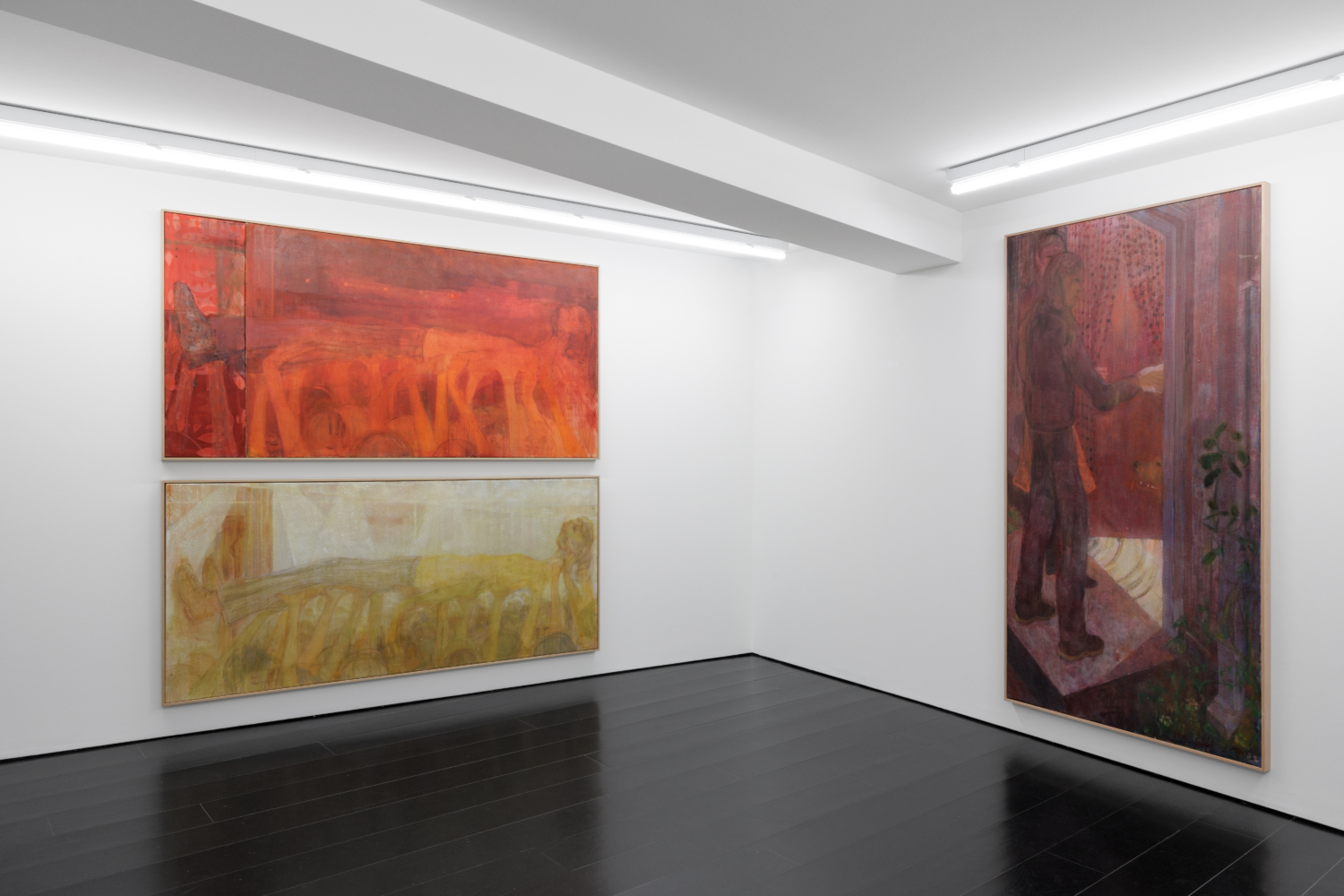
DKM: The show’s most iconic figure must be the one stagediving. Crowdsurfer I and II more or less fill the entire surfaces of two long paintings stacked in the back room of the exhibtion—a clear nod to Holbein’s Dead Christ at the Kunstmuseum Basel. Yet the depiction of the body—the flesh—in Travis’s crowd surfers couldn’t be further from the Holbein reference. Holbein’s Jesus has more of a body—and even though arguably dead, is more alive—than the figure in Travis’s paintings. Crowd surfing—arguably peak aliveness from an adolescent vantage—becomes a ritual of bodily dispossession.
Your description of this giant baby as a bundle of down jackets, and of lying in clothes as a form of surrender, also makes me think of certain wet look fetishes in which clothed people—often in oversized down jackets—lie in bathtubs and find the sensation of wet clothing on the skin sexually stimulating. The complementary form of the fetish is people watching others get wet. I think the giant baby in Silkbar is treated by the characters at the bar more like a performance than a sculpture. The counter is a bit like a stage, too. Maybe the giant baby appears when you conjure it by drinking a certain amount of drinks in a particular order.
I also like the way Travis paints pants. In Silkbar and many other paintings, pants often appear in a single brushstroke, falling like soft dress pants or pajama bottoms. Clothes are very important in these paintings.
|
|
Travis MacDonald: Silkbar, 2025. Courtesy Contemporary Fine Arts. Photo: Nick Ash.
|
|
|
OH: Clothes function as a second skin, that define the figures more than their actual bodies. You speak about dissolving into the mass, perhaps even giving up subjectivity. Does that also happen here through fashion, which defines belonging and distinction? The clothing becomes the body. You can see it in that one long brushstroke you describe. Where you see fluttering pajama pants, I see jeans, even though jeans are a much stiffer material. Maybe that’s because I’m not really looking closely, and the “fashionable,” even “scene-y,” feel of the social settings makes me project onto the figures the clothes I most expect them to wear, an assumption that probably arises from the constellation of images in the show.
I have the sense the figures come more from the world of music and nightlife than from the visual arts. They live in a kind of half-world, also in half-shadow, in dim light. But maybe they surrender not only into the (social) space, but also into colour - or light.
You said something recently that I can’t get out of my head—maybe you can explain it again. You talked about “painting fast images slowly,” and then argued that Travis does the opposite: he paints slow images fast. Can you explain what this idea of shifted time layers means?
DKM: Fashion, or the question of the fashionable, plays a role here—not only in terms of the prominence of clothing in the scenes, but also in terms of fashions within painting. Maybe we could use the term wet look here as fashion and not as fetish—don’t the pictures all seem wet, saturated with paint? Fluid oil color, layered in many glazes, yields a particular glow—and suggests a lengthy process, which isn’t necessarily true. That’s what I meant by “paint slow images fast.” The advantage of this method is that many things can change quickly in the process. Colors, forms, figures, and narratives can appear and disappear, rearrange themselves, and merge in new layers. You can sense this decisive spontaneity in the way forms are found. Although the pictorial world—the mythic/nostalgic narratives of suburban adolescence paired with the earthy glowing color that recalls Munch or Gauguin—is nothing new, and aligns with much of what’s being painted these days, the actual painting never feels labored or trivial. The narratives, oscillating between the everyday and the mysterious, and the luminosity of the colors interlock effortlessly. Narrative and color dissolve into one another.
|
|
Installation View: Crowdsurfer II, Crowdsurfer I, and Greetings, Travis MacDonald, 2025. Courtesy Contemporary Fine Arts. Photo: Gina Folly.
|
|
|
OH: Painting as wet look—I love it! Maybe there’s also a connection to music—the voice is something fleeting and thus, in a way, fluid. The figures also seem to be constantly evaporating, or maybe they were never fully “there.” They remain at the stage of drawing beneath the paint, tethered to the contour.
Autoluminescent is both a Rowland S. Howard documentary and a term for something that glows from within. I’d apply this quality of “self-glowing” to the color of the works. Though the mood is matte, even sluggish, a persistent yellow, late-summer afterglow, threads through them all. Sometimes it’s explicit; sometimes it’s ground. Thinking about your fetish association, “golden showers” naturally come to mind. But perhaps here it’s more of a golden fog, a golden haze (or smoggy air?) in which the figures seem to linger. The color reminds me of the term “afterglow,” German “Nachglühen”, which can mean alpenglow; or the glow plugs of diesel engines after the engine is switched off, or the flushed cheeks of a person after great exertion. I like the trinity of that meaning: the individual, bodily and emotional, the machine, the sublime experience of nature. All of them can be generated in an afterglow. Travis’s canvases live in that afterglow—charged lethargy before or after an event, motion without a destination. Just “hanging out” or simply “hanging in there” within the framework of the canvas for a while.
|
|
“Clothes function as a second skin, that define the figures more than their actual bodies.”
|
|
|
And yet there’s actually a lot of movement: the works are very dynamic—and, literally, multilayered. The movements never seem entirely directed, always a bit clumsy, or missing the punchline. Their limbs are just a little too long to use them precisely, it becomes an involuntary dance. That also recalls adolescence, a phase when the connection to the body is awkward, as something you still have to get to know. Maybe that’s where the fashion association comes from: in adolescence, fashion is instrumental—used to belong, to fit in, or to set oneself apart, to create distance. I’m thinking, for example, of the young woman in the leopard-fur coat who walks across the storm-drain grate, clearly pleased with herself. Folkloric elements appear, too: the accordion, played almost ironically but with passion—more like a theater prop than a musical instrument. Temporal references stack up here as well. I’m a bit envious of Travis’s figures: they don’t look as if they have to work.
|
|
Travis MacDonald: Gift of the Moment, 2025. Courtesy Contemporary Fine Arts. Photo: Gina Folly.
|
|
|
DKM: Or they can’t work. Maybe the characters are pre- or post-work—too young, too far away, too privileged, or simply over it, unemployed. From a social history perspective, much of that seems plausible. Under evermore precarious labor and growth-logic absurdities, doesn’t education now overlap, oddly, with retirement? What results, perhaps, is that strange standstill you call charged lethargy.
OH: When I look at the mood of the works and imagine what it means to make them, I think: eyes closed—or eyes open—and push through.
|
|
|
|
|
|
|