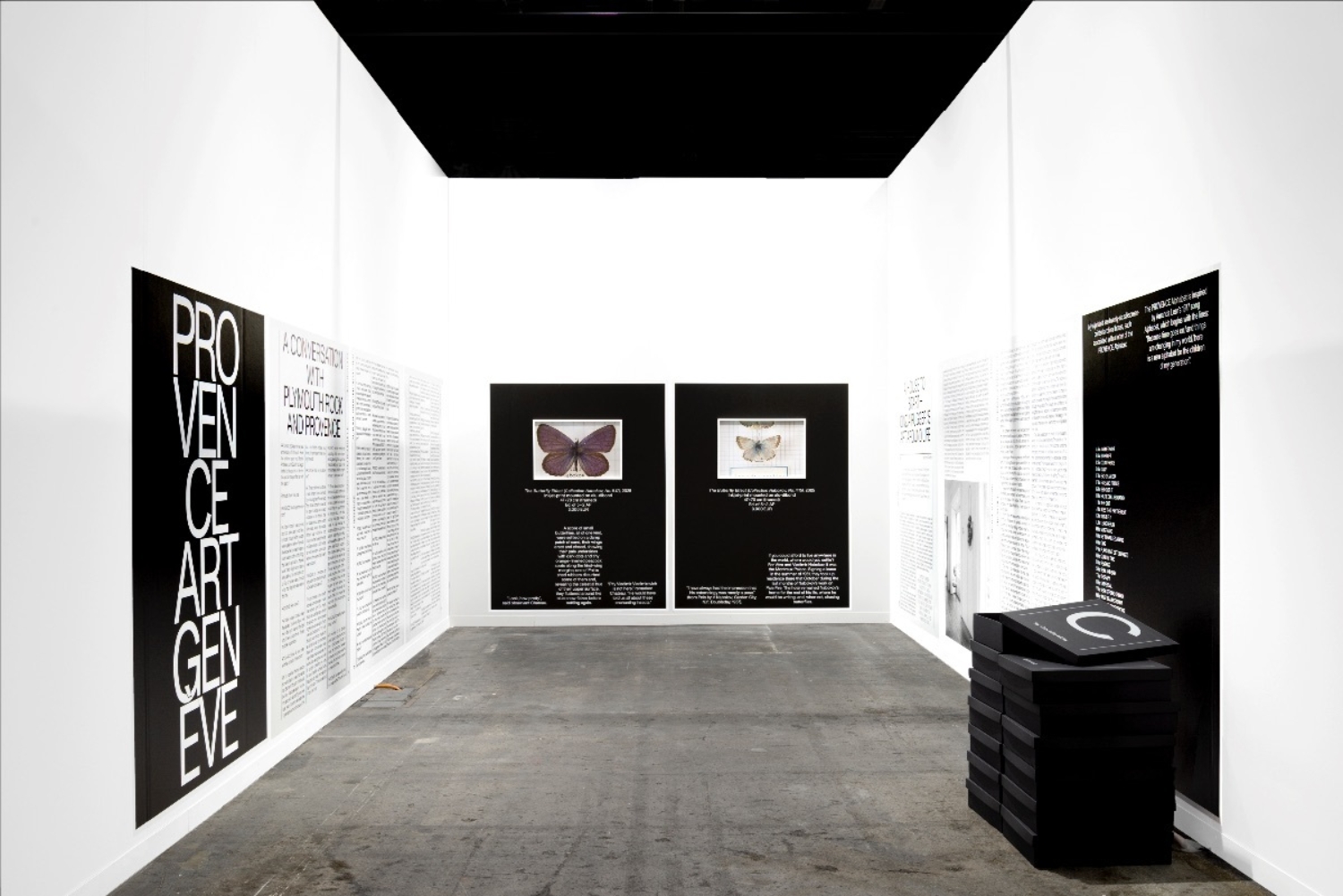
Installation view: PROVENCE at Art Genève, Booth B44. Photo: Simon Jaton
|
|
Installation view: PROVENCE at Art Genève, Booth B44. Photo: Simon Jaton
|
|
A Conversation with Plymouth Rock and PROVENCE
|
|
|
PROVENCE: 2024 saw the ten year anniversary of Plymouth Rock, the artist-run space you, Mitchell Anderson, run in Zürich. You’ve got invited to take part in Art Genève this year, is this your first fair with the space? Plymouth Rock: Yeah, it is. PROVENCE: What’s your motivation? PR: I don't know. It was summer, and I got asked, and I said “okay, let's do it”. It could be fun. I used to work in galleries before Plymouth Rock, so when I opened the space, I didn't want to do for fun the things that I used to get paid for, that was work. That’s why it's an off space, not a gallery. I do not do fairs for fun. But for some reason, I'm excited for this. Maybe it makes sense this time. PROVENCE: How come? PR: I think I was in Corsica when they asked. You know, if you ask me in the right place at the right time, I'll be in a good mood. There's no other explanation. PROVENCE: How do you relate with the context of the art fair? PR: It's more like that my association with them is one of forced labor. But then I thought that it could be kind of a celebration. I’ve had the space for almost 11 years now. Last year I didn’t celebrate the 10 year anniversary because it felt like a lot of effort. And also, you know, I'd rather spend time moving forward. PROVENCE: What are you showing? PR: Three sculptures from three artists: Miriam Laura Leonardi, Lorenza Longhi and Samuel Haitz. They all had formative shows at the space. Lorenza’s was her second show, but the first right after her studies at écal, and her first in Switzerland, where she resides. Miriam’s was in 2014, the third show I did when I opened, her first, and Samuel’s was in 2019, his first as well. I see some connections between these works that haven’t been explored. PROVENCE: Is it intentional, to bring artists from the German part of Switzerland to Geneva? PR: I don't think so, I come up with excuses sometimes after I make the decision, right? But maybe that's also just the nature of inviting a space from German speaking Switzerland to exhibit in French speaking Switzerland? The initial thought was kind of simple and stupid and visual: Lorenza makes these cans, Samuel makes these cans, Miriam makes whatever she wants. And seeing if we can make it, combine it like this, you know, to have this little garbage booth. It’s gonna be really minimal looking on the floor. That’s where I built it from, the floor. PROVENCE: In this ambition of supporting artists over a longer period, gathering them again, this time outside of your space in an art fair, is there a similarity in spirit with what a gallery would do? PR: The fair allows me to have a plan of what I can do for these artists and these artworks that maybe I didn't do when I had the shows or didn't have the opportunity to do. Plymouth Rock is first of all just my hobby that entertains myself. But I also view it as this altruistic, artist focused.. an actionability for artists. Plymouth Rock isn't a space that's obsessed with getting like 100,000 visitors in there. It's about mediating towards the people who can take the next step for these artists that I respect. The next step for young artists is usually, you know, either a gallery or an institution. I focus on making sure that every gallerist and every curator who works with young artists in the area will see each show. That's the direct force, the actionability.
|
|
“The initial thought was kind of simple and stupid and visual: Lorenza makes these cans, Samuel makes these cans, Miriam makes whatever she wants. And seeing if we can make it, combine it like this, you know, to have this little garbage booth.”
|
|
|
PROVENCE: Actionability is when things connect? PR: Or where it's not abstract, when I have an idea of what and how it could happen. You try to make that connection between an artwork and a person, which is basically the connection between an idea and a thinker. PROVENCE: I also see actionability in the sense that Plymouth Rock feels very close to yourself as an artist, creating a feeling of exchange between the show and your work. PR: I don't know if that's really true. I haven't really shown artists whose work is like mine, because I understand their work, so I don't need to spend the resources to get them in the space, to sit there and live with them for a month and a half or two months. PROVENCE: Making the space become kind of an obsessive project? PR: It’d be great if I just ran out of obsessions and could move on. Ultimately, I hate it. I wanted to close for years. It's a waste of money. I could have bought a fucking apartment instead of doing it. But the nice thing about art is that there's always new art, right? When I'm most honest, and it's also when I'm most happy with the space, is when I describe it as what it is, as an extracurricular, as a hobby. It's the same as if I joined a tennis club. It's expensive, I like to do it, I enjoy it, I do it for me. PROVENCE: But a tennis club can go on for life. It doesn’t feel an artist-run space can? PR: I still didn’t close, maybe a younger generation could force me. PROVENCE: Like a new space? PR: Yeah, or a new bar or something. Just a reaction against another reaction. PROVENCE: You think this is specific to Zurich? PR: Zurich feels more provincial now than it did 10 years ago. PROVENCE: I have the feeling a majority of people would say the opposite? PR: Well, is there an international outlook? PROVENCE: What made it different 10 years ago? PR: I think that Beatrix Ruf, then director of the Kunsthalle, did a lot of effort to make Zurich an international stop, and it worked. And then she left, and one of the costs of stopping that kind of work is a slow, then sudden, loneliness.
|
|
“It's a waste of money. I could have bought a fucking apartment instead of doing it.”
|
|
|
PROVENCE: That’s what brought you to found Plymouth Rock? PR: I opened while she was still at Kunsthalle, but you don't realize at the time what's going on. I could afford it because I had a job in secondary market dealing. It made me a lot of money, and so I could afford a space for 800 CHF a month. I pay for my space and never received any funding from Zurich City and Canton. PROVENCE: This feels close to a kind of American-survival mindset. PR: Sure, since, as an American, it would never occur to me that there was funding. But that’s also great, since we know so many people who stop making art when the funding dries up. They just think that someone should take care of them, which is so idiotic. With art, no one’s asked for this shit you’re making. It’s your job to mediate and make people want it. PROVENCE: So, absence of funding filters out? PR: No, it's just there's too much. It makes it boring and bad. It makes it like social realism. Well, that's the next step. PROVENCE: Because you assume funding never follows any specific desire. But surely some funding links “desire” and art, like awards? PR: I think art that wins awards is a very specific type of work, right? So it becomes bureaucratic, done to win it. We know so many people who are very successful with awards, and are not important artists and don't exhibit and, really, shouldn’t. But they figured out, like this trick of solving it, right? That's a problem, because the money's not going where it should go. It’s just projects for winning awards. It’s not art. And then the public sees this, and it ruins their education. PROVENCE: Right, but it could be conceivable to imagine a situation where awards would work closer to how the “real world” is, satisfying your “American survival” condition. PR: My point is that it doesn't have to be between some bureaucracy and the market. In the Artforum October 2007 issue on production, Roni Horn has a little text about making her Gold Field in the 80s, and it's such an amazing little text because it’s only like, I had this idea to make a gold field, so I learned how to do it, and then I worked this shady ass job for a year, and at the end, I had enough money to buy the gold to annealed it in a special way. That’s really nice. No one wanted to make this gold field. The other option is, like Matthew Barney, just to convince someone somehow to pay for it. None of those are market based solutions. They are now, but at the time this was not like that. There’s no reason to assume that it’s a market thing, right? Obviously, Barney learned how to merch it afterwards, to pay for it. But I think if you’re not going to make it anyways, you shouldn’t make it. That’s why when I had a job I liked it. I made just as much work when I worked full time as I do now. But you know, people don’t respect it because an artist shouldn’t have money because they’re supposed to be like a weak, little, suicidal Van Goghs who needs to be supported by the state or by the market. But I like having that self control. PROVENCE: Isn’t that abusively romanticizing self reliance? PR: I believe the current status is the romanticized one. This idea that the artist is some kind of little thing that must be protected, that’s the post-Van Gogh idea that has been amplified with Pollock. This idea that you’re like a crazy person, that you need to be protected. That’s a new idea, and it takes away the agency of the artist. And at the same time that agency gets taken away, there’s new middlemen like contemporary art curators.
|
|
“We know so many people who are very successful with awards, and are not important artists and don't exhibit and, really, shouldn’t.”
|
|
|
PROVENCE: It still looks like artists are the major providers of fresh contemporary art, especially through artist-run initiatives. PR: Artists, of course, know how to do everything best. This hasn’t changed: artists will be better viewers of art than anyone else. It used to be that a gallery would show a great artist, maybe one that you couldn’t sell, because you wanted access to their friends, and access to the art. And I think somewhere over the last 10 years, there was this idea that art is open, or you don’t need to know anything. And then collectors, or people like, pretending to be collectors, started telling galleries that they should show this person. Now, it happens that you see a show opening up at a gallery, and no one knows who this person is. It’s someone who lives in fucking South Dakota, and obviously some collector saw it on Instagram. I don’t believe this is an example of “the internet has changed it, so you don’t have to be in a center”. The work is just not part of a conversation. And just because you can see it doesn’t mean it’s part of a conversation. PROVENCE: Surely, we talk a lot about “access” these days. Curators in modern art or historical museums also re-hang their collection, integrating contemporary art, supposedly for greater “access”. PR: Right, but did they lower their admission price, or did they raise it? I’m sure they didn’t lower. So if they ask their trustees to get rid of the admissions price, that would change. But that's not easy. So instead, they put some bullshit up from their collection and be like “Oh, look, this person has an identity”. That's cool, even though no one can get in because it's 30 bucks to enter. PROVENCE: Financial access is a major element, but as far as art historical consideration goes, including contemporary art in a historical lineage aims at situating the contemporary viewer and allowing them to track back where they come from. PR: Yeah, but I don't think they should do it. That's not their job. PROVENCE: You believe there’s no possibility for them to do it in a good way? PR: Ok well, tell me, what’s the most important artist of the 1970s from the West, in your eyes? PROVENCE: Louise Lawler? PR: Right well, she probably wouldn’t be in those “rehangs” exhibitions if they would have happened back then. But Jules Olitski, who was the most famous artist from the 1970s, would have been in those shows, and all the work would have been purchased. But what’s his standing now? So the argument, of course, it’s that it's not their job. You cannot see today from today, that's not the job of a museum. That's the job of a Kunsthalle, it's the job of a space, it's the job of a gallery. The museum, they’re not equipped to do it by their nature. PROVENCE: But today museums have, between many other new roles, curators that are out there, connected. Why should artists still be the best to give us access? PR: Well, who would you rather get a recipe for a croissant from, would you choose a baker, a dentist or an army general? PROVENCE: Or a food critic? PR: Come on, you trust the baker over the fucking critic. Now, if you could find a genius baker who was also a genius food critic, that person should be supported endlessly.
|
|
“Artists, of course, know how to do everything best.”
|
|
|
PROVENCE: I’d advise the baker-food critic to open their own bakery then, and you to open your gallery? PR: Why would I want to do that? It's easier to lose the money up front with the off space, rather than trying to claw it back with a gallery. There's a certain purity, like, where I don't have to think of what type of work I should show. I mean there’s still other influences, economically for instance, but overall I just know that money is lost because it's like, it's not a business, it's a passion. PROVENCE: Going back to our discussion about funding, some museums willingly buy hardly sellable stuff from the local galleries, as a support system. In Art Genève, the booth of the local museum, the MAMCO, shows this: their “In course of acquisition” project exhibits all the works they buy on the fair for their collection, supporting galleries and the art fair alike. PR: The MAMCO is an interesting specific case, a new museum that’s building a targeted collection on its initial strengths. The Whitney museum in the 70s, when it opened, was very similar to this, or the MoMA in the 30s.
|
|
“That's also where my space works, because it's about me. I started it, I paid for it. You can come or you don't.”
|
|
|
PROVENCE: It also tells the story of individual interests, more or less, since what is there from the start depends on a restricted group of people who didn’t answer institutional goals to build up their collection. It also tells the story of directions for the collections established by the directors of the museums. We both enjoy what MAMCO has offered over the last years, and it has been historically serious, but nevertheless with a strong subjective taste. PR: Right, that’s why they work. There’s not many chefs in the kitchen. There's a beauty to that, because there's not other people's interests going in there. That's also where my space works, because it's about me. I started it, I paid for it. You can come or you don't. The best thing about my space is that I answer to no one. It's mine. But it's funny, there's nothing. It's just a room and a website.
|
|
|
|
|
|
|