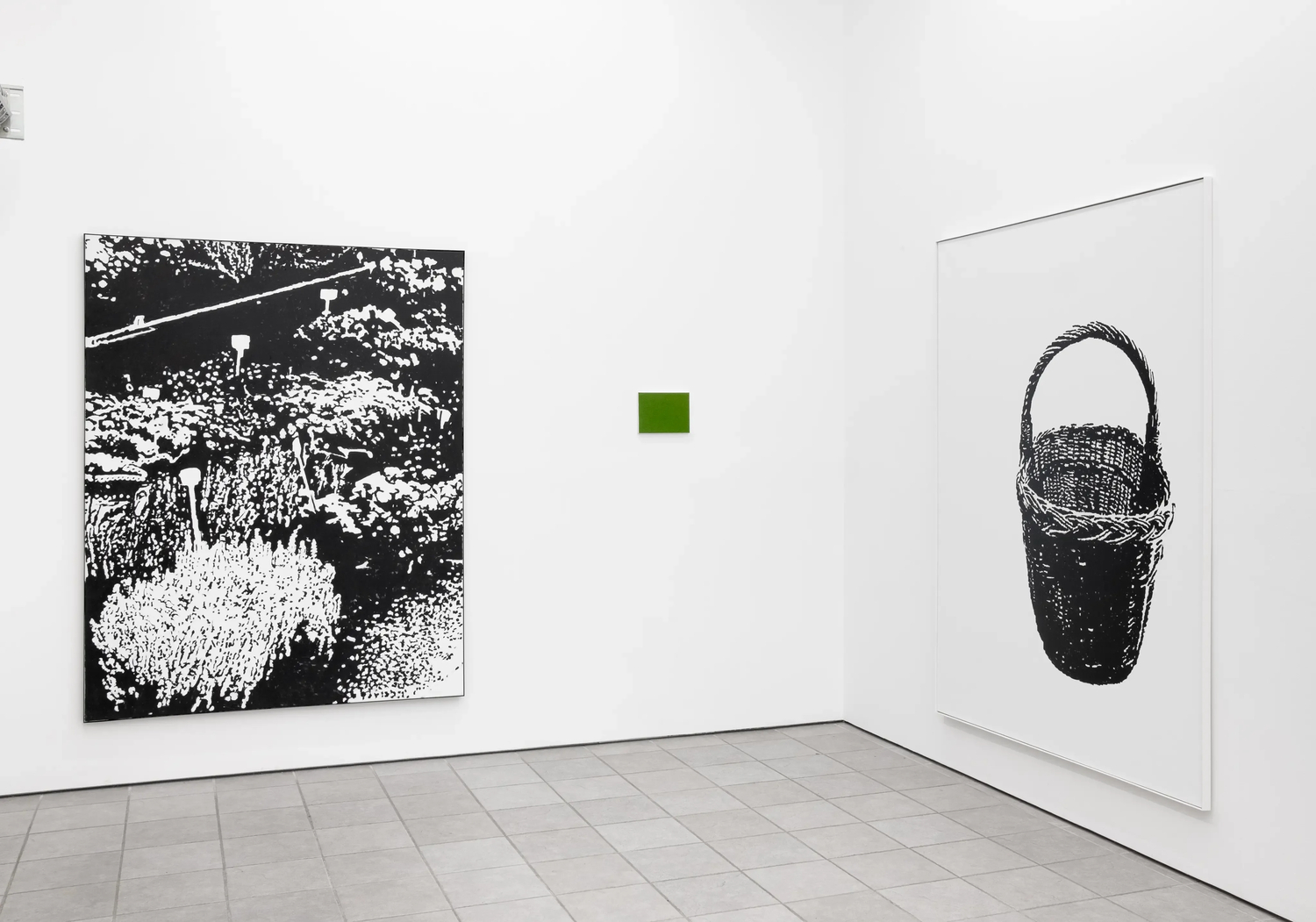
Adrian Olas: Including Caspar David Friedrich, Issues Gallery, Stockholm, 2026.
|
|
|
What I’m about to tell you must have happened around 2008, because I remember how Lady Gaga’s Poker Face was playing round the clock in bars and cars and living rooms. What happened was I got lost in the woods under an autobahn bridge, in the twisting valley known as Teufelstal. I was hitchhiking from Hamburg with a truck driver heading south toward Munich, and he missed the exit for the A4 toward Frankfurt. I was dropped off too late, on the A9 in the direction of Munich. To get back on course, I would have had to cross all six lanes on foot, including the barrier, so instead I walked back to the rest stop, hoping another solution would present itself. The building was a grand-hall relic of the Reichsautobahn, and the interior architecture was deliberately channeling Valhalla. An owl-like woman at the cafeteria told me there was an old trail into the valley that would take me under the Teufelstal bridge and up to the right side of traffic. It would take no more than 35 minutes to get through the valley. I had no phone charger, no food, no money, and no real choice, so I followed her directions down an overgrown path into the darkening valley. First a steep climb down, and after that just slowly descending, descending. The forest was dense and humid, the ground muddy, and in front of me was a faint trail. I forged ahead in my broken-down sneakers.
|
|
“I had no phone charger, no food, no money, and no real choice, so I followed her directions down an overgrown path into the darkening valley.”
|
|
|
Occasionally along the trail I saw animal spilling, big piles of dark matter. Severe cases of four-legged German animal diarrhea. Later on, I learned from all the years living in Germany that the art of digestion is a huge thing down there. And when it goes wrong, it tends to go catastrophically wrong. What kind of animal takes a dump like that, I wondered, and what could they be eating? Could it be wild boar? It was unsettling to realize I didn’t have a clue, and no real means to find out. I came to a fork in the path and flipped a coin in my brain: I took a left. The path led me down a dead end, to a swamp with a rotted signpost. Having left the rest stop with big confidence at 5p.m, it was now 8 or maybe 9p.m and getting dark. For the first time I thought to myself I might die here. In this demonic gorge. Maybe that woman at the rest stop wanted me to die here. And for my remains to break down and disappear into the mud. I backtracked and took the other turn. Far above me on the autobahn bridge, I saw the headlights of tiny cars passing by. There was something about this grand scale of things, a top-down view of myself as a little insect scurrying around at the bottom of this massive bowl of industrialized nature. It touched me on a spiritual level. I had forgotten to bring water from the cantina. My phone had gone out of service already at the forking path, but now it was completely dead. After what felt like hours, I reached the opposite slope of the valley and made a brutal climb through thorny bushes. I finally clawed my way back onto pavement. Electric light spilled from the parking lot, and traffic was roaring past me on the A4. I was saved. Looking back across the valley, at the cloverleaf interchange Hermsdorfer Kreuz where the A9 and A4 meet, I could barely make out the Valhalla rest stop in the dark distance.
|
|
“I came to a fork in the path and flipped a coin in my brain: I took a left.”
|
|
|
I looked down and saw my hands bloodied and my T-shirt covered in mud. A white van suddenly pulled up, and the driver motioned for me to get in. He was on the phone, but as soon as I got in, I realized he wasn’t talking to anyone. I caught a glance of a makeshift bed lit by candles in the back of the van, half hidden by a curtain. There was a musty smell. A survival instinct kicked in, I opened the door and jumped out before he could react. He drove off, staring at me with crazed eyes through the rear-view mirror. It happened too fast for me to process at the time, but later I thought it was such a strange coincidence, having just survived my journey through the valley and then meeting that man.
I don’t know what would have happened had I stayed in his car. But my instincts told me my life was in danger. I was already in a weakened state, having destroyed myself for over a week drinking in Hamburg, and the ghoulish trek had finally finished me. It seemed to me that this encounter was one of magnetism, of predator and prey. Hours later, with no success in hitching a ride, I had nearly resigned myself to sleeping rough behind the parking lot when a Frankfurt-plated Corvette pulled in. The driver got out, wearing a dark suit and tie, with slick back hair and chiseled features, and walked over for a piss at the bathroom stalls–it was a wonderful sight. As he exited the stalls, I asked him for a ride and without hesitation he said yes. As we approached the city of Frankfurt and the world-famous skyline rose ahead of us, he said with genuine determination: “Frankfurt bleibt das Nest.” He looked at my hands gripping the canvas bag on my lap. “Wer hat das nochmal gesagt? War das nicht Goethe?”
|
|
|
Years ago, John Knight made an exhibition at Greene Naftali in New York in which he returned to one of his long-standing interests: the museum as an architectural and institutional machine. For Autotypes, a work in situ (2011), he produced a series of dining plates featuring the shapes of newly built museum extensions and wings. The exhibition was about museums growing. Not just because they need more space for their collections, but because museums have become part of a global economy of tourism, cultural prestige and architectural spectacle.
|
|
Emil Michael Klein: Passages, Atelier Amden, 2026.
|
|
|
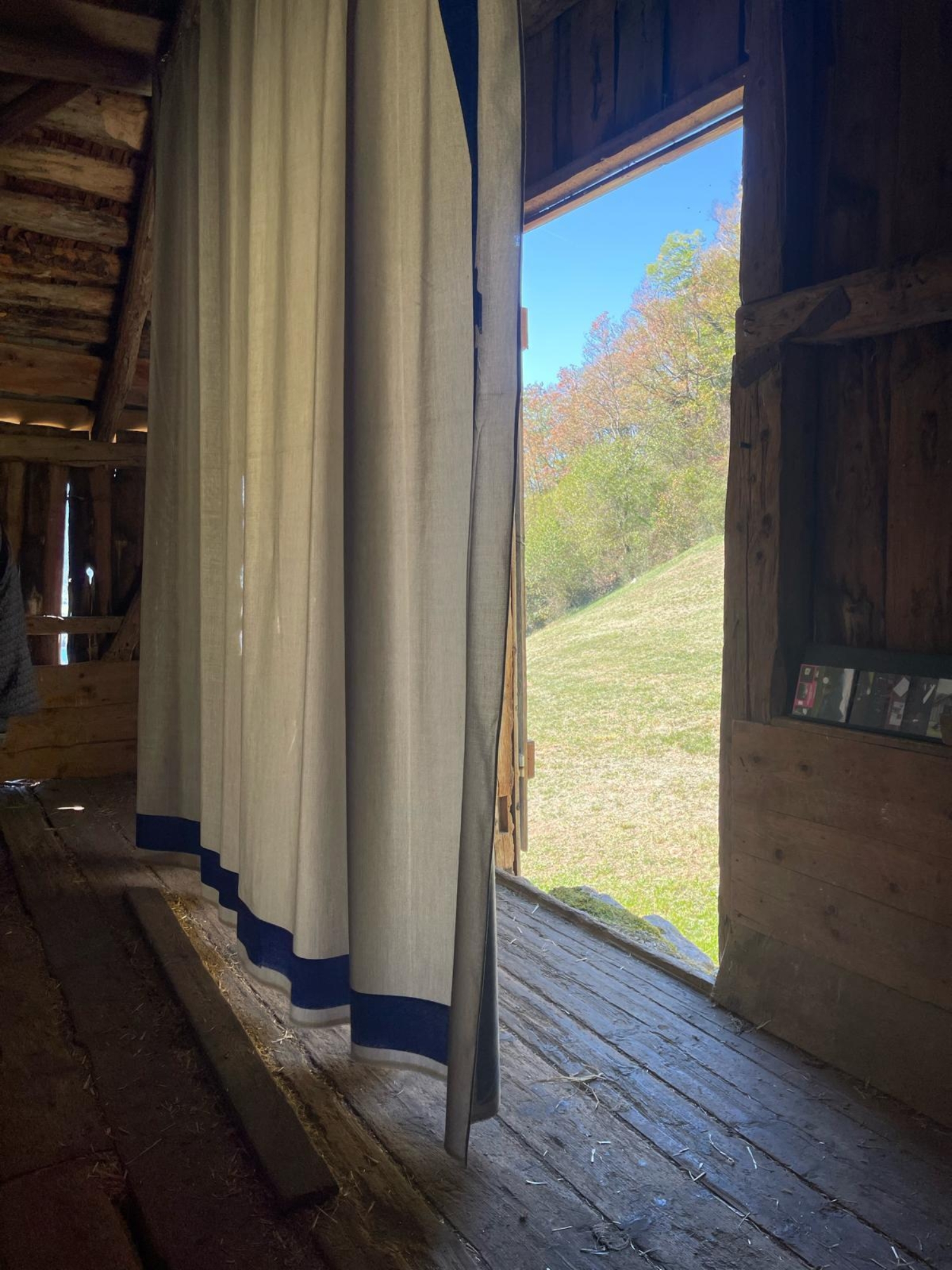
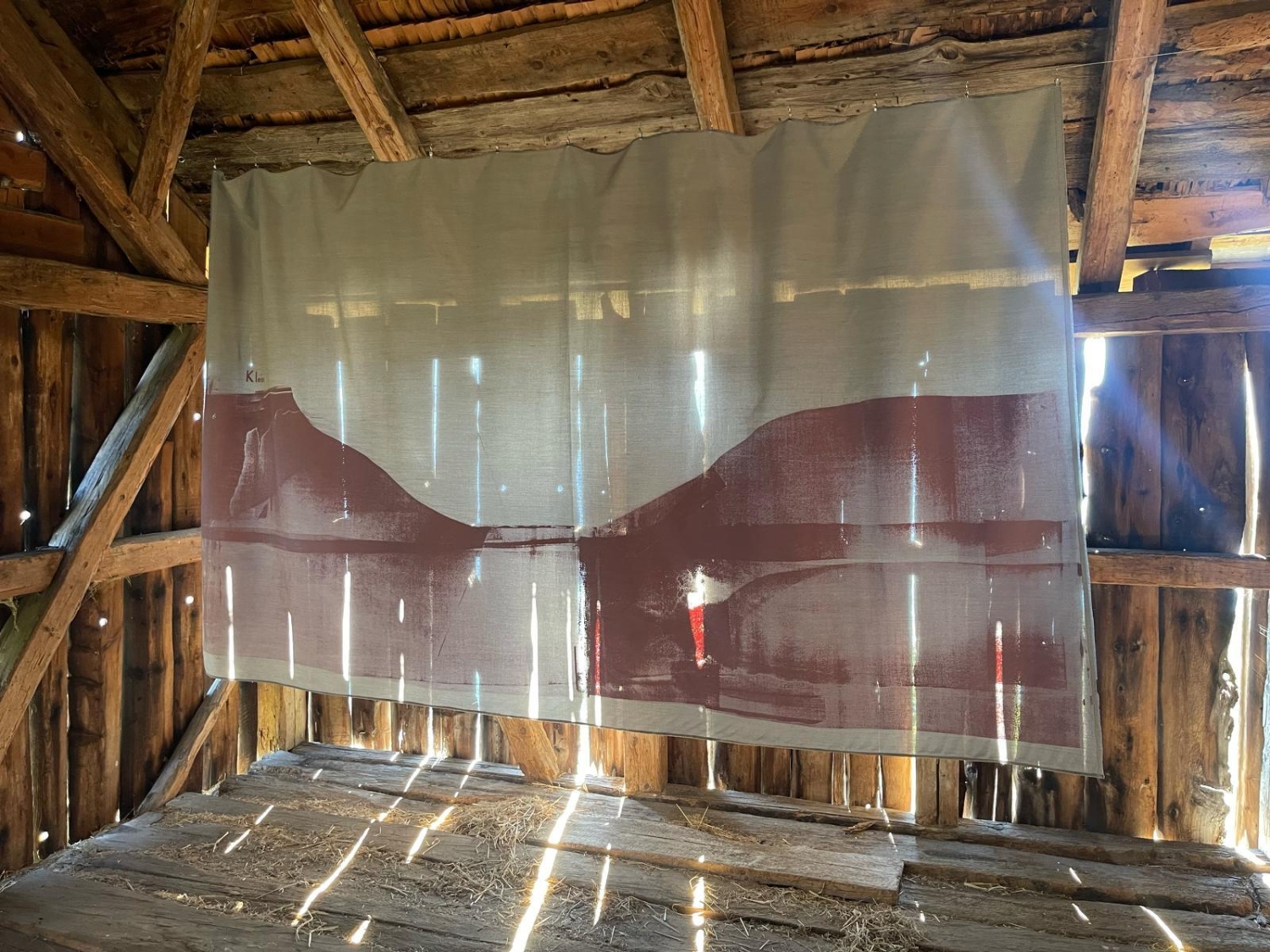
I thought about this last Saturday when we went to the opening of Emil Michael Klein’s Passage at Atelier Amden in Switzerland. The Atelier Amden is a small former cowshed above Lake Walensee, reachable by a twenty-minute walk from the bus stop in Amden. Art historian and curator Roman Kurzmeyer started the exhibition series there in 1999, following his research into the artists who had gathered around Otto Meyer-Amden at the beginning of the twentieth century. The first exhibition in the barn included a work by Katharina Grosse. Since then, the place has been used for exhibitions by artists including Anselm Stalder, Bruno Jakob, Mai-Thu Perret, Brian O’Doherty and many others. There is no museum shop. There is no merchandise. There isn’t even a toilet. There is a barn. And there is an extraordinary view over the lake. The current exhibition consists of curtains by Emil Michael Klein. They hang inside the wooden building, moving with the air and changing with the natural light. The works are obviously the same works they would be elsewhere, but they don’t behave like the same works. They are good, the word KLEIN is always written, it's all silkscreen. A play between abstraction and typography. They become part of the building, the weather, the landscape, the walk you have taken to get there. The Atelier itself describes this difference quite explicitly: the works are experienced differently from how they would be in an institution or commercial gallery because the building continues to be what it is, an exposed, disused agricultural structure.
|
|
Emil Michael Klein: Passages, Atelier Amden, 2026.
|
|
|
This is perhaps what interests me most about Atelier Amden. It is an incredibly specific place, yet the exhibition itself could, in principle, take place almost anywhere. What makes it different is not necessarily the production of something more spectacular, but the conditions under which you encounter it. You have to decide to go there. You take the train, walk. You look at the exhibition, the lake, and talk to people. We have become very good at making art available. Museums are expanding. Every exhibition needs an announcement, a press release, a newsletter, a viewing room, a website, an Instagram post, a second Instagram post, a reel, documentation, an opening, a collectors’ dinner and preferably a photograph of someone standing in front of the artwork. We are very good at broadcasting art. We are perhaps less good at actually spending time with it. Of course, there is nothing inherently wrong with large museums or spectacular architecture. Some of the great new museum buildings have genuinely changed the way we experience art. But there is something strange about the fact that, at the same time, we are building increasingly sophisticated bunkers in which to preserve our art forever, with expensive climate-control systems, enormous storage facilities and architectural budgets that can reach levels normally associated with infrastructure projects.
The Atelier Amden proposes almost the opposite. It doesn’t try to accommodate everyone. It doesn’t try to mediate everything. It doesn’t try to maximise visibility. It creates a situation. And because the situation is so specific, people behave differently. At least most people do. They slow down. They talk. They exchange information, gossip, knowledge and emotions. They stay for dinner. There are, of course, still a few people who arrive, look around for five minutes and leave again, as if they were ticking off another stop on their weekend art itinerary. This is why places like Atelier Amden will become increasingly important. Not because they offer an alternative museum model in any grand institutional sense. And not because small is automatically better than big. But because they remind us that an exhibition does not necessarily have to reach as many people as possible to be meaningful.
|
|
|
|
|
|
|