Jason Dodge at Kunsthalle Friart Fribourg
|
|
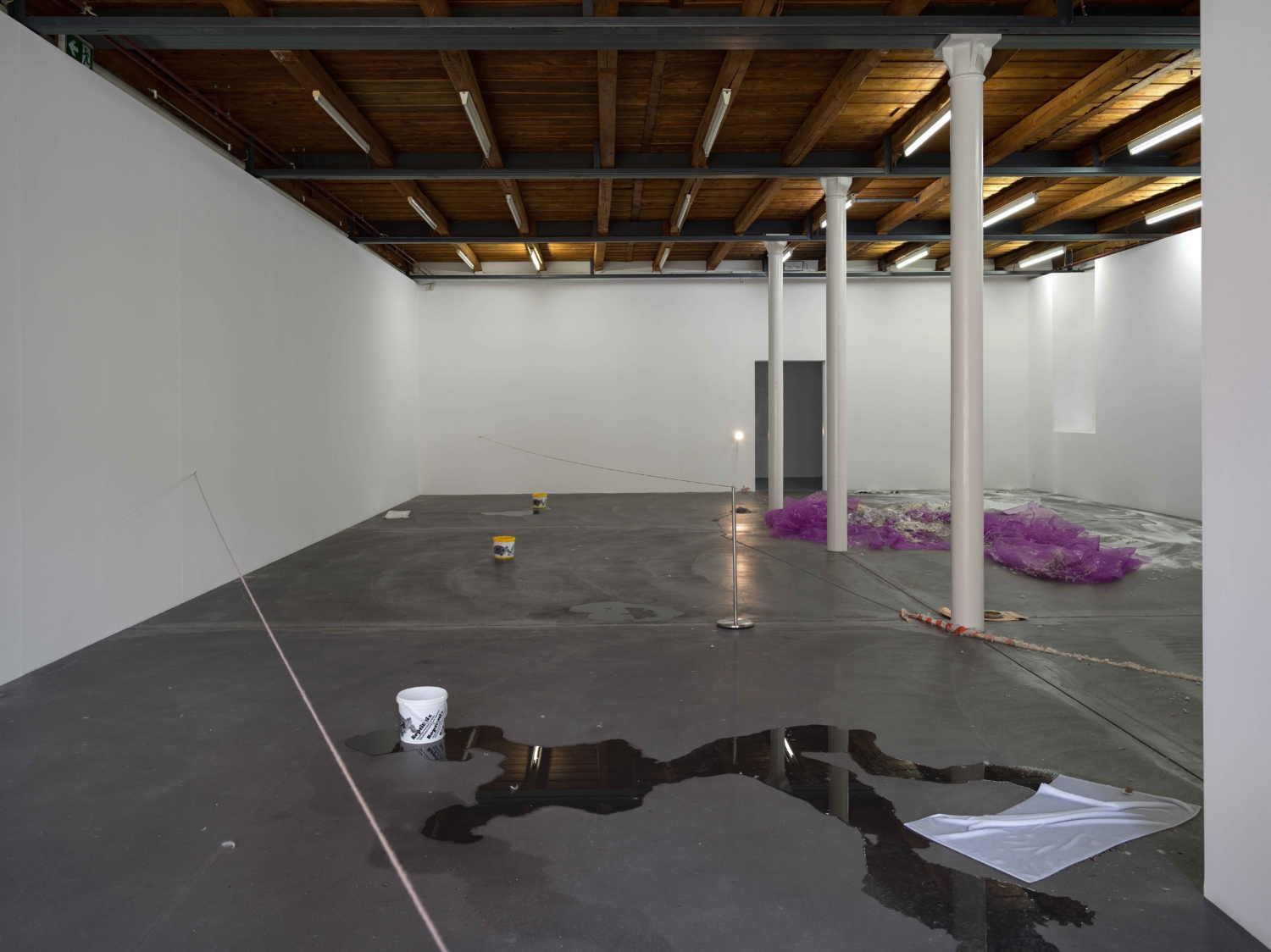
Jason Dodge, installation view, Kunsthalle Friart Fribourg, 2026. Photo: Cedric Mussano.
|
|
|
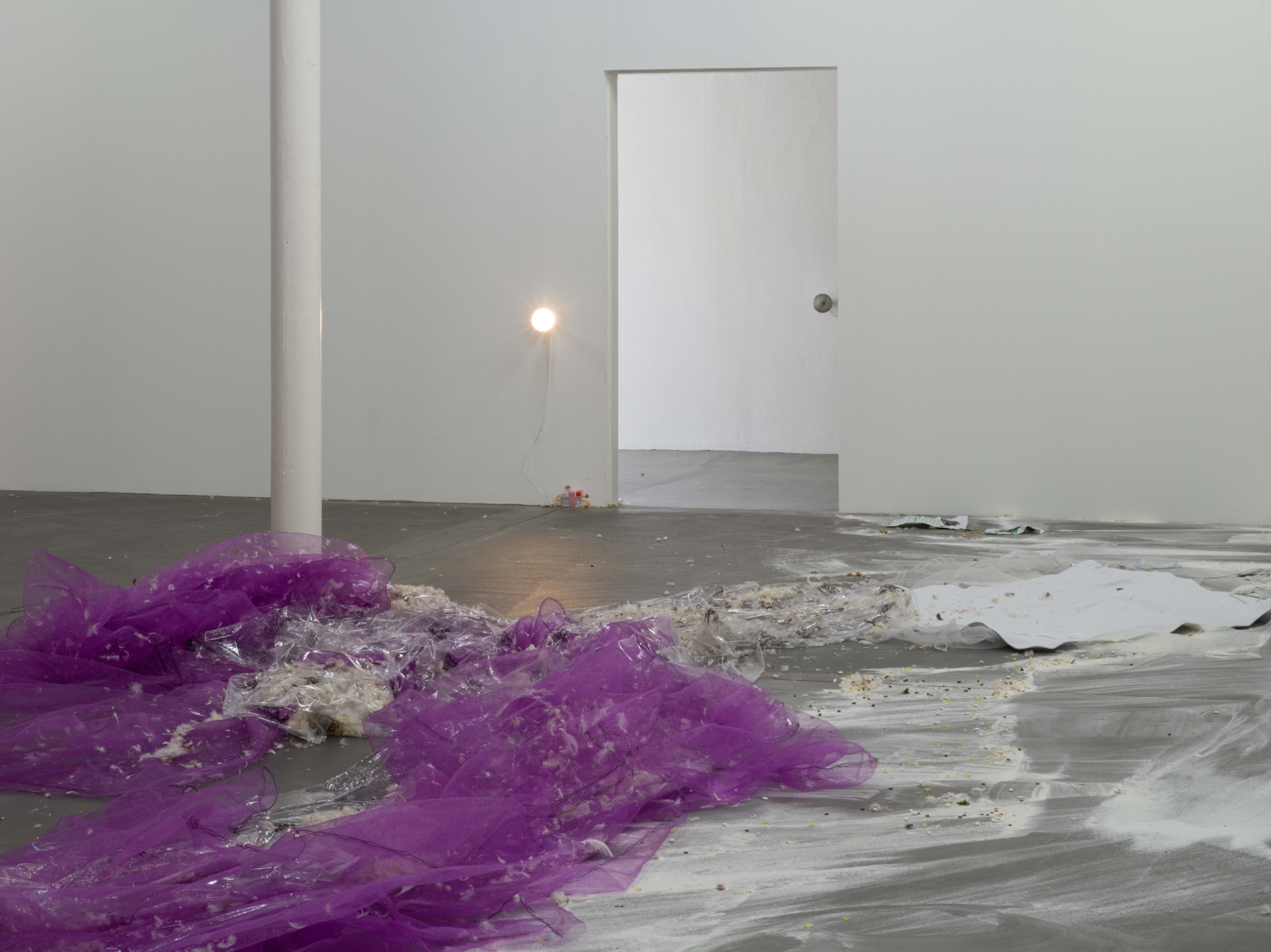
Like a photograph, the scene appears as though it has been caught mid-movement: white powder is scattered across the floor in indistinguishable patterns; pills, pollen, dead bees, and an electric blanket, everything entangled in a purple net. Jason Dodge's exhibition at Kunsthalle Friart Fribourg is presented without titles, dates or a floorplan. Yet one piece of institutional scaffolding survives: the booklet. There, curator Kathrin Bentele describes the exhibition as ‘at once both very concrete and very abstract’, a formulation that could stand as the show's operating principle: everything here declares itself considered, and nothing confirms for what it was considered. The exhibition occupies a former cardboard factory, and is spread out across four rooms, two floors, the stairwells, and even the institution’s toilets. Wall-mounted lights flash at irregular intervals, guiding viewers from room to room; walls are blank and white, while the various materials are concentrated on the floor. In the first room, three structural columns divide the space, a division that is emphasised by a chain attached to a barrier tape covered in feathers. To the right of the division, materials accumulate into chaos. The net lies in a tangle on the floor, a plastic banner wound through it. A repeating pattern of a family of nesting birds is printed across the plastic, contrasting with the real feathers scattered about. Nearby, a catfood bowl is placed on top of a newspaper. Before I can invent a scenario involving cats and birds, predator and prey, the image resolves into a logo I recognise from my first years online as a teenager: one of those complex, colourful, structural relationship diagrams tracing everything from KitKat to bottled water back to a single parent company: Nestlé. Throughout the exhibition, references to oversized Swiss corporations accumulate, appearing in the form of tiny pieces of shredded paper on which one can make out the red keys from the UBS logo, or the blue lettering of the biotech giant Roche. To the left, the scene thins out into a sparseness that is divided further by stanchions with strands of pink yarn. The object group mimics an abandoned attempt to suppress a fire or put a leaking institution in order with water pooling on the concrete floor, two wet towels, an unmatched row of white and industrial-orange buckets whose labels state explicitly ‘food for carnivores’ yet are filled merely with water—required, obviously, by every living thing.
|
|
Jason Dodge, installation view, Kunsthalle Friart Fribourg, 2026. Photo: Cedric Mussano.
|
|
|
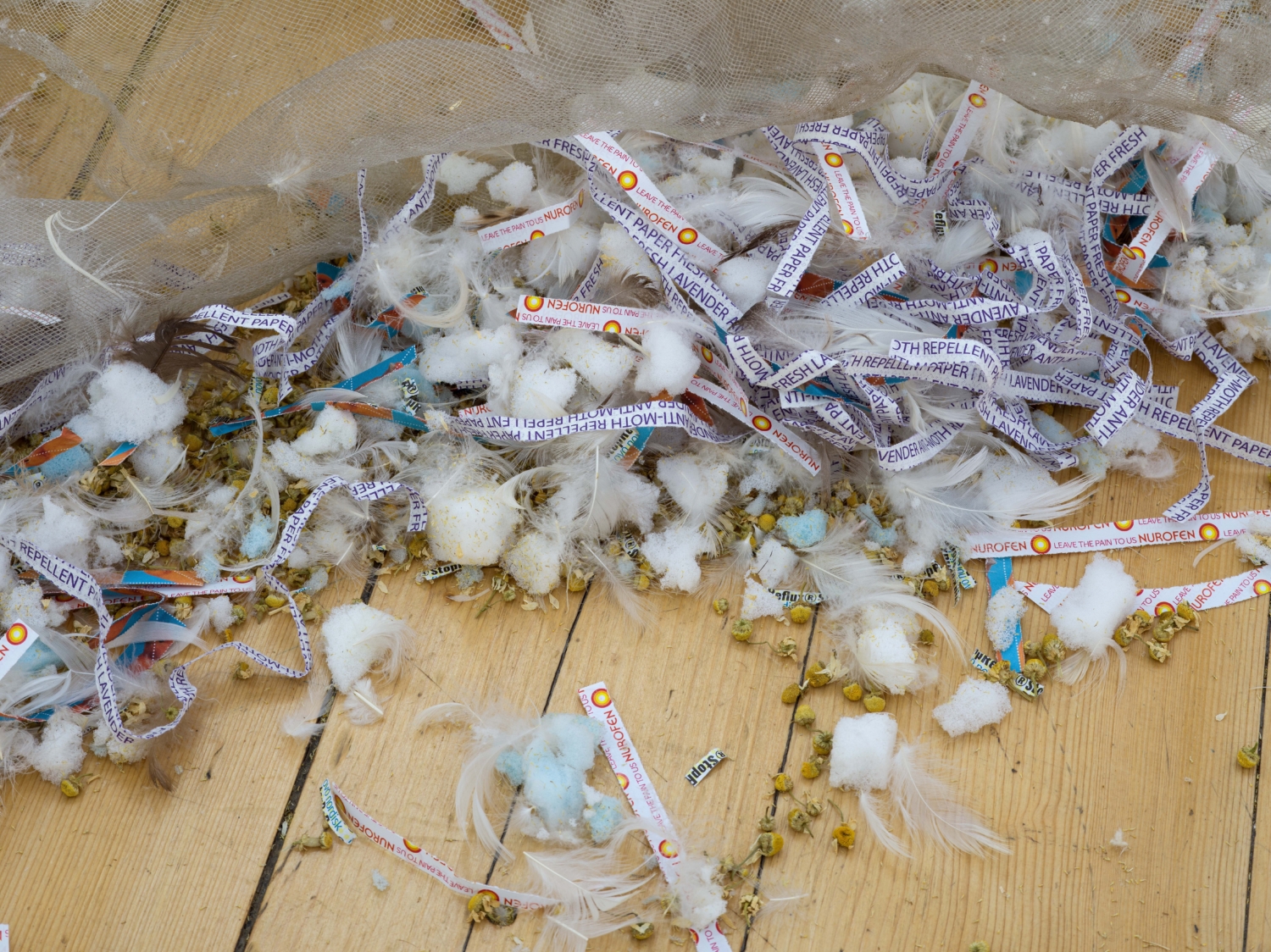
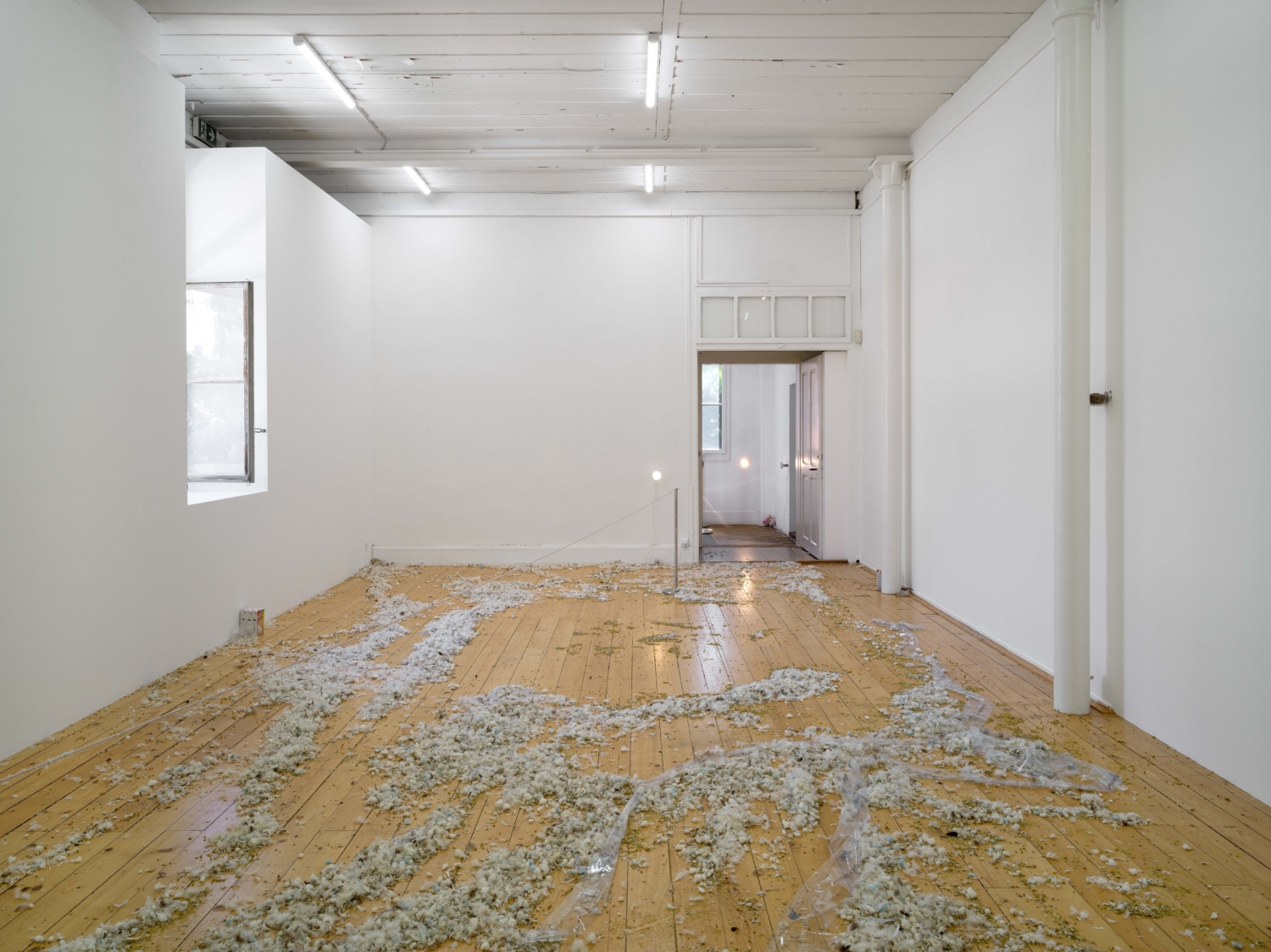
The second room reverses the register to minimalist restraint. One side of the space features a tent-like, opaque plastic sheet, which reduces everything placed beneath it to mere shapes and colours, while the other has six white down pillows arranged into a bed. The pillow tags are carefully turned outward to show the standard warning: ‘carelessness causes fire’. On the wall above, a rectangle glows faintly. One could imagine the whole disorder of the first room siphoned into that one glowing shape, watching it perhaps from the bed. When you come closer and shade it with your hands, it glows brighter. The rectangle is in the exact location on the wall where Dieter Roth’s o.T. (Puppe in Schokolade) (1969) was recessed for the previous show, a sculpture depicting a doll plunged headfirst into a brown sugary mass. The window on the first floor of the Kunsthalle is left open; a bowl of birdseed stands on the windowsill. In the exhibition documentation, the seeds were arranged neatly in the bowl but are now scattered across the windowsill, continuing to the floor. Absurdities keep piling up: more feathers are mixed with new paper shreds, claiming reference to an ‘anti-moth repellent’, or Nestlé banners printed with the chemical name for chloroform, trichloromethane (depicted in films as an instant knockout, though in fact it requires several minutes of sustained inhalation) are paired here with the words ‘Moth-Metallic Silver’ on the same corporate-looking banner. Jason Dodge’s materials appear appropriated, but where exactly does one acquire, or even find, such large numbers of banners and snippets bearing the logos of the five largest corporations in Switzerland and beyond? Appropriated corporate objects usually arrive with a history already attached, but with Dodge, the burden of narrative construction falls instead on the viewer, who must supply plausible histories for objects that resist obvious explanation. One might suspect that some, perhaps all of these fragments, were not sourced but are images printed in the artist's studio.
|
|
Jason Dodge, detail view, Kunsthalle Friart Fribourg, 2026. Photo: Cedric Mussano.
|
|
|
Here, the hovering between two modes of looking could almost illustrate the distinction Annie Dillard makes in her 1974 essay ‘Seeing’, between the effortful and the given: her account of walking a creek bed hunting for hidden pennies, primed and expectant, seeing only what she'd already decided to look for; against the rarer, wordless receptiveness she trusted more but could never summon on command. The exhibition booklet's language, both concrete and abstract at once, seems to confirm which mode Dodge intends: presence first, pattern second, if at all. And yet the recurrence of specific corporations—UBS, Roche, Nestlé—is too consistent across four rooms to be stumbled upon rather than sought; it poses another question: if pattern only arrives to the hunting eye, what does it mean that this particular hunt keeps turning up the same few names? The installation conveys a precise sense of its materials and with what they are associated. The arrangement itself, however, remains loose and, in places, almost accidental: objects rearranged by the wind blowing through the open window, or by visitors simply walking through. That same uncertainty, hunted or given, intended or projected, didn't stay behind at the Kunsthalle when I left the show. It came with me. I found myself noticing the artist's sensibility everywhere: a plastic crate of onions with most of the onions removed for the shop display, a trail of pollen leading to an accumulation of trash blown into a corner near the train station. Patterns have been waiting there the entire time. Only four rooms of materials were required to teach my eyes how to see.
Jason Dodge
Kunsthalle Friart Fribourg
30 May – 02 August 2026
Petites-Rames 22, 1700 Fribourg
|
|
Jason Dodge, installation view, Kunsthalle Friart Fribourg, 2026. Photo: Cedric Mussano.
|
|
Isa Genzken, I Love New York, Crazy City, 1995/1996, installation view Galerie Buchholz, New York, 2026. Courtesy Galerie Buchholz, © VG Bild-Kunst, Bonn / ARS, New York.
|
|
|
Isa Genzken’s solo presentation, “Projects for Outside – ISA USA”, was the inaugural exhibition at Galerie Buchholz’s new location in a renovated townhouse just across from MoMA’s back entrance on 54th Street.
Focusing primarily on Genzken’s Aussenprojekte — interventions on buildings and in public spaces — the exhibition presented maquettes of both realized and unrealized works. While the projects themselves were mainly conceived for European cities between the late 1980s and early 2000s, the models were produced for her contribution to Okwui Enwezor’s Venice Biennale in 2015, later shown in solo exhibitions at the Bundeskunsthalle in Bonn (2016) and at the Kunsthalle Bern (2019). The series reflects Genzken’s sustained engagement with architecture — particularly modernist structures — and public space, often introducing a humorous tension through shifts in scale and spatial relation.
In Deutsche Bank Proposal, 2000 (2015), Genzken reworked a model of the former headquarters of AT&T — often cited as an early landmark of postmodern skyscraper design and located just a few blocks from the Midtown exhibition space — by adding two radio antennae to its distinctive “Chippendale” pediment. This gently mocking intervention makes the building appear as though it were receiving a message, transforming the “AT&T Building into a World Receiver: a sensitive, receptive entity much like the artist herself,” as the exhibition text stated.
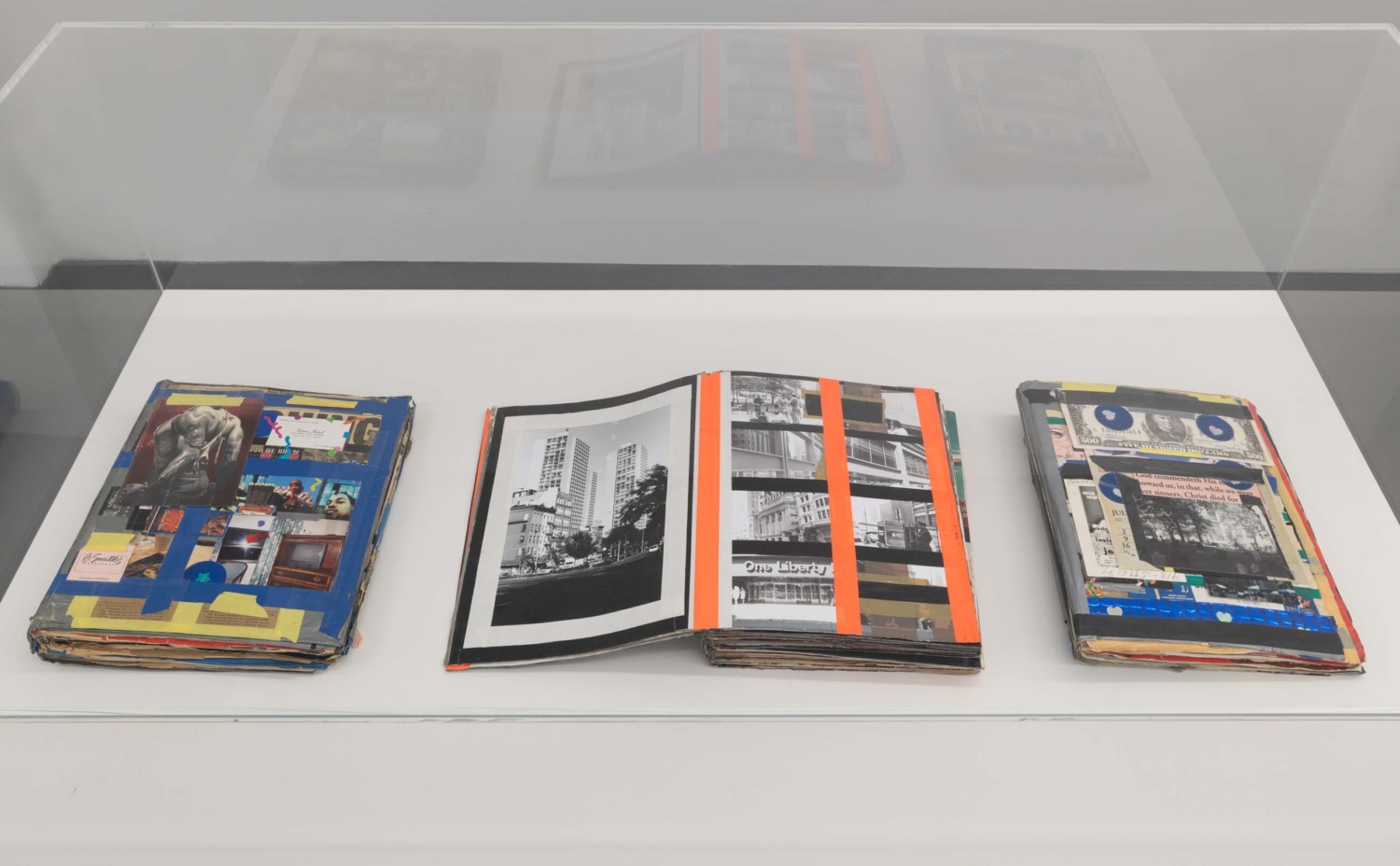
Spanning three floors, the exhibition also underscored Genzken’s long-standing relationship with New York City, where she has repeatedly worked and exhibited. Alongside photographic studies of reflective glass façades (New York. N.Y, 1998–2000) and an assemblage-like skyscraper sculpture combining wood, photographs, and mirror foil (Untitled, 2001), the presentation included a series of beautiful artist books, among them I love New York. Crazy City (1995–1996), a three-volume collaged New York travel guide produced in collaboration with fellow artists and architects. The volumes emerged from ISA USA, a conceptual agency articulated by Genzken in the 1990s and through which she envisioned collaborative projects during her time in New York. Displayed in a museum vitrine, the books — containing photographs of New York architecture, maps, flyers, and interviews — not only foreshadowed Genzken's later practice but also encouraged exhibition viewers to further imagine the experiences and encounters that shaped her time in New York.
Isa Genzken, “Projects for Outside – ISA USA”
Galerie Buchholz
11 March – 25 April 2026
31 W 54th St, New York, NY 10019
|
|
Michèle Graf & Selina Grüter, installation view, 229 Lenox, New York, 2026. Photo: Michèle Graf & Selina Grüter.
|
|
|
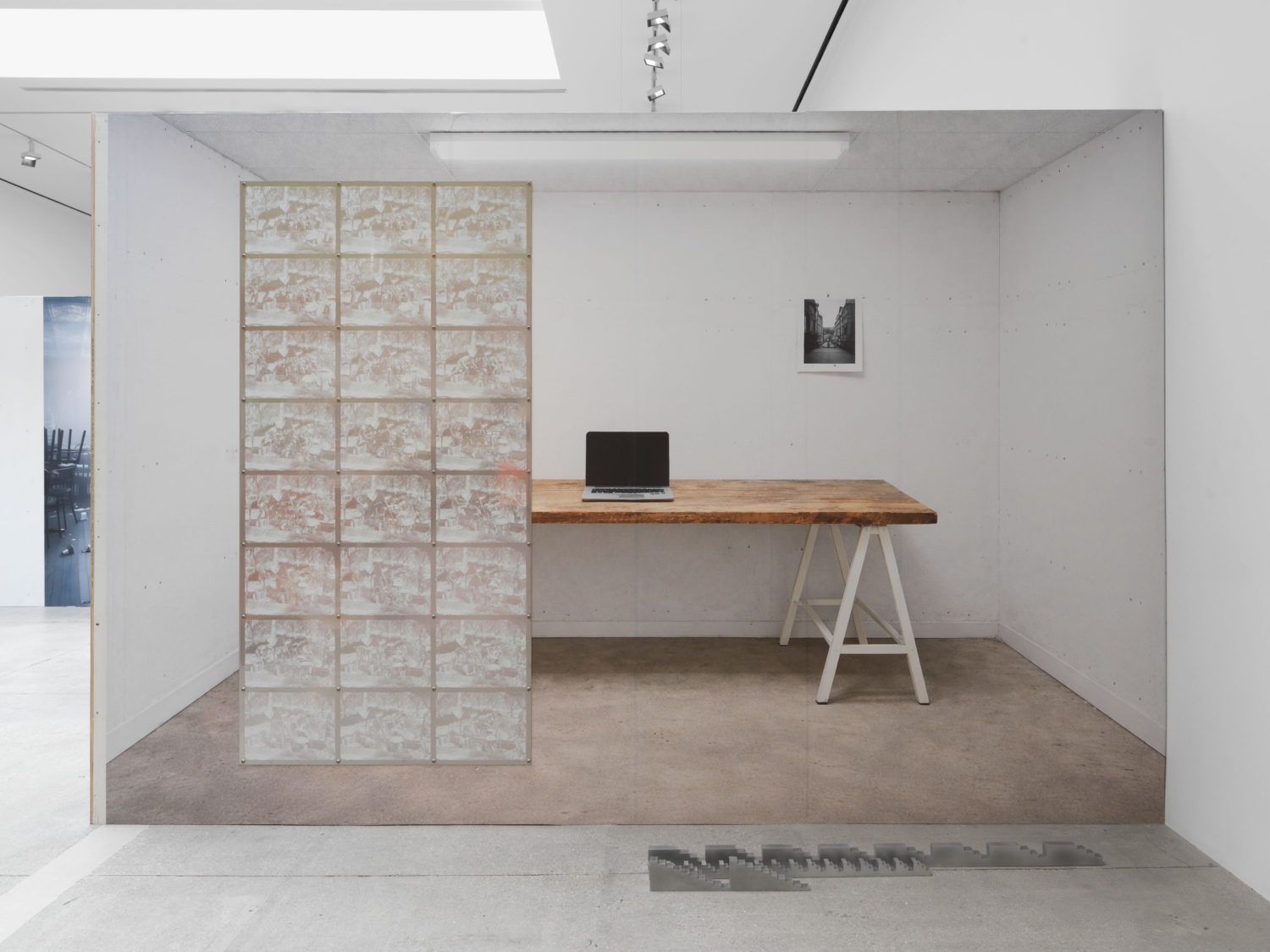
Another exhibition engaging with the timeless fascination of Manhattan’s skyline was Michèle Graf & Selina Grüter’s untitled presentation on the ground floor of former gallerist Gavin Brown’s Harlem home, where he had established a private exhibition space in 2012. The Swiss artist duo, based in New York, presented around a dozen works from their Clock Works series — an ongoing body of small to mid-sized kinetic objects built from disassembled mechanical clocks and additional materials such as L-brackets, screws, washers, nuts, felt, rubber bands, fishing line, and motors. More recent iterations also incorporated tin cans filled with water, which splattered as the devices performed their repetitive, seemingly purposeless movements and clattering sounds, prompting a playful reflection on time as an instrument of capitalist productivity.
Each of these so-called “non-productive” machines was placed on white foam board plinths of varying sizes, a material typically used in architectural model making. The even yet seemingly random distribution of the pedestals structured the rhythm of the installation as a whole, recalling the loosely ordered arrangement of plinths in Peter Fischli and David Weiss’s iconic Suddenly This Overview (1981–2012).
A second, more theatrical version — or informal activation — of the exhibition unfolded as the artists switched off the ceiling lights and moved through the installation with flashlights, illuminating the sculptures in the dark. As perceptions of scale began to shift, the pedestals assumed the appearance of skyscrapers, their shadows stretching and overlapping across the walls. The objects balanced upon them started to resemble fragments of urban infrastructure, while the individual works gradually dissolved into a single, dreamlike nocturnal cityscape, evoking the modern metropolis as one vast, interconnected machine.
Overall, the installation offered a mesmerizing experience within an unconventional exhibition setting, prompting reflection on one’s own perception of the city and on how one’s own (pop-culturally) shaped image of it shifted through personal encounters and experiences. Later, in conversation with the friends with whom I had visited the exhibition, we found ourselves drawing connections between the works on view and the legacy of Jean Tinguely, another significant figure in the history of Swiss art. We were struck by how two female artists living abroad engage not only with (male!) Swiss artistic heritage but also with the country’s association with precision, craftsmanship, and its identity as a “watchmaking nation.” In an increasingly digital world, the depiction of the city as a large mechanical system evoked a sense of nostalgia while raising questions about the continued relevance of mechanical imagery today.
Michèle Graf & Selina Grüter
229 Lenox
8 March – 12 April 2026
29 Lenox Ave, New York, NY 10026
|
|
Sung Tieu, Double Foot, Double Ell and Double Shoulder, both 2026, installation view, Hauser & Wirth, New York, 2026. Courtesy Hauser & Wirth, Photo: Object Studies.
|
|
|
Equally theatrical, though in a distinctly contemporary register, was “Studio Visit”, a project conceived by Anicka Yi and Josh Kline for Performance Space New York at Hauser & Wirth’s relatively new SoHo location. Taking the artist’s studio as both “material infrastructure and conceptual site,” as the press release described it, the exhibition proposed a surprisingly effective use of AI through a deceptively simple premise: the artist-curators invited around two dozen artists from New York and abroad to submit short written descriptions of studios they had occupied during early, formative stages of their careers.
Displayed as printouts against a green-screen-like wall in the gallery’s front room, these brief texts offered intimate glimpses into the precarious realities of early artistic labour. Sung Tieu, who has not only recently inaugurated her contribution to the German Pavilion at the Venice Biennale but is also part of this year’s Whitney Biennial, has described her first studio in Kreuzberg in 2013 as an overpriced shared space with her friend Sol Calero. She recalls it as a place that felt “borrowed, out of necessity, from whoever couldn’t afford to pay their studio rent anymore.”
The second part of the exhibition translated these written recollections into AI-generated wall-sized images that served as scenographic backdrops for works loaned by each participating artist. The resulting installation oscillated between exhibition display and stage set, situating the project within Performance Space’s long history as a site for experimentation, performance, and artistic dissent. At the same time, the charity exhibition for Performance Space’s activities engaged broader questions surrounding the conditions of artistic production in the twenty-first century: how artistic labour is spatially organized, economically sustained, and culturally perceived under increasingly precarious urban realities.
In this sense, “Studio Visit” resonated strongly with Josh Kline’s widely circulated essay “New York Real Estate and the Ruin of American Art”, published in October only weeks before the exhibition opened. In the essay, Kline examine the corrosive impact of the city’s real-estate economy on artistic life, cultural production, and the conditions under which artists are able to work. Interestingly, in June, during Art Basel, Kline also participated in a public panel discussion on the role of AI in the cultural sector, where he took a firm position against incorporating the technology into his own artistic practice.
“Studio Visit”
A curatorial project by Anicka Yi and Josh Kline for Performance Space New York
Featuring work by American Artist, Jean-Michel Basquiat, Huma Bhabha, Cecily Brown, Nicole Eisenman, Jason Fox, Black Quantum Futurism, Nikita Gale, Georgia Gardner Gray, Jesús Hilario-Reyes, Josh Kline, Ella Kruglyanskaya, Carolyn Lazard, Guadalupe Maravilla, Paul McCarthy, New Red Order, Monira Al Qadiri, Farah Al Qasimi, Alicia Riccio, Tschabalala Self, Avery Singer, Tavares Strachan, Sung Tieu, Wolfgang Tillmans, Rirkrit Tiravanija, Anicka Yi and Ambera Wellmann
Hauser & Wirth
27 February–11 April 2026
134 Wooster St, New York, NY 10012
|
|
Louise Bourgeois’s former home and studio, now The Easton Foundation, Google Street View, 2026. © Google.
|
|
|
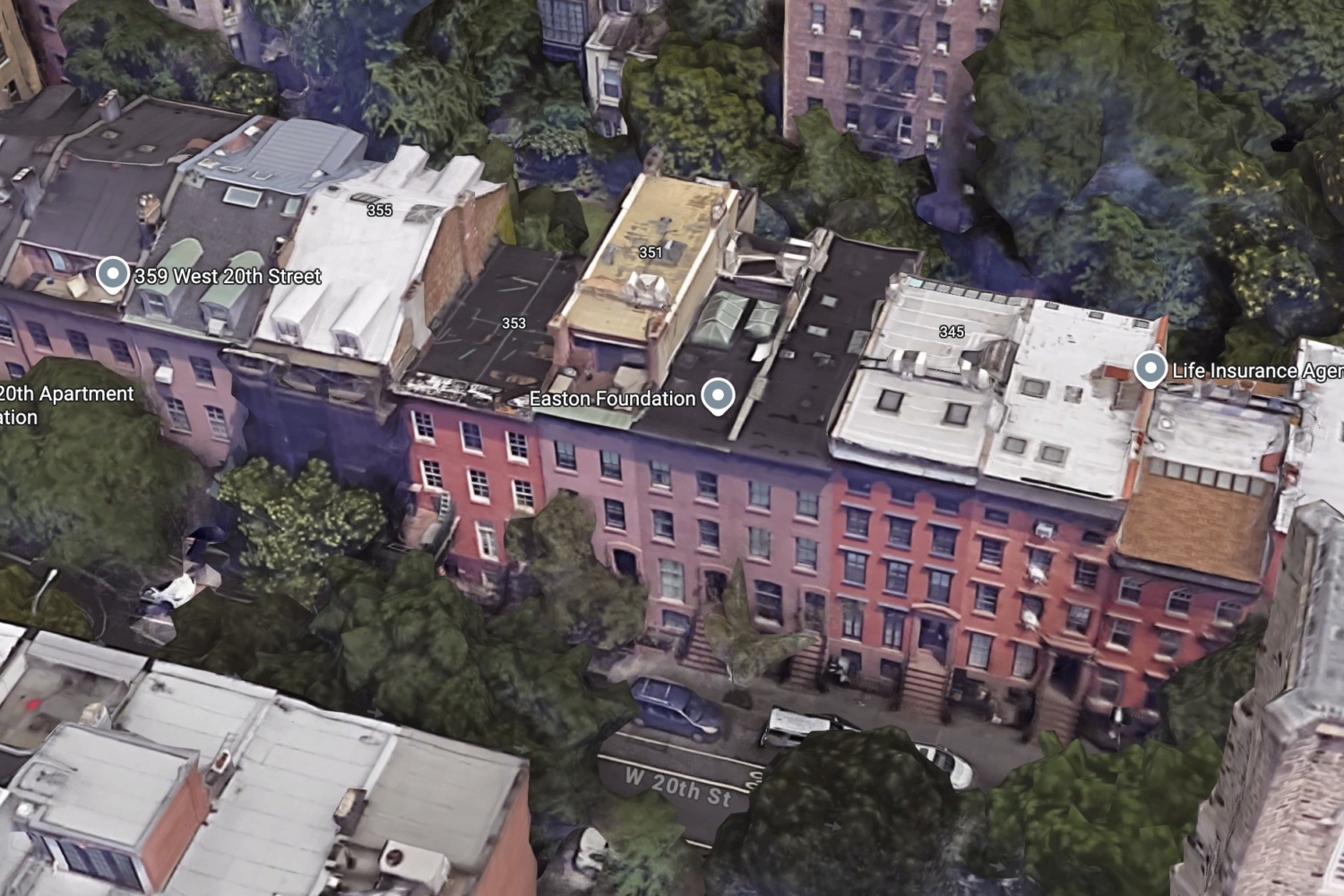
A studio visit of a different kind was the visit to Louise Bourgeois’s former home and studio, located in a 19th-century brick rowhouse on West 20th Street in Chelsea. One of the few artist house museums in New York, besides Donald Judd’s renowned residence in SoHo, the lesser-known home can be visited by appointment through guided tours led by members of The Easton Foundation staff, whose remarkable knowledge of Bourgeois’s life and work extends even to details of her intimate relationship with her cats. Founded by Bourgeois in the 1980s and named after her family’s countryside home, the foundation inherited the property upon her death in 2010 at the age of 98, together with an adjacent townhouse and an extensive archive of artworks and personal materials. Comprising the artist’s papers (writings, letters, ephemera), photographs, sound and moving image recordings, and books, the impressive archive offers profound insight into Bourgeois’s experimentation with material and form, as well as her sustained engagement with psychoanalysis and literature.
Bourgeois and her husband, the art historian Robert Goldwater — whom she met in her native Paris in August 1938 and married only a month later — purchased the townhouse in 1962 for less than $30,000 and lived there with their three sons. Following Goldwater’s death in 1973, Bourgeois gradually transformed the domestic interior, extending her studio practice from the basement to the parlor floor and ultimately turning the entire house into a living work of art. It was here that she produced many of her sculptures (e.g. The Quartered One, 1964–65), drawings, gouaches (e.g. La Famille, 2007), and prints, while also conceiving of large-scale projects (e.g. Maman, 1999) and commissions. As the archivist leading the visit explained, the parlor also served as the setting for Bourgeois’s legendary Sunday Salons, which she began hosting shortly after her husband’s passing and continued into the final years of her life, gathering artists, writers, and curators for presentations, discussion, and critique.
Although the contents of the house were carefully inventoried after the artist’s death, the spaces have been preserved as closely as possible to how they appeared during her lifetime: works in progress remain scattered throughout the studio, boxes of clothing used in her fabric pieces are still stacked along the walls, books line the shelves, and handwritten notes remain pinned in place, giving an unusually intimate impression of the artist who once inhabited these spaces. The adjacent exhibition space presents a carefully curated selection of archival materials — including letters, photographs, and other documents — alongside interesting drawings by the artist.
The Easton Foundation
349 West 20th Street, New York, NY 10011
theeastonfoundation.org
info@theeastonfoundation.org
|
|
Crackhead Barney, GOD IS RAPING ME, 2026, performance view, Pageant, Brooklyn, 2026. Video still: Pageant.
|
|
|
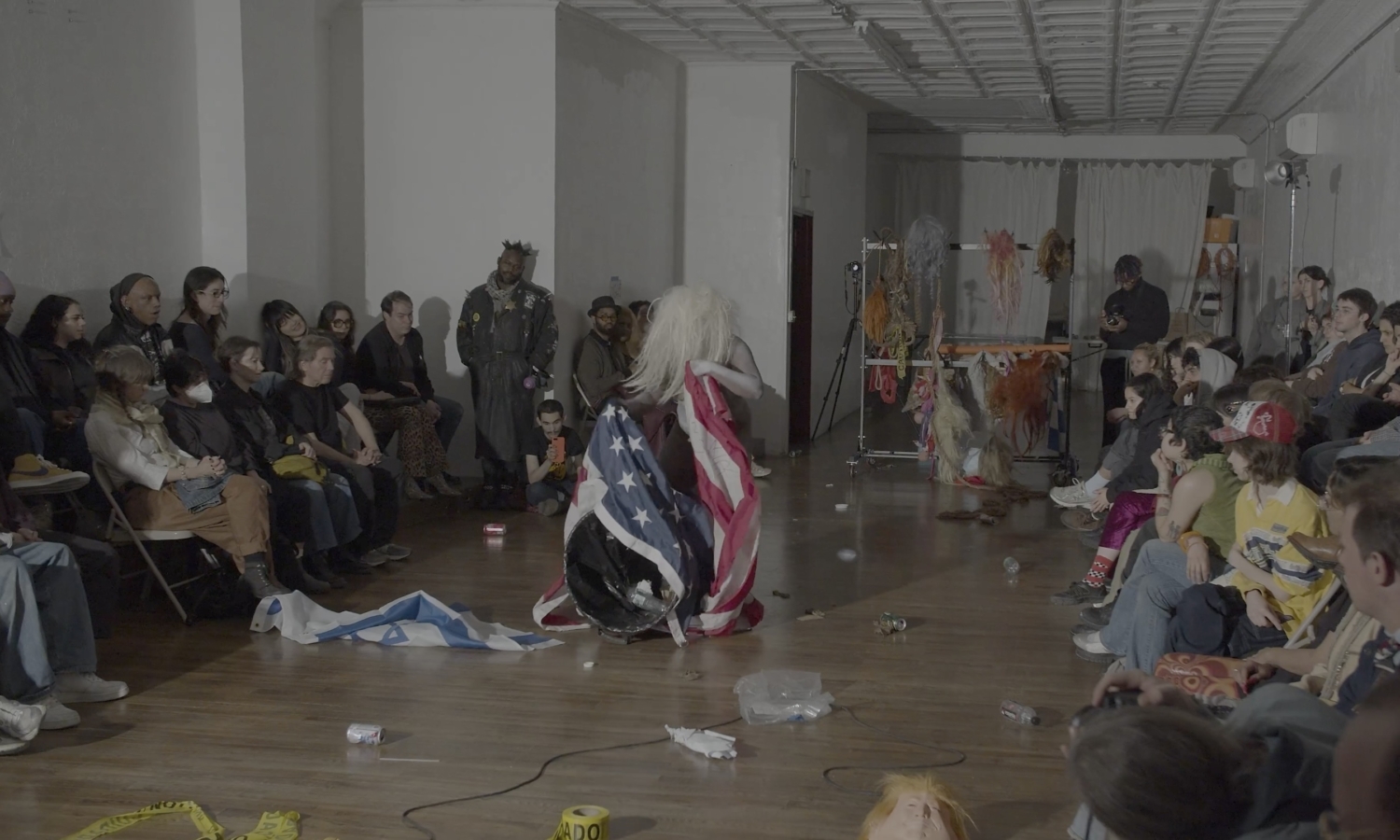
While the exhibitions and spaces discussed above each offered distinct perspectives on past and present modes of artistic production and working conditions in New York and beyond, Crackhead Barney’s performance GOD IS RAPING ME (2026) stood out as by far the most surprising and provocative encounter with the local art scene. Presented over two consecutive sold-out evenings at Pageant — an artist-run performance space founded in 2022 in East Williamsburg, Brooklyn — the hour-long work unfolded as a deeply personal, poignant, and fiercely confrontational reflection on contemporary U.S. politics.
Drawing on the legacies of avant-garde movements such as Dada and Surrealism, the New York–based artist — widely known for her filmed interventions at both pro- and anti-government political protests circulated online — employs absurdity to challenge entrenched power structures, mobilizing discomfort and transgression as deliberate artistic strategies. As she remarked elsewhere: “2026 is insane. Art should be going insane. (…) The chaos exposes tensions between authority and the marginalized.”
An Israeli flag placed on the floor at the entrance, which audience members were forced either to step on or step over as they entered the space, foreshadowed the confrontational atmosphere that would follow. Inside, the two opposing rows of seating were divided into categories marked by politically and socially charged labels such as “Tradwife,” “Cracker,” “Zionist,” “Muslim,” and “Raper,” compelling the audience to symbolically take sides before the performance had even begun.
GOD IS RAPING ME opened with the nearly nude Black performer, her face and body painted white, moving slowly through the audience and repeatedly asking individual spectators whether they wanted to rape her. The gesture produced palpable discomfort and a profound uncertainty as to whether the work sought to expose, reproduce, or destabilize the violence embedded within such language and power relations. As the piece unfolded — described by the artist in the announcement text as “a play about a woman who is confused, desperate, incoherent, and wants and needs lots of attention” — references to national and international politics became increasingly explicit and pervasive, ultimately revealing the work’s provocative title as a scathing critique of both the U.S. and Israeli governments and their political leadership.
Pageant
2 & 3 April 2026
70 Graham Ave, 3rd Floor, Brooklyn, NY 11206
|
|
|
|
|
|
|