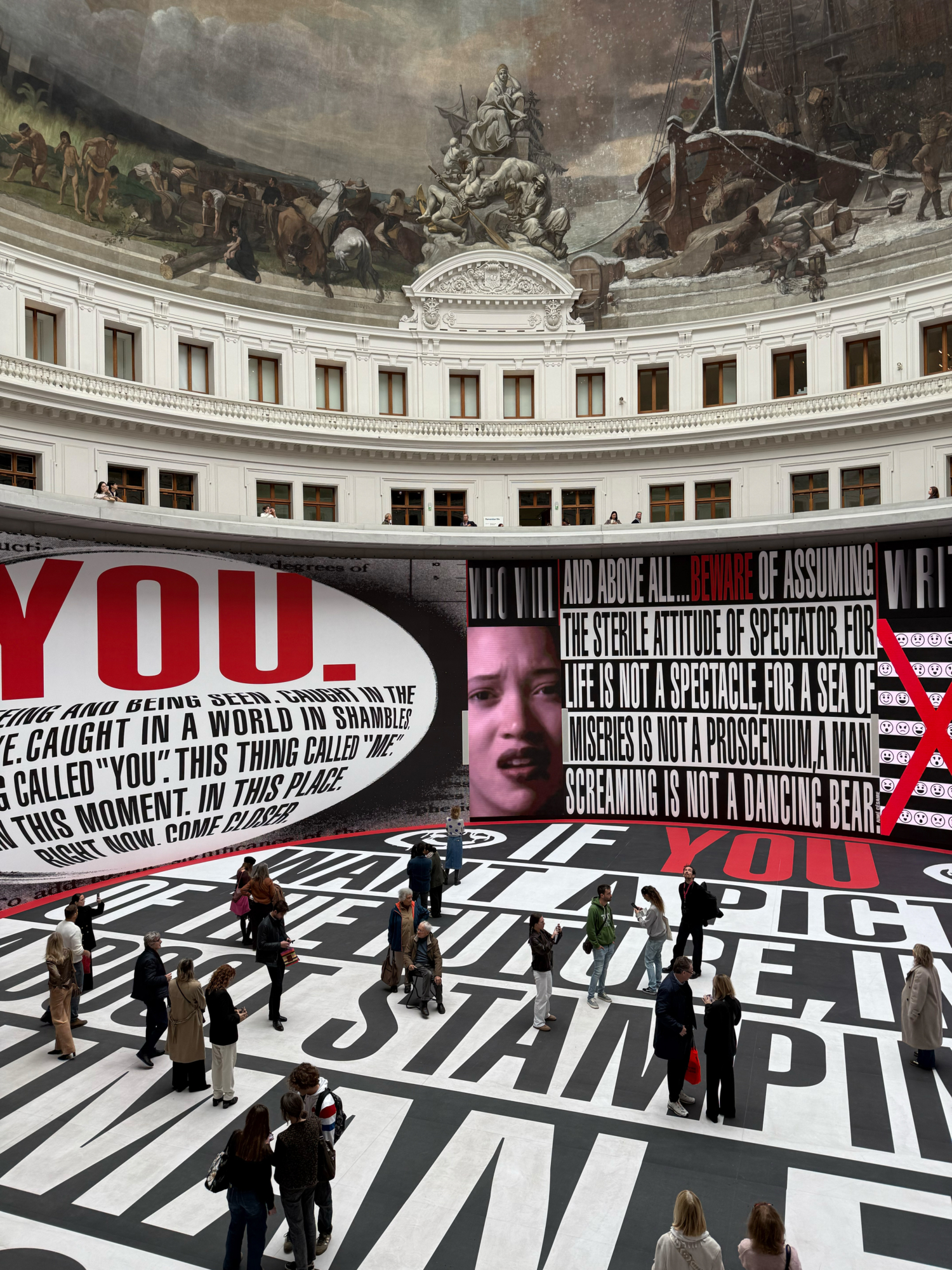
Barbara Kruger: History of Tears, Bourse de Commerce – Pinault Collection, 2026. Photo: Anke Dyes
|
|
|
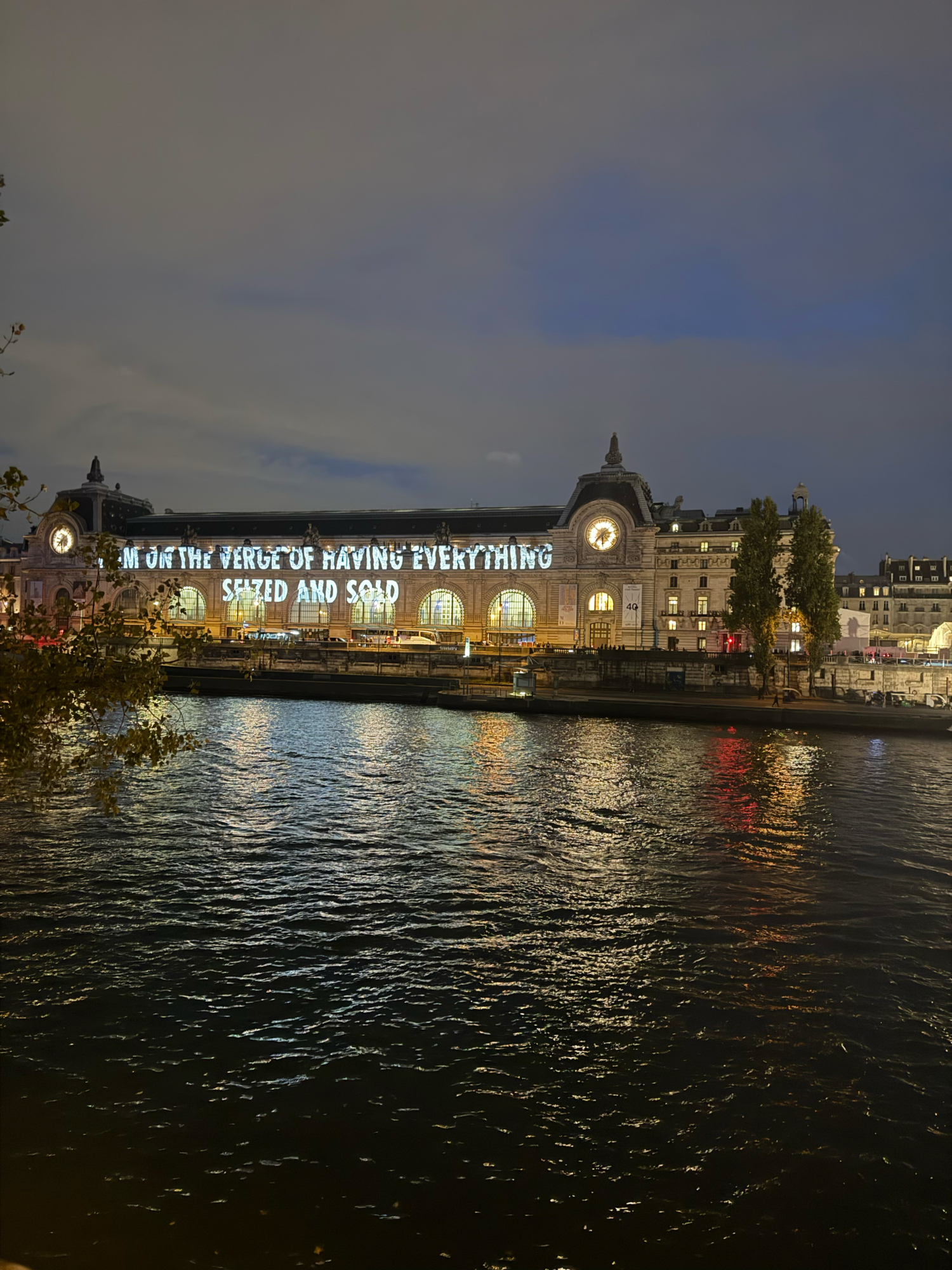
On none of my other trips for PROVENCE has the “aura battle” between money and art been so clearly visible—or, for that matter, so decisively settled. Outside of the art fair, protests against the high cost of living (not the occasion, but certainly the issue); inside, art that could just as easily be shipped off to Qatar—or so the Basel art fair behemoth promises. I arrive at the train station at night, a place where gatherings are currently prohibited. Lots of police and broken glass are the remnants of the weekend. But the atmosphere is more like groups of students on fall break. Some are sitting on paper trash cans. I assume it’s because they smell less. My VIP pass is the wrong color again, but that might be my fault. I had technical and emotional difficulties downloading the Art Basel app and am now standing in line with the locals in front of the Pinault Collection at the Bourse de Commerce. Here, art is popular; everyone wants to see Barbara Kruger, for example. Her installation pursues her very direct idea in a very direct way, as she does. And so the viewers enter a rotunda stylized as a social media forum in three-dimensional space. Actors, filmed in elongated videos in the “story” format, heckle visitors, surrounded by cautionary words that highlight the mutual observation and blind spots of this type of self-reflection. Weirdly, this slogan art seems to work again, just as the tweet-length text disappears (Jenny Holzer is shown at the Musée d’Orsay, or rather, on its façade—which I discover by chance when I decide to take a short stroll along the Seine in the evening, for the fresh air, the exercise, and the light drizzle). It immediately strikes me as obvious to map social media onto an art space. But it does not work as a comment or a joke, because there is not enough distance for a pointed transposition of one space into another. No one is laughing really; everyone just lets the heckles wash over them. I walk quickly through the rest of the building, which makes less sense to me. One curatorial trick, for example, is to display some photographs in different sizes, but I learn nothing about intensity or how representation works from this. The installation only takes up wall space. Of course there is some iconic photography here, and I even believe there is an authentic interest in these works rather than this being another collection as a tax break. But I am also tired of enduring these gazes and gestures, the stark contrasts, and the decisive moments just gotten right. In the lines I’m standing in, I see curators, some I know, some I don’t, clinging to their cell phones so they don’t have to talk to everyone right now. Understandable. I’d rather not talk to myself either, and nobody here needs art criticism. The magazine section at the fair is practically nonexistent. And Pinault: 3 out of 5 stars; two of them for Barbara Kruger.
|
|
Jenny Holzer: J’AI VU, Musee d'Orsay, 2026. Photo: Anke Dyes
|
|
|
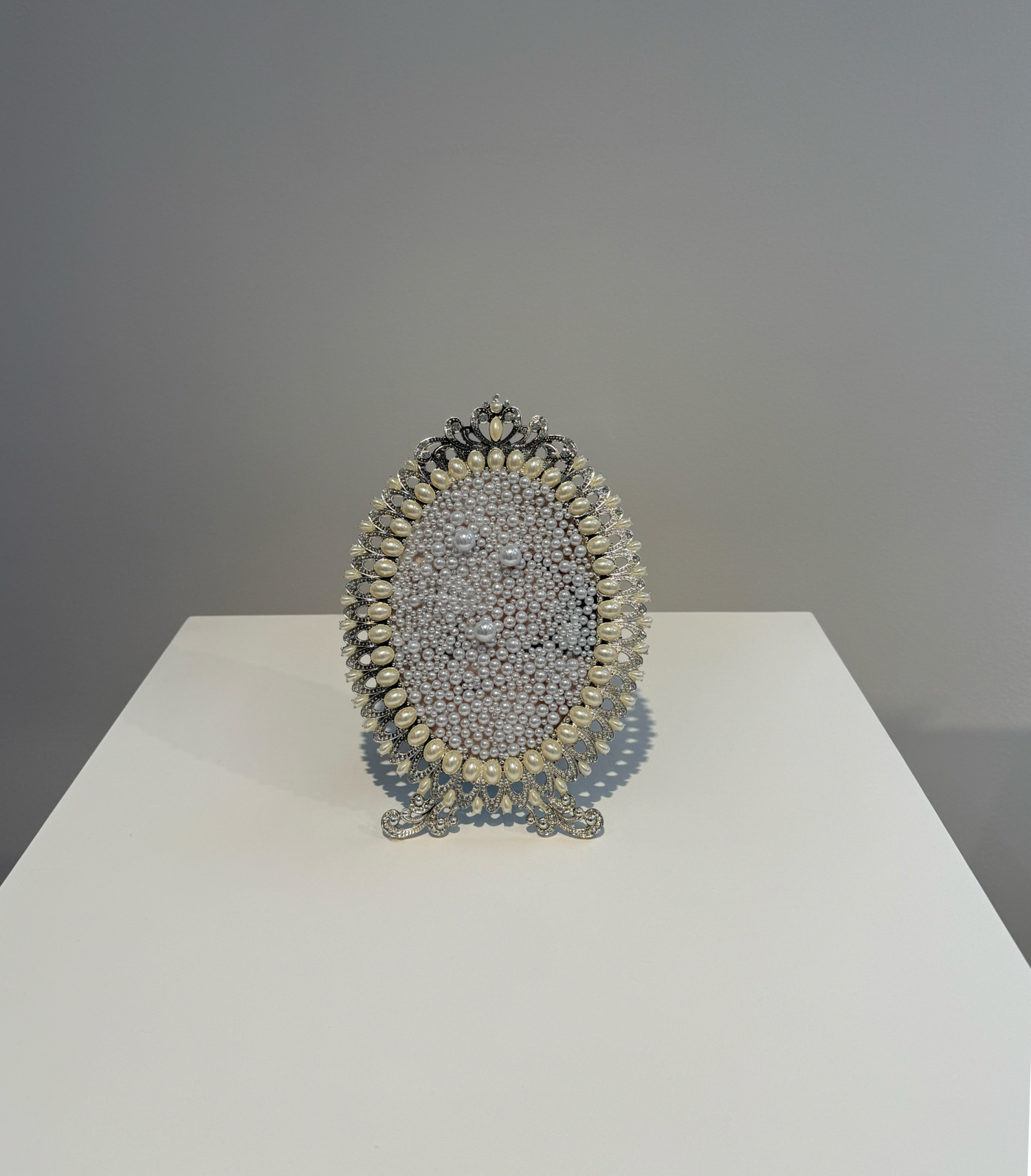
Much of the art I see over the next few days is made of metal (which seems to have replaced ceramics as a popular material when I wasn’t paying attention) and, at the same time, has a craft scale, that is, you could make this at home or at a tolerant co-working space; aside from a glossy finish or real metals, it primarily features hobby materials—beads, stickers, glitter, chains or rather necklaces—perhaps more “cute” than “zany” overall. And interesting to varying degrees. At Roh Gallery, for example, the silver floats on a flat waterbed—a variation on the metal theme—which Thao Nguyen Phan somehow steers more towards nature and metals as elements and resources than toward crafts and memorabilia in type cases. A few years ago, Lafayette Anticipations opened with a Lutz Bacher exhibition. In that exhibition, glitter was an element that defined and reflected the new institution, because the sticky and increasingly dirty material was carried by the visitors from the gallery into every room of the building and out into the city; it was impossible to get rid of, so you took the exhibition with you, and it shifted the focus from the videos on show to the visitors as well as to the stairwells and the café that of course, are also part of the look, context, and offerings of this new art space. This time there is also something shiny on show in this institution. The exhibition text is just a snippet (and I’m missing the book presentation where I might have learned more, thanks to my escape from Paris on Friday), but it immediately brings me joy: The press release for Helene Fauquet’s exhibition challenges me to imagine a woman with a dripping hot-glue gun. OK, I’ll do that. And yes, it’s a baroque image. It’s the woman with a gun, but it’s potentially minor burns instead of fatal wounds, or home decor of the toxic kind. The work is the most interesting of its kind, if you take all those that work with shells, pearls, shine, metal, and that were not only made at home but also in relation to the private interior space. With Fauquet, it seems to be more about the aesthetic forms that currently signal that an object is “personal.” There’s an aesthetic to the turning toward one’s own memories, and Fauquet presents it as the cliché of an inner world that has a fake shine to it. Many of the paintings I see are also devoted to this personal relationship with popular taste, with the forms of popular culture, with décor and comics, that become art by the simple fact of their mode of production. That is, is this fan art, or thinking about painting in the times of fan art?
|
|
Hélène Fauquet: Vivresse, Lafayette Anticipations, 2026. Photo: Anke Dyes
|
|
|
Outside, we see the fears of the popular and the masses reemerging, which defined the boundaries of modern art at its inception. But it’s the tone in which the government and part of the press speak about the demonstrations that convinces my friends (who are neither students nor teachers) to join them. Later, the windows of the banks are smashed (okay), as are those of the sneaker and cell phone stores (well). My friends say it’s also a matter of optics—which businesses the state protects and which it doesen’t. The issue will prematurely end Art Basel Paris, but I don’t know that yet as I walk past the stores, which are taking precautions for the next weekend by having wooden boards installed in front of their windows. They’ll ban the next demonstrations to less central parts of Paris, but that isn’t clear at this point either.
My French companion speculates that only the corks of wine houses that belong to LVMH were imitated for Jeff Koons’ sculpture, the first thing we see as we enter the fair. These signifiers have in fact, little significance in my life or in the lives of the people I normally talk to about art. And yet, some of us are here. I don’t know if I’m manifesting or summoning the people I meet. I try to consult the tote bag oracle to decide what else I need to see, and I miss events I would have liked to attend because they don’t make bags, or because I run into people carrying the right bags too late. I won’t make it to the program curated by Alice Diop (hosted and sponsored by Miu Miu) in time. They are showing her film “Fragments for Venus”, which was on show in Paris on Mubi, though, and I watch that. (And, fyi, another film of hers, the 2020 documentary “Nous,” is currently on view on the website of Bundeszentrale für politische Bildung, bpb.de, as background information on the current situation in France.) Lots of people are also walking around with Hauser & Wirth bags, but I don’t want to go there. I’m carrying a Kunstraum München bag.
|
|
“These signifiers have in fact, little significance in my life or in that of the people I normally talk to about art. And yet, some of us are here.”
|
|
|
Since I’m a bit tired from all the walking around, I take a short break in a side wing of the Grand Palais and watch the guards change shifts. It reminds me of my time as a guard at the Haus der Kulturen der Welt in Berlin. There, too, everyone spoke a couple of languages and was paid the minimum wage. At some point, we were given a tour of Ulrike Ottinger’s exhibition so we could provide information to visitors; the press office staffer mentioned, among other things, that the queer filmmaker had studied under Paul Bourdieu; and my colleague blurted out, “Is that his little brother?” and everyone laughed.
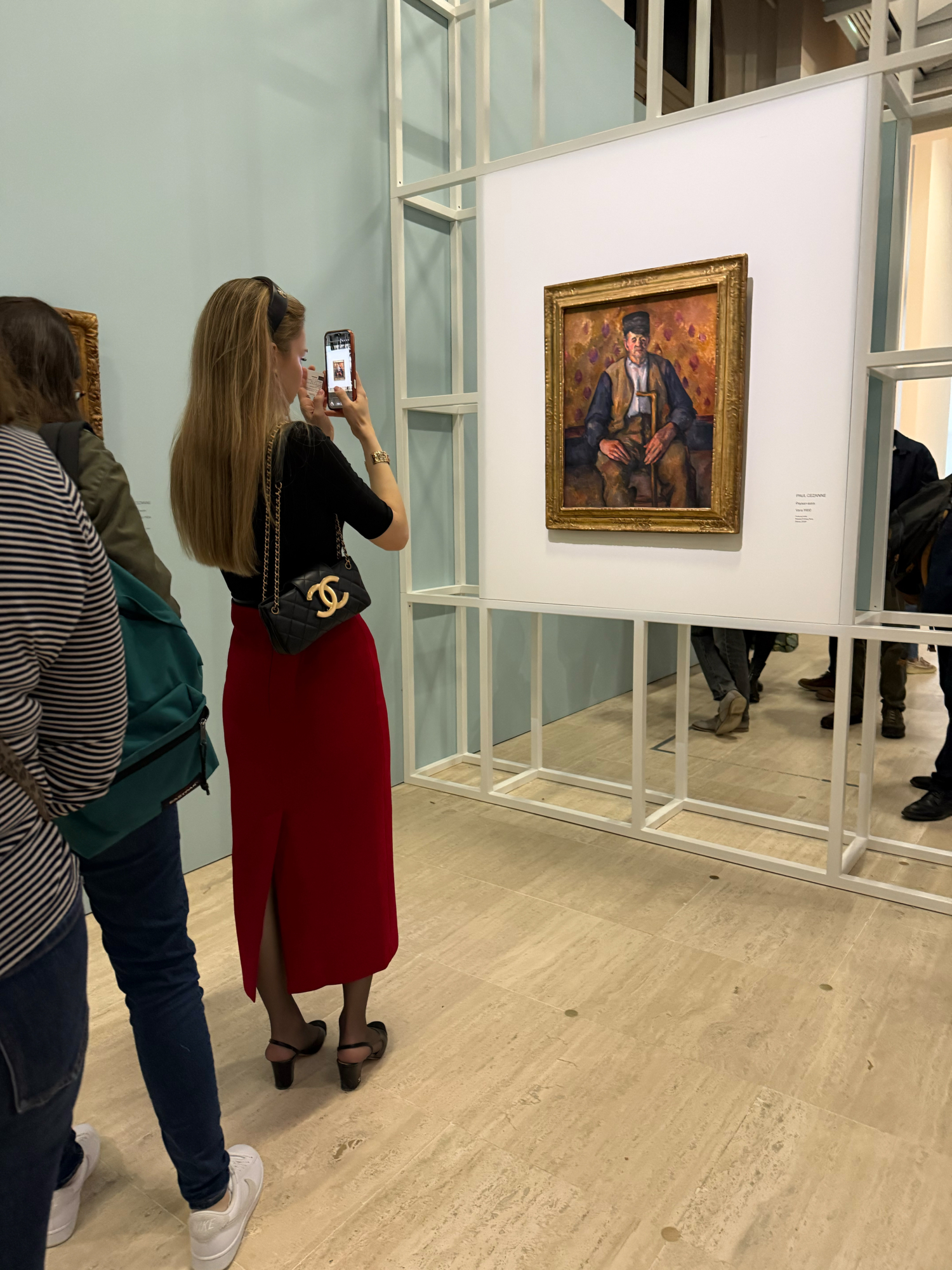
I was waiting in line at Barbara Kruger’s exhibit and am now waiting in line at Cézanne’s. The exhibition is insanely crowded; the “artist’s-artist” is being celebrated, and the exhibition manages to unearth a few women who were part of his various fan communities (like Natalia Gontcharova or Maria Helena Vieira da Silva) that are so often curated out of painting history when the focus isn’t explicitly on women artists. The contemporaries (mine, that is, not Cézanne’s) are a bit boring, even though I’ll later discover variations on the motifs at the art fair as well.
|
|
Cézanne: Cézanne et nous, Grand Palais, 2026. Photo: Anke Dyes
|
|
|
Somewhere at the fair I spot a Robert Fillou piece. The stones, shards, and the inscription (“Angst Ende”) seem strangely topical, but they’re from 1982. My French commentary sees Yellow Vests (look there!) and also finds many other ways to highlight the contrast between this event and what has been going on in Paris in the last days. This contrast always exists, of course, when art is for sale and offered to those who can afford it, but it is rarely as pointed. On the balconies along the sides, art competes with the view of the Grand Palais. In one corner there is Kin, the gallery Nicholas Schaffhausen founded a couple of years ago, and it is filled with several large blue fish paintings, Trout, by Angharad Williams. I have misplaced what she wrote about them herself, which is a shame, because now I only know what the gallery says on their website. That these trout are a self-representation. Which things an artist does a couple of times, of course, always are. Right next to it, a visitor at Lorenza Longhi’s Oskar Weiss booth fits so perfectly into the installation that, for a moment, I mistake her for the artist herself, her see-through logo bag on the plastic logo floor an immersive experience for one. Everyone knows there’s “the work” and “the hustle” (hüstle), says my companion. She’ll be working this weekend on the TV show C Politique, which will air every day at 6:30 p.m. The protests will be the central theme.
Alongside the metallic works, there’s also art that I’d summarize as “going outside and touching grass”, an oversimplification of course – some of my friends make this kind of art! It’s about objects and images that look analog, as if you mixed the sand that you felt between your toes into the paints, and threw everything together on canvases, where it dries in crusts and cracks. Also decidedly analog is most of the kinetic art on show. For example, Michael E. Smith’s rattling plastic bottles, each filled with a single pebble (it really sounds like water!), producing sentimental feelings towards everyday objects. This does not look like luxury, which makes me nostalgic for art before Y2K became an expression. Just like there’s always stuff that moves, there is always a Conversation program, and I never want to go there. I’d rather find the diagnoses of what is going on in art elsewhere. Recently, a colleague (a colleague because he’s also an art critic) complained in a text even longer than this one that art is increasingly becoming an “art of education” or rather educational art. What he’s perhaps getting at is that we see a lot of art that relates to the self and childhood—and things you can control (works that fit on a desk are examples of that), as well as a certain literalness, nothing too far removed from what it’s supposed to mean, of what an audience should take away from it. I don’t know what I’d call it, but I refuse to take intellectual offense at it, as I don’t see it as condescension, but rather as problems of and in mediation. This art isn’t trying to teach me something. It is rather struggling with what to do with its viewers in general. Art shows have been addressing an audience they don’t know since they were invented in this very city. Being exposed this way is, of course, terrifying. With the role of the audience, and what it can do, shifting, it’s once again completely unclear how one can even address anyone at all—or whether everyone isn’t just inter-passively participating.
|
|
“This art isn’t trying to teach me something. It is rather struggling with what to do with its viewers in general.”
|
|
|
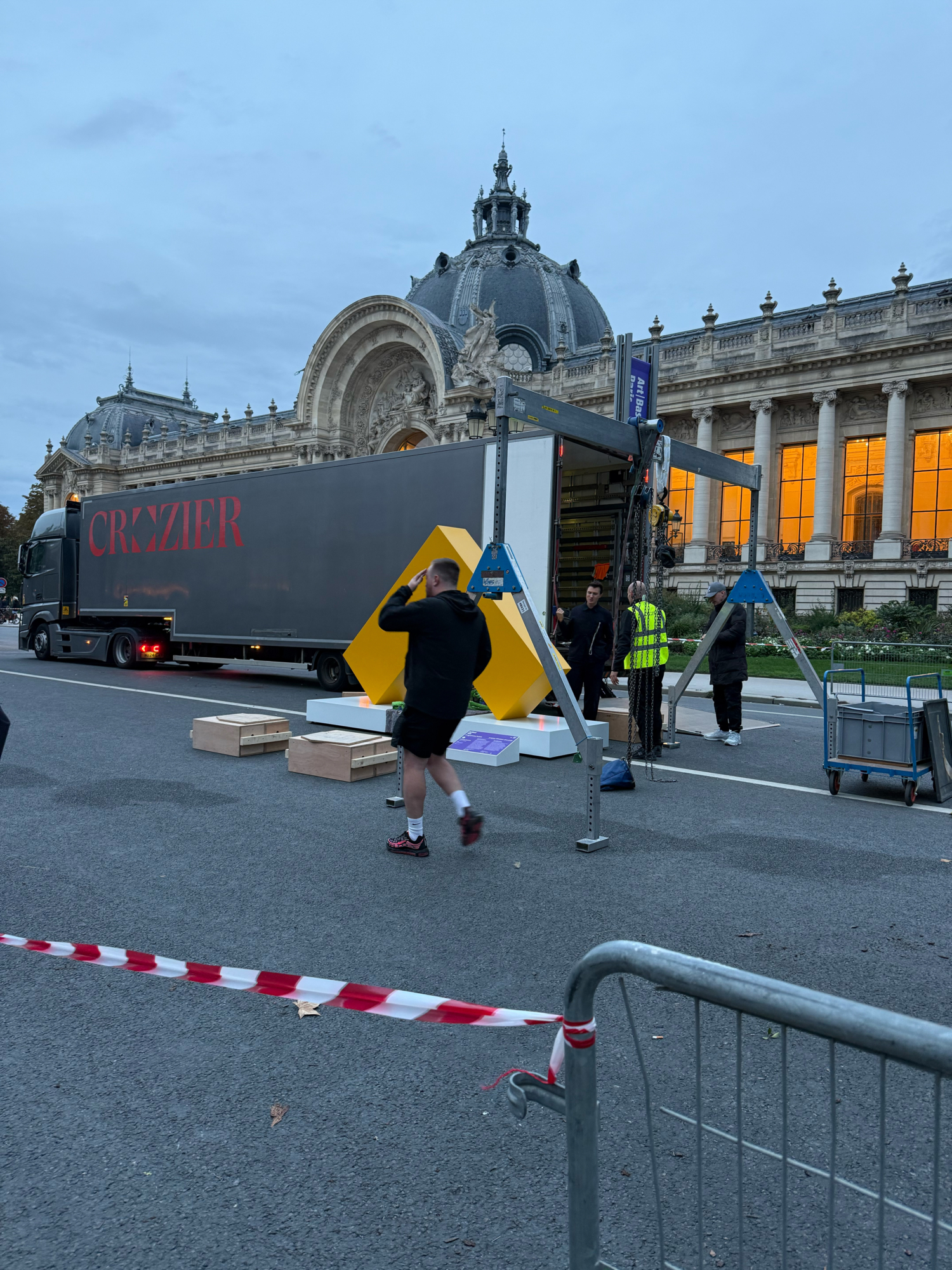
In the back corner, the Qatar Lounge is promoting the next edition of Art Basel Qatar. The hosts’ outfits are gender-neutral, undyed cotton with an interesting lapel—like a pattern, a toile à patron. You can imagine the marketing meeting: “Based on the Art Basel model, but different and local, like a pattern that becomes something in itself.” The people in the interesting outfits are selling interesting non-alcoholic beverages. But that can’t hide the fact that the growing Basel monster—which is buying up all the other art fairs (poor art fairs, lol) and endlessly narrowing down what the showing art here can be about—is revealing its particularly unpleasant side and its role in the different cities it takes place in. While going back and forth from Berlin to Paris, I am reading a book by Roland Barthes. I stumble upon the German translation of Le plaisir du texte, as not only Die Lust am Text, but “Wollust”, meaning the urge to read the text and the text’s urge. It’s desire, or maybe even horniness, toward the readers. This text arrives uninvited in the recipients’ inboxes (to you—my pleasure), a fact that both amuses and frightens me. But, with Barthes, it’s my text that’s intrusive, not necessarily me. Almost in the same breath—since le plaisir du texte is about the joy a text gives, rather than its ability to transmit it, Barthes advises against texts about parties, because they are boring. Thankfully, I hadn’t planned on going to any. My pleasure in these types of events is waning, even if I found out I quite like Ruinart Champagne. But this whole moment, with the glittering art inside and the protest outside, is starting to feel more and more like a reenactment in which the people on the side where I’m currently drinking champagne end up getting beheaded. Except from the obvious, this is also a problem for how we want to show and see art. Since the dealers depend on the monster fair, they can’t really offer the kind of aura anymore the kids are apparently so fond of. An artist friend says that this doesn’t feel like the place to be anymore, and I agree. The dealer-critic-system, which I think didn’t originally refer to critics who were also dealers, does not feel that attractive right now. The art of the fair is loaded onto trucks as early as Thursday evening and taken to safety.
|
|
Premature deinstallation, Art Basel Paris, Grand Palais, 2026. Photo: Anke Dyes
|
|
|
|
|
|
|