Open for Paradise at Contemporary Fine Arts: A Conversation with Arno Brandlhuber and Charlotte Matter
|
|
|
On the occasion of this exhibition, architect Rubén Valdez interviewed art historian Charlotte Matter, and architect Arno Brandlhuber. Find their discussion here below.
|
|
Exhibition view: Open for Paradise, 08.11-20.12.2025, Contemporary Fine Arts. Photo: Gina Folly
|
|
|
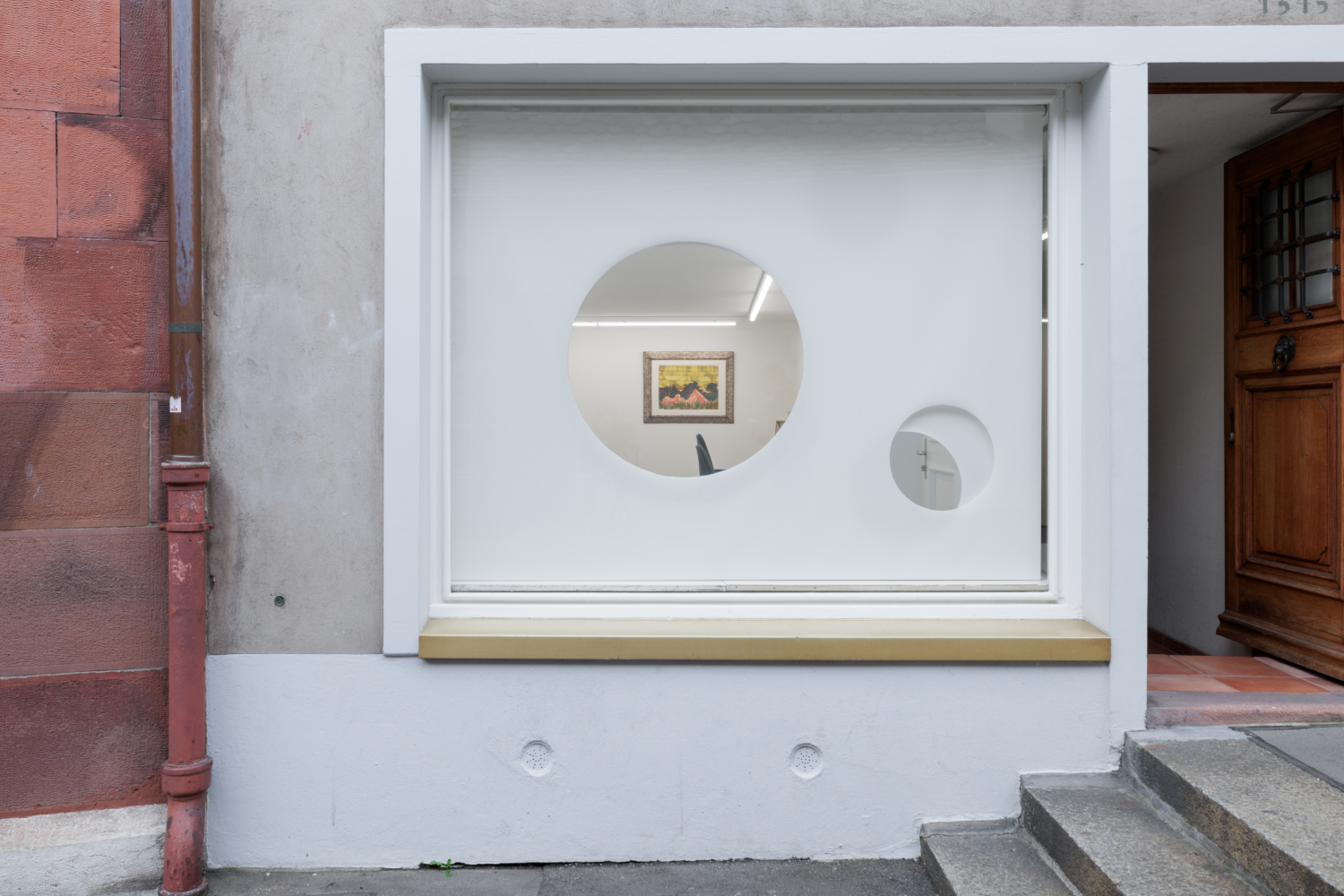
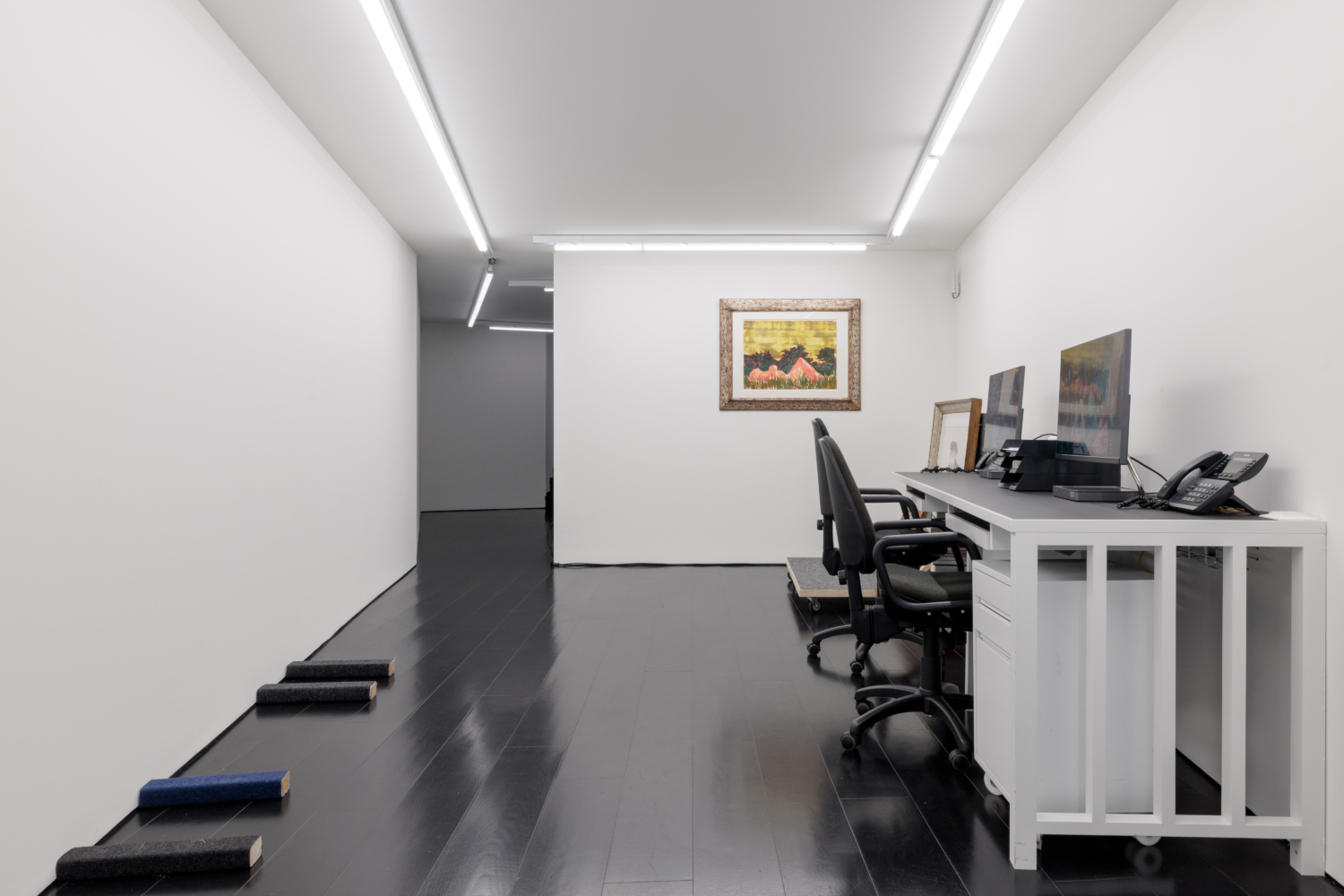
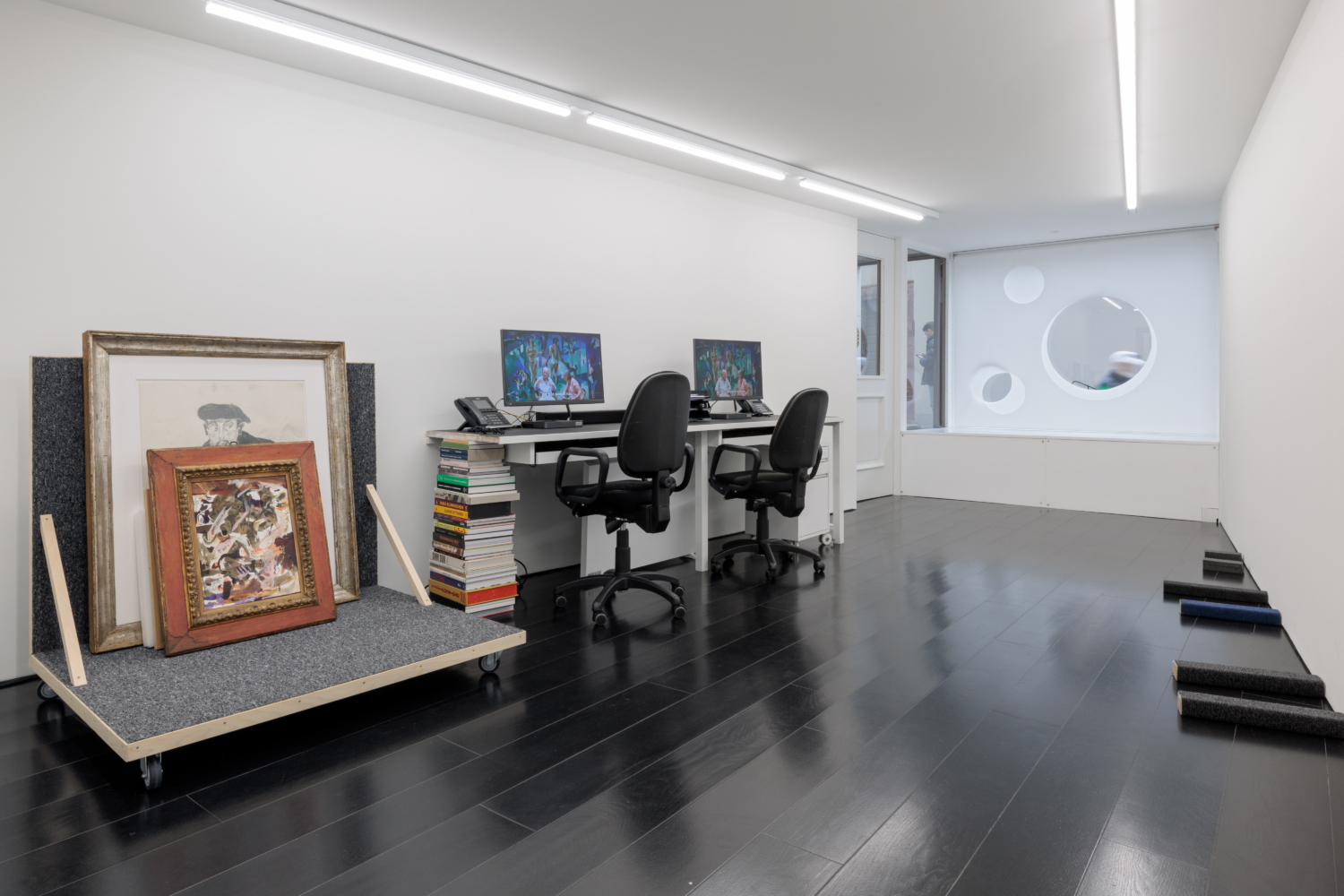
Rubén Valdez: Charlotte, Arno, thank you so much for being here. I’d like to start with the everyday life of the exhibition. I feel there’s a very important aspect of performativity: the exhibition changes the place of the office space of the gallery so it is visible from the street, and the street visible to the office through Constanze Hass’ white flag blind in the window. The artworks remain unhung unless requested, and there are many other performative aspects in the exhibition. Could you expand on the performativity of these spatial gestures? Charlotte Matter: This performative aspect you are describing was not thought of as an empty gesture, but as something that needed to be negotiated and discussed with the people who actually do the work. So this gesture is not merely a conceptual way of exposing work by bringing the office desk into the first room and making it visible to people passing by. It’s also about trying to understand the needs of the people who work there. Having this conversation with the gallery director, Arno learned that this setup would actually improve her working by making it easier to make eye contact with people on the street. So I’m not entirely sure it’s only about a performative gesture. In the end it’s also about caring for how a gallery works and for the people who do that work.
|
|
Exhibition view: Open for Paradise, 08.11-20.12.2025, Contemporary Fine Arts. Photo: Gina Folly
|
|
|
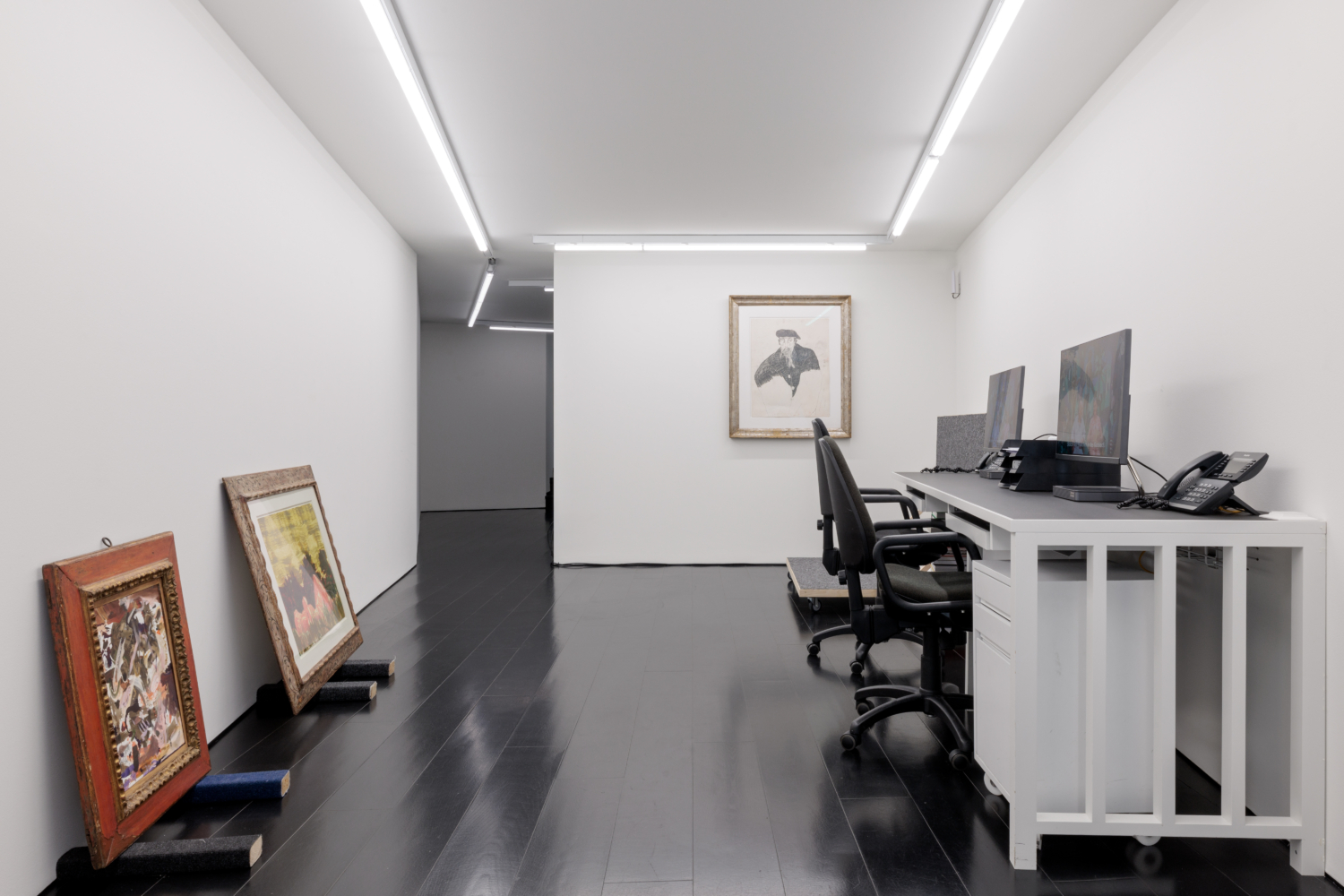
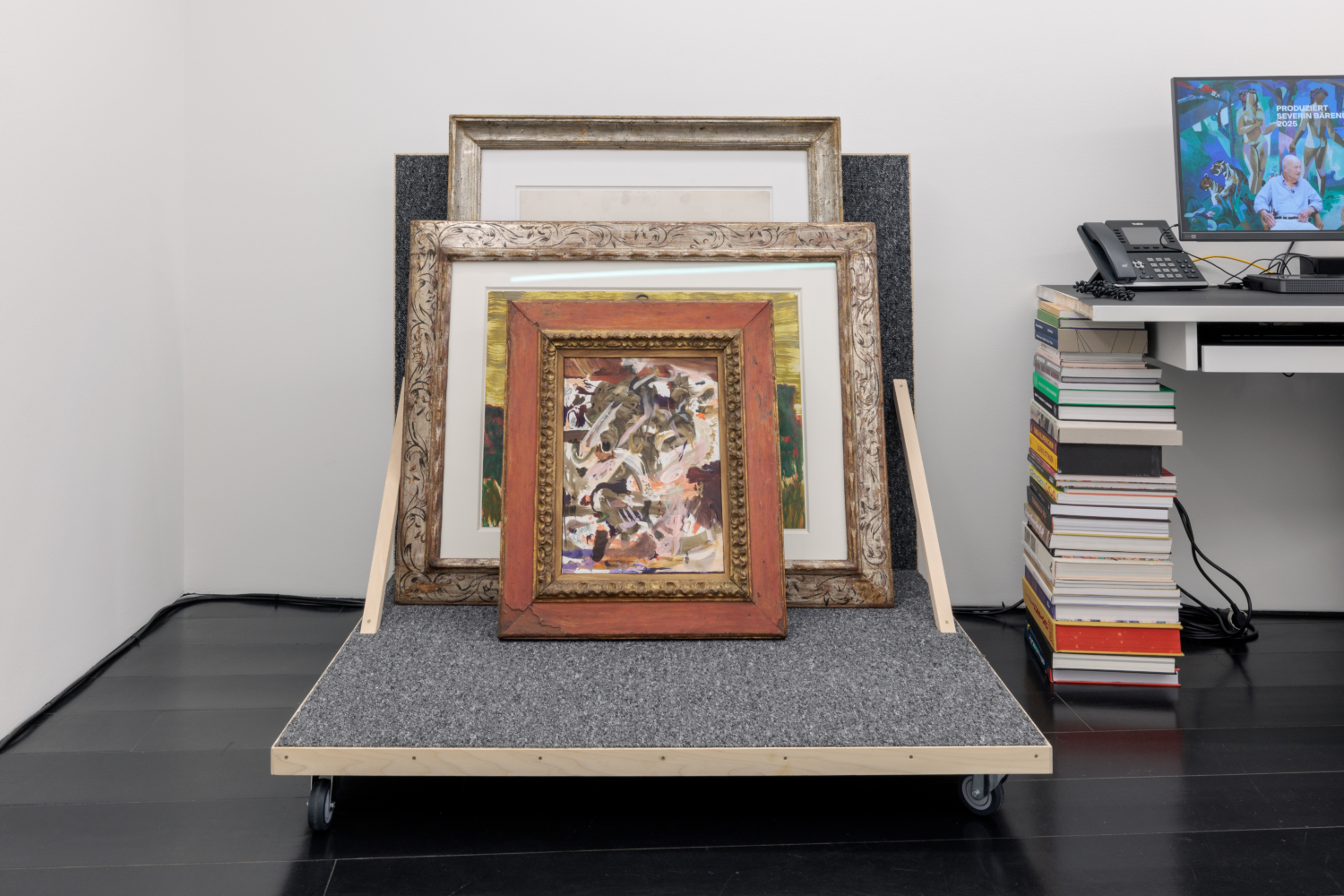
RV: And what about the hanging of the paintings—or rather, leaving them unhung unless requested? Would you say that’s not a performative gesture? CM: It certainly is. But it remains to be seen—the show has just opened—if the score will actually be carried out, if the gallery staff will really leave the paintings on the rack and hang them only for a limited time upon request, thereby mimicking the visual regime of a peep show. It will be interesting to see whether this becomes a real practice or stays at the level of a proposal. What do you think, Arno? Arno Brandlhuber: First of all, it’s showing the process. By hanging the pieces, you make them tradeable. That’s what we wanted to show, how a gallery functions in a very basic economic sense: you place something in the focus, in the “best” possible way, aiming for a certain valuation level. I’m not even sure whether it’s “performative” in itself, but the difference now is that the hanging a gallery normally does in the background becomes visible. They have to hang the work each time someone asks, so this action is exposed. In that sense, we could agree it’s a kind of performative thinking, as we also care for the performances that normally are not shown and that in this case are just part of the scenery. CM: Yes, exactly. These are the same gestures that happen all the time at art fairs. There was this question during the discussion after the opening about the local specificity of the exhibition. Someone mentioned that it matters that the show takes place in Basel—not only as the city of Fasnacht, but also as the city of the art fair. These gestures—rehanging, moving works around, making pieces available to specific buyers—are happening constantly during the fair, but in back rooms. Usually exhibitions present this sealed-off space that conceals all the work taking place behind it.
|
|
Exhibition view: Open for Paradise, 08.11-20.12.2025, Contemporary Fine Arts. Photo: Gina Folly
|
|
|
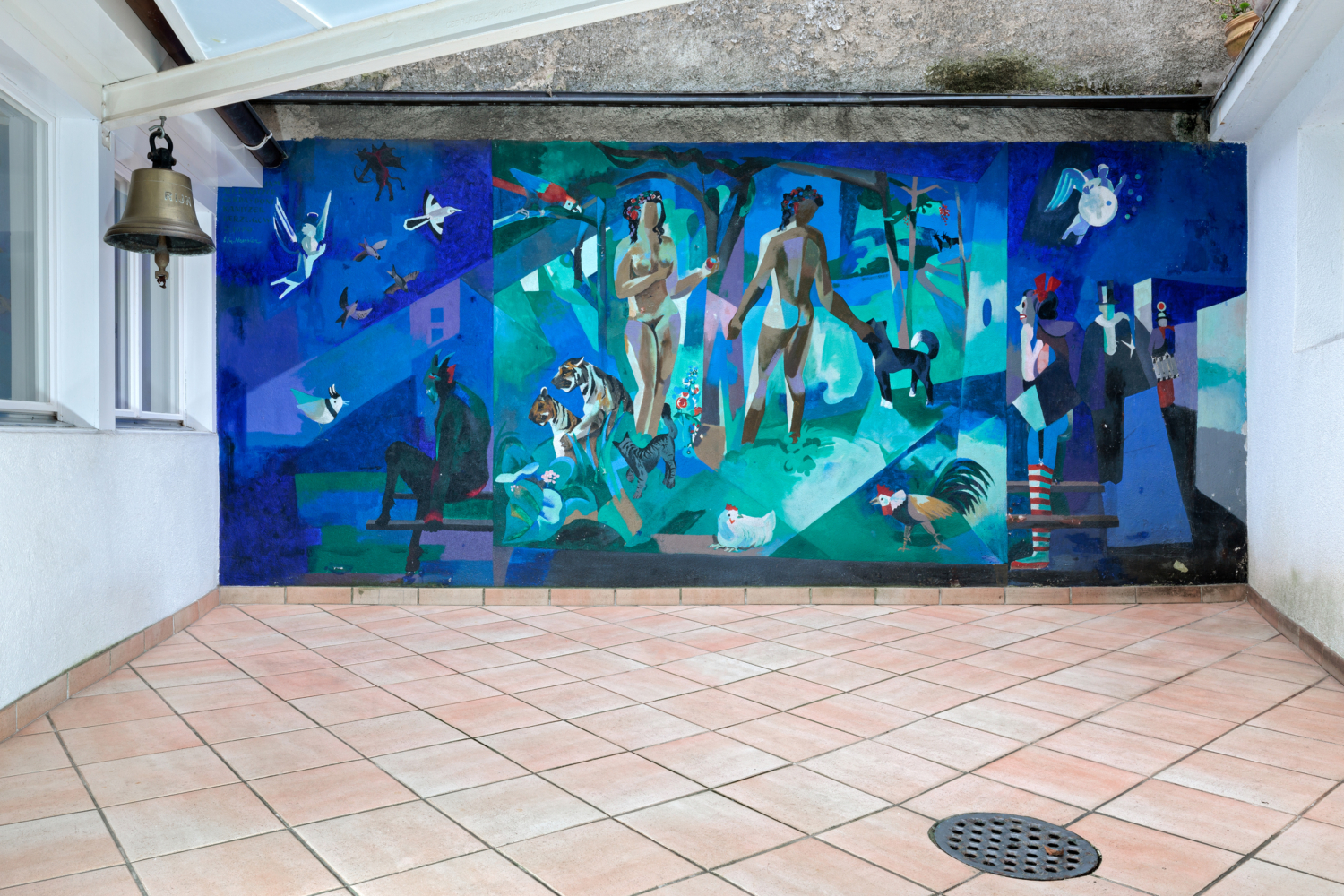
AB: There are a lot of roles and modes of enabling embedded in the work of architects, historians, gallerists, artists… which we normally don’t talk about because we usually focus on the final service or object where things are projected onto. I like that here, even though the materials and formats are rather old-fashioned, when you overlay a kind of reference image, it makes it possible to create another sense, another content—shifting the focus and playing with foreground and background so that reality becomes different, while still working with the existing, with the normality of shows and how they are normally constructed. RV: Speaking of how shows are constructed: you were originally invited to do an “architecture exhibition”. Yet the show operates much more within the language and codes of contemporary art, while using architectural tools such as working very directly with the spatiality of the existing situation. Could you talk about this friction between the language of contemporary art and the tools of architecture? AB: Let’s say architecture and art are both corrupted, but in different ways. Architecture may be corrupted in the sense that there is virtually no room for a perspective that goes beyond providing pure service “I need a building, so I get a building”. You might consider whether you want it in a different color or slightly slimmer or taller… aesthetic questions. But as a concept, there might be nothing else left. In the art world, there is growing awareness that art has become an asset and as such co-creating market-driven environments. Perhaps we are starting out in a field of double self-corruption, which, as a double negation, can lead to a positive outcome. We started with that kind of mindset when we found this mural in the courtyard, which is neither interesting for art history nor valuable for the contemporary art market. It has no economic value in that sense, but if you don’t stick to the usual evaluations because they are already corrupted, and you shift it and bring the mural to the forefront of the gallery—where they have to deal with mobile and tradable goods—you create a new meaning. Then there’s a third layer—and here we asked Charlotte to participate in the project, to talk about front and rear views and their construction. That is an interesting moment to start working on this. There are three points: architecture, art, and a way of thinking about how views and values in that sphere are created.
|
|
Exhibition view: Open for Paradise, 08.11-20.12.2025, Contemporary Fine Arts. Photo: Gina Folly
|
|
|
RV: Thinking about that, something I found very interesting is the collective authorship of the project. Everyone involved is credited through a non-hierarchical authorship model. In what way did the collaborators’ different skills and backgrounds influence the exhibition? AB: Hierarchies are usually there to highlight, evaluate, and economize. When you put everyone on the same level, in my experience, you get a win-win situation. Of course, this usually causes problems—I don’t know exactly why—especially in institutions, offices, galleries. “The paper is not long enough to credit everyone; we’re not used to it…” all those arguments. But on the one hand, it opens up new connections and enables unexpected forms of collaboration, closeness and equality. CM: It also connects to current attempts to rethink work in more empathetic ways. There are cooperative organizations where everyone rotates through different roles—for example, a bakery in Basel where everyone, at least once, bakes, sells, and cleans just to understand what each role feels like. The show somehow speaks to such a rethinking of the distribution of work. What I like about the collective authorship as it plays out here, however, is that it also reveals the limits of such attempts. For example, we discussed certain conspicuous absences in the list: the fact that the cleaning person isn’t mentioned—but neither is the gallerist himself, Bruno. So on the one hand, it’s about rethinking hierarchies, but on the other hand, this gesture makes them even more visible, because you realize you can only go so far in including people in this ongoing list. It also makes it clear that any attempt to truly flatten hierarchies will necessarily fail as long as we operate within the dynamics and structures of capitalist thinking.
|
|
Exhibition view: Open for Paradise, 08.11-20.12.2025, Contemporary Fine Arts. Photo: Gina Folly
|
|
|
RV: I think that's very interesting, because you mentioned the dynamics of this bakery in Basel. But supermarket chains like Migros, Coop and Aldi also work like that: the cashier can also be putting products on the shelves, and so on—but they do it mostly so they can be more efficient and flexible in how they operate human resources. Staff can occupy the entirety of their time because there are always some tasks to do, and if someone is sick or gets fired they can easily replace that person. So my question is: As long as we work within a market framework, once collective authorship produces value, how can it resist being reabsorbed into market-driven logics of authorship and value production? That’s something we’ve seen happen to many collectives: they get absorbed by the market.
|
|
Exhibition view: Open for Paradise, 08.11-20.12.2025, Contemporary Fine Arts. Photo: Gina Folly
|
|
|
AB: In this case, I’m pretty relaxed about it. Everyone can use the project in whatever way they like. Take the Kanitzers, the elderly couple who commissioned the mural 45 years ago—they can now simply rejoice that someone attaches value to it. They derive something completely different from it. There is also the idea that one can achieve a result that cannot be summarized as a kind of tradable or economic output that has to be divided up. That’s why I like the question of addressing the supermarket strategy of “anyone can do anything” as a form of exploitation. But if there’s nothing to sell, there’s nothing to share in economic terms. At the same time, the gallery operating professionally is covering production costs, shipping, installation etc... CM: I think the question of value is really at the heart of the exhibition. Why is there such a consensus within art history that the mural has no value for the gallery, to the point that it was simply covered up? At the same time, the four works exhibited in the show are not for sale, so nothing is technically on the market. Yet, as you pointed out, Arno, this still produces capital: it signals that the gallery doesn’t need to make sales with this show, which in terms of Bourdieu is another way of asserting capital. RV: Exactly. And that leads to the choice of paintings. Even though nothing is officially for sale in the exhibition, three of the artists shown are extremely valuable on the market, especially Peter Doig. What can you tell us about the choice of paintings? Of course we can talk about how they relate to the theme of “paradise”, but they’re also very valuable in the market. AB: You asked about the performance of the space earlier on, and there’s also a history of this “performance” in that space—not only what’s happening now, but also what has happened there over the last 10, 20, 50 years. Even if it sounds kind of esoteric, I believe the space is also a sort of memory system. For instance, in 2025, there was Jane B (2024) a kind of peep-show-like presentation of a figure by Sarah Lucas in the front window, which related very closely to the subject of the mural—the Paradise mural—but she didn’t even know that. What can we speculate about this? How could she not know that for 45 years there was this mural depicting a peephole with a woman looking through it in a very similar way to what she was doing in the window? Therefore, we decided to include a piece of hers in the exhibition. For the rest, Bruno’s selection of the four works reveals differences in value and dissemination.
It only makes sense to talk about “flattening” when there are real differences to flatten—and here, those differences are very present. It only makes sense to talk about “flattening” when there are real differences to flatten—and here, those differences are very present. RV: Speaking of differences and value, the exhibition engages strongly with themes of power, labor, voyeurism, and sex work—both theoretically and in the spatial configuration of the gallery. Could you expand on how these themes operate in the exhibition and its conceptual framework? CM: I think the core for me is the long-standing comparison between producing and selling art and sex work. The gallery is where these ideas meet very visibly: you have art, money, and the negotiation of their relationship. At the same time, the exhibition invites us to think about how questions of labor, exposure, and desire pervade other art-related spheres that aren’t directly tied to the art market but are still in constant dialogue with it. There is also the question of making visible things that are otherwise not visible—and how the visible is not necessarily always what you may think it is. The mural is crucial here. There’s not much literature on Heussler, so it’s hard to fully understand his motivations, but we know from a text he wrote in the late 1950s that he was very interested in circus performers, and he engaged a lot with the Fasnacht. There is another text in which he describes his experience as an apprentice and how he was moved by a general strike he witnessed. There seems to have been a real engagement with working-class life in his work. That makes it possible—even if it’s anachronistic in some ways—to read the mural from a feminist angle: as a way of thinking about sex work as work and exposing the bigotry of a society that was scandalized by something like the “Stützli-Sex”[1] at the time. The mural stages voyeurism and value judgments, but the exhibition also reflects that back onto the art world, which often behaves as if questions of labor and money only concern the “mainstream market,” when in fact they are much more pervasive and permeate the entire field.
|
|
Exhibition view: Open for Paradise, 08.11-20.12.2025, Contemporary Fine Arts. Photo: Gina Folly
|
|
|
RV: I found your analogy between sex work and art production very striking. Thinking further: sex workers are, in many ways, service providers. Once artists are fully absorbed into the market, they become commodity producers. Architects, on the other hand, are service providers who often end up commodifying space. In that sense, maybe architects get the worst of all worlds… AB: (laughs) A triple minus. But you can also find hints in the space itself. The mural starts with the figure read as the sex worker, looking into paradise in a reversed perspective. The site she’s looking at is a kind of illuminated box—a lantern carried around once a year during Fasnacht, supposedly “negating” social differences for a few days. The gallery space has a small window facing the street, then the space widens towards the back. When the Kanitzers ran the shop floor, there was no wall in the middle; you saw straight through to the mural, which was the backdrop for everyday activity. When the gallery moved in, a cross wall was erected to hang the “best” painting. The holes cut in the gallery blind by Constanze and the center of the paintings hung on the wall align with the mural, reconstructing the regime of formerly constructed views. So space itself starts telling us something. I have a certain trust in reading space, Charlotte has a different trust in her work, and all those different trusts of the participants come together and create a multitude of readings in this specific situation.
|
|
Exhibition view: Open for Paradise, 08.11-20.12.2025, Contemporary Fine Arts. Photo: Gina Folly
|
|
|
RV: The exhibition also feels like a kind of gentle critique of the dynamics in the art market and in how we exhibit both architecture and art. In a recent article, the artist and curator Mohammad Salemy argued that Documenta should be abolished, claiming it no longer confronts power but offers only the optics of critique while protecting the establishment from it. A similar argument has been made about some exhibitions at the most recent Architecture Biennale. In that context, how do you prevent institutional critique from being absorbed and instrumentalized by the very institutional and economic structures it aims to challenge? AB: First of all, I wouldn’t describe this exhibition as critique, more as a construction—of relations, situations, and possibilities for reading space. When critique gets absorbed, as we’ve seen in debates around art institutions and political conflicts, must we then return to “pure objects” and stop questioning modes of production? For architecture, that would mean talking only about buildings as finished objects and ignoring how they are produced, financed, and lived in, how they fuel the climate crisis and fail to address the housing issue. An endless list. I don’t see critique being embraced in the same way anymore, at least not in the field of architecture. CM: I’d say critique is still very much needed, and it is still happening—but perhaps not mainly in the form of classical institutional critique. That mode does feel a bit exhausted, and it’s not a new observation that institutional critique has been institutionalized. However, many artists today are critically addressing racism, ableism, homophobia, and other structural issues within the art world itself. There exist many forms of critique, even if they don’t always present themselves under that label. Maybe it’s helpful to think of these practices not only as critique of institutions but as forms of production that create new structures, relations, and ways of working. That’s closer to imagining entirely new institutional forms rather than reforming the existing ones from within. AB: Exactly—the question is whether we call it critique or production. My hope would be that production itself is shifting. In architecture, for example, a lot of our discussions about borders and accessibility have been taken over by politics in a very direct and sometimes brutal way. So we must ask again: what is our role, and how can we produce something different rather than just commenting on what already exists? RV: I think that’s a very interesting—and productively open—conclusion. Thank you both very much for your time. I really enjoyed seeing the exhibition and discussing all these ideas with you. Would you like to add anything ? AB: I would like to acknowledge the generosity and open-mindedness of Bruno and the CFA team, they were really engaged in a very fruitful collaboration.
|
|
[1] “Stützli‑Sex” was a 1970s Zürich peep-show on Brauerstrasse where, for one franc, a man could watch a naked woman behind a glass plate for about 30 seconds.
|
|
|
|
|
|
|