Of Fucked-Up Perpetual Motion Machines
|
|
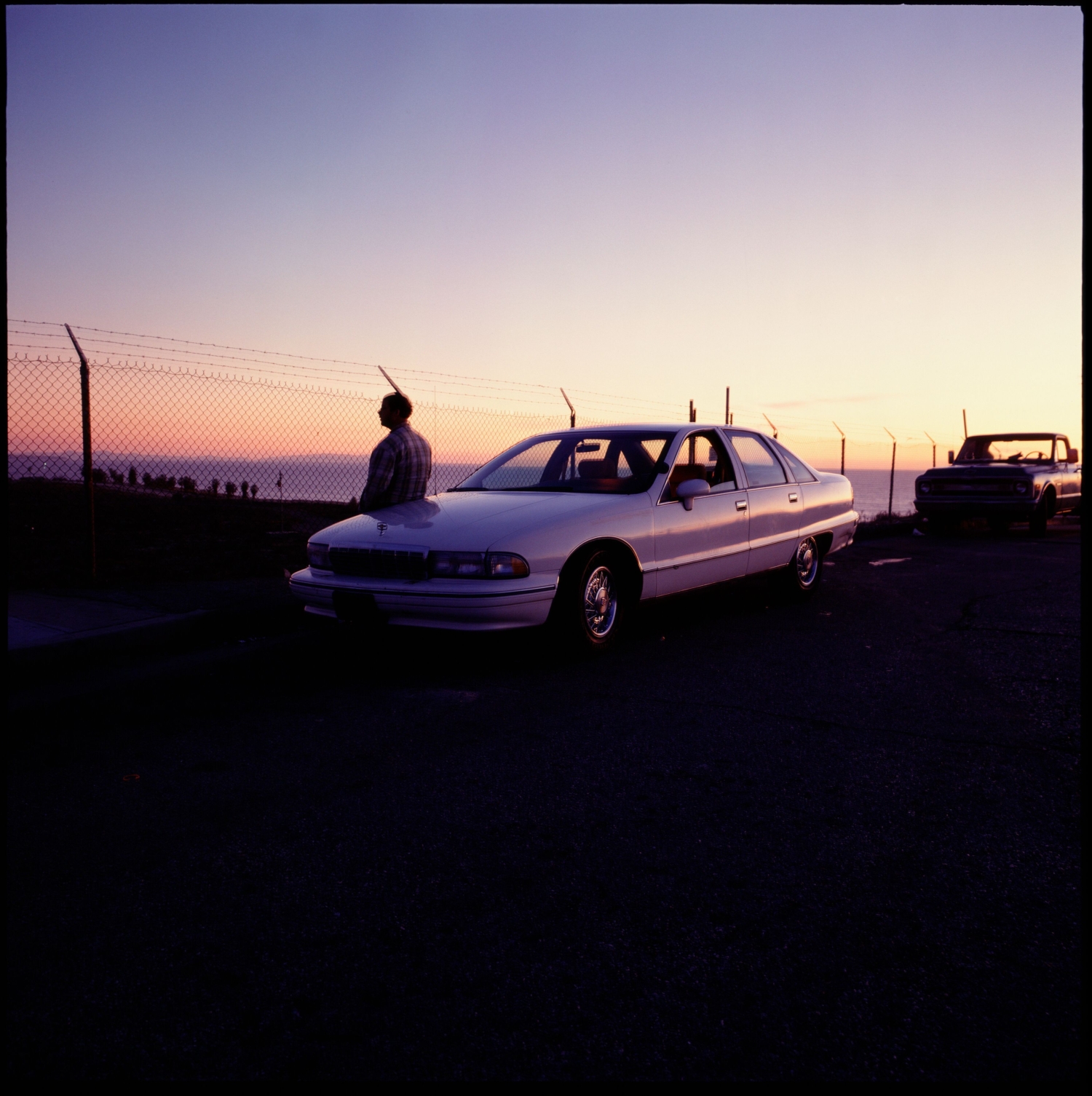
Jason Rhoades with the Caprice overlooking Los Angeles International Airport, 1996.
|
|
|
“…endless additions . . . , endless expansion . . . , endless growth . . . Not a having and a resting, but a growing and a becoming, . . . the character of perfection as culture conceives it; . . . under pain of being stunted and enfeebled in his own development . . . to be continually doing all he can to enlarge and increase the volume of the human stream sweeping thitherward.”
— Matthew Arnold, Culture and Anarchy “Oh ye seekers after perpetual motion, how many vain chimeras have you pursued? Go and take your place with the alchemists.”
— Leonardo da Vinci, 1494 “Take it as a call to action—To contour culture, to draw its spirit out of bounds,” I scribbled in a notebook during a lecture loosely inspired by Matthew Arnold’s Culture and Anarchy (1869). My roving mind was moved to think of Sergei Eisenstein’s On Disney: “This triumph over all fetters, over everything that binds, resounds throughout, from the plastic trick to the hymn . . . This cry of optimism could only be drawn.” At a stroke—of luck, genius, stupidity?—I’d sensed myself tooned, that is, into the apparent excess of action verbs in Arnold’s lines: additions, expansions, accumulations, and amped-up volumes, things moved to multiplicity and mentions of vital movements, streams and sweeps, within which, by way of random thought and twist of logic, an unexpected sympathy had emerged with animation’s motor-metaphors, motive powers, and spirited methods. Chasing the elusive ends of a purely associative logic, falling deeper and deeper into language’s allusive rabbit holes, I found myself burrowed into the etymology of the word “contour”: from the Italian, contornare, “to draw in outline,” as formed of the parts con- (“together”) and tornare (“to turn”). Was there a common contour to chase along these lines? It seemed to me that the odd pair, even in their opposition, each from their own desperate situation—anarchy, capitalism—had turned toward the same tendency: “a displacement, an upheaval, a unique protest against the metaphysical immobility of the once-and-forever given.” The cries and calls for transformative influence, the accumulated allusions and lines, all the spirit-driven movements and motions: Was it motif, or chance? (Eisenstein: “the humour of the incompatibility of one with the other.”) As if intimating my end-game, Eisenstein would remind me that the stroke, “the simple automatism of ‘outlining a contour’,” would not suffice. The contour was “a roving eye, from which the movement of the hand has not yet been separated (into an independent movement.)” Eisenstein point rings clear: To set the mind into action, one must let go of the logical grip. Regress into the motions of physical change. Sink into the human stream. Feel the self swept “thitherward”: drift out of bounds, off-track, out-field, elsewhere. Trust that the invisible hand—of God, maybe: an “animator,” per Thomas Aquinas?—will guide the spirit along its way. This track (mine, here) is prone to shift, I think; the spirit should be obvious and speak for itself.
Read through the Eisensteinian line, Arnold’s Culture and Anarchy appears to conceal cartoonish aims. His very idea, if you may, of culture’s capacity to achieve perfection in progressive motion rests on a vested belief in the essay’s capacity to embody, by way of its elastic method, a kind of animism. The essay, after all, places its stock in the polymorphous line’s ability to convey meaning in, or as, a sequence of spirited actions. Arnold, aspiring to rouse our spirits by such means, takes off on “the simple, unsystematic way”: his essays let thoughts suggest themselves and develop, through an interplay of ideas, meaningful associations, allusive slips, and elastic lines, constantly changing course, as though thoughts were expressed in movements themselves, and thinking consisted in controlling the drift, or, as if language were gesturing to us through elasticities in scale and pace, plastic shifts, and we had only to look to understand its sense—in short, it was as if Arnold had essayed to animate his ideas, revolting, as Eisenstein writes of Disney’s beasts, “against spiritual stagnation and grayness.” Lines full of lyric peaks and comic lapses force thought to rise and fall, coasting through “the accumulation of vivid dialectical images rather than rigorous argument.” The track of thought is made to act, fast; the pace makes it “stimulating and suggestive over a wide range,” as Jane Garnett says. Where the subtext caught, for both Arnold and Eisenstein after him, was of a culture that had lost track of its natural “changeability, fluidity, the suddenness of formation,” Eisenstein had taken to the term “plasmatic” to describe the god-like hand that (Walt Disney, cinema?) commanded the cel into action. Where, for Arnold, the spirit sought was less secularised, the stakes remained the same: “a revolt against partitioning and legislating, against spiritual stagnation and greyness. But the revolt is lyrical. The revolt is a daydream. Fruitless and lacking consequences... These aren’t those daydreams which, accumulating, give birth to action and raise a hand to realize the dream. They are the ‘golden dreams’ you escape to, like other worlds where everything is different, where you’re free from all fetters.” The writer, like many cartoons after him, struggled against an unseen master: the power of the machine. Cartoons, parodies of industrial means, were often drawn into more-or-less silly situations (of power, authority, impulse, control), which permitted the grand satisfaction of seeing “this machine of self-discipline and self-control” smashed—with delight, as Eisenstein stresses. Yet for Arnold, whose methods predated those of Disney, the smashing wasn’t so simple. The written line could only hope to describe by similarly spirited means (tropes, allusions, gestures) how intellectual life had fallen—kerplunk!—into a bathetic lapse. To his way of thinking, the natural love for bad taste had corrupted the true spirit of action, now curbed by the cartoonishly aimless impulse of anarchy: an unruly force absent of gravity, void of motive or course, which had gripped hold of culture’s contours, much like Eisenstein’s roving eye. (It helps to remember that, to the 19th-century mind, anarchy was not yet a consciously creative act; rather, it suggested a culture struck ambling in the staid rites of a language of absolutely ordinary disorder: “clap-trap,” to use Arnold’s word. The anarchic cartoon line, also a critique of technocratic means, would come later.) Arnold tried to separate culture from its fixed contour, to see what might still move. Citing Robert Buchanan, the critic wrote: “We move to multiplicity . . . If there is one quality which seems God’s, and his exclusively, it seems that divine philoprogenitiveness, that passionate love of distribution and expansion into living forms. Every animal added seems a new ecstasy to the Maker; every life added, a new embodiment of his love. He would swarm the earth with beings. There are never enough. Life, life, life,—faces gleaming, hearts beating, must fill every cranny. Not a corner is suffered to remain empty.’” Lewis Caroll: “What hopeless confusion the people who happened to live on the line would always be in.” The mechanism that Arnold calls “god” drove the writer to consider crannies, contours, edges. He searched for life in limits. He searched for amorous ways to fulfill, and fuel the contour, by chasing “this one quality,” which in the very instance of its completion also ruptured, and spilled. Was this spirit expenditure, energy, excess? The spirit of words and sentences “pressing force and reality” to their load-bearing limits? Whatever the figure, its animated momentum led him to locate forms of life living at the edge: “forms of expenditure” (e.g., “laughter, heroism, ecstasy, sacrifice, poetry, eroticism, amongst others”) per Georges Bataille, which could define amongst themselves “a law of communication ordering the play of isolation and the loss of beings.” “God,” then, as a point of convergence, something caught in the interplay. On this line, nothing rests, but is rather revived. Energies are transposed and transferred, exchanged. Matters transport, and evolve. Systems and world-views are overturned—perhaps to show us “this one quality, which seems God’s”: the primal cause to our profusion: “a pre-established harmony, that is, an absolute synchronism of psychic and physical events.”
|
|
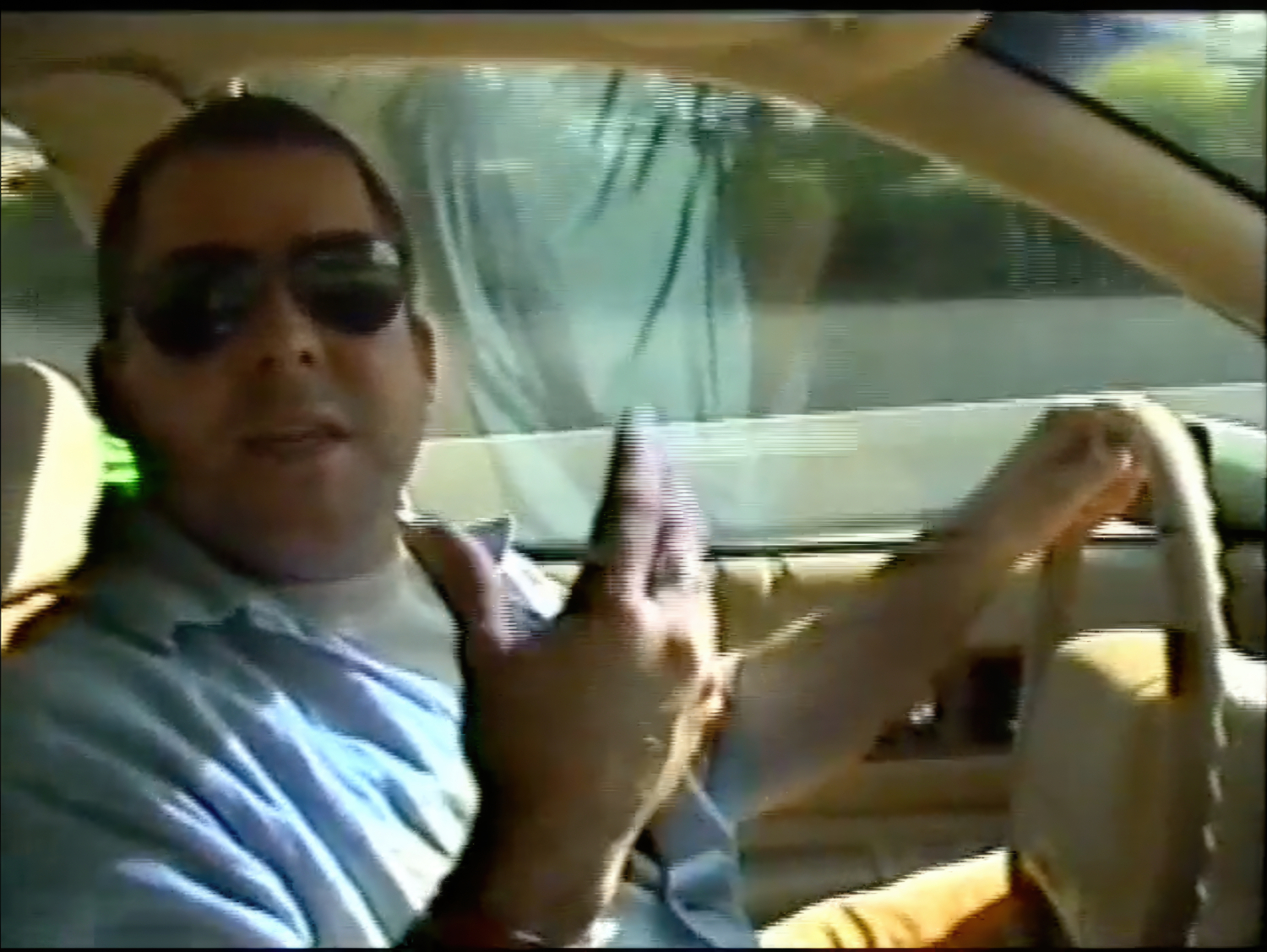
Video still from Jason Rhoades interview with curator Hans Ulrich Obrist while driving the Caprice around Los Angeles, 1998.
|
|
|
In Romantic Dynamics: The Poetics of Physicality, Mark Lussier compels us to “make efforts to perceive interdependence,” as if edging into Bataille’s advice to “scream I AM THE SUN”: in the declaration of seeing the self in, or as, the other, “an integral erection results, because the verb to be is the vehicle of amorous frenzy.” To by chance be captivated by the other, by something outside, or unexpectedly already inside: this is culture’s belabored, difficult, strange way of becoming. Good ideas, like spirited insights, usually befall by accident, by what collides in the interplay. Meaning happens in the moment of contact, in things touching: the language of amateurism, a momentous labour of love. Built are new systems, methods, scaffolds, such as Arnold’s unsystematic way, which forked from the felt necessity to restore what culture had lost—love? Common contour? Alienation dragged out dull lines, a pour of bad taste and distance; with contact lost, language could not move. The lyric essay, on the other hand, promised, as if commanded by some invisible hand, to follow the “force of inward persuasion acting on the soul.” God working somewhere beyond the line, compelling the immobile to find new ways to speak of love, compelling systems of speech and line as imagetic as lingual, pure momentum—vroom vroom!, goes the heart. From this perspective, Arnold’s goal was to be on track, in full control of one’s frenzy, searching for the perfect line. Read via motor-theorist Pierre Niox, this amatory headspace is the racer’s active state: a “distinctive mode of lucid unreason, wherein cold calculation, craft, and intuition commingle in an improvisatory dance”: “... a mode of real-time, on-the-fly deliberation so accelerated that it can only be described as cutaneous, there being no time for the relaying of impulses from brain to body or body to brain (which happens) through physical training, because processing the compact sensorium of a landscape traversed at high speed is physically demanding. Through mental training, because excellence at speed sports presupposes the ability to attain a Zen-like state in which extreme concentration meets extreme relaxation, tightness and hair-trigger reaction time meet looseness, smoothness, and cool. But through practice most of all: the tireless mental and physical rehearsal of circuits; the gradual development both of a feel for the performance characteristics of a given machine and of a high comfort level within the twilight world between mastery and catastrophe that is racing; the cultivation of a counter-instinctual set of instincts (stay on the throttle as the rear comes around, counter-steer on a slide, throttle on/brakes off—brakes on/throttle off, no drifting or rolling).” To what does Arnold aspire but this mastery over drift, the cultivation of thought by operations that relay, and concentrate, and traverse? Always motion, amassment, motors steering the spirit, hearts throttled to prevent the stall, lines at risk of derailment. By “this one quality,” the persistent faith in our omni-mobility, Arnold “transposes, and this is the most precise word,” writes Eisenstein (not of Arnold, but of French fabulist La Fontaine): “for he transports into one world what he has seen in another, into the spiritual world, what he has seen in the physical world.” He takes to his critique of anarchy, only to transport its force into his lines. Perhaps he felt that writing could achieve, by its very form and delivery, the reconciliation of antagonisms cultures thought also sought (e.g., “sweetness and light” versus “fire and strength,” elemental oppositions, which also centered Eisenstein’s On Disney. A quasi-Hegelian thread runs through it all, but let’s let that linger, unseen, in all these vehicles of frenzy.) The anarchic is overturned to the page, where its disordering can be contained, controlled; no longer adrift, not merely rolling on, but rather mastered under the writer’s command. The essay concentrates a mental space. The written line is thus the limitation of form, but as is the case of Disney’s Merry Melodies, this limit also expands an idea of its potentially perpetual motion. Writing’s vital action moves “thitherward”: to the other, things unknown, significant limits, which notably came with a warning. Arnold had cautioned, namely, on multiple occasions in the text, that is, that our sensuous impulses were best kept in check. Tempered—this was Arnold’s choice word. We were to keep our sympathies “tempered by renouncement.” Curiouser and curiouser, I thought, thinking to have heard, here, an intimation of the hookah-smoking Caterpillar from Lewis Carroll’s Alice in Wonderland (1865). Speaking in smoke rings, blowing spirited meanings into the air, the Caterpillar had also advised: Keep your temper. I first thought about abandoning this course, then changed my mind. (Every Caterpillar added is a new ecstasy, after all.) Whence contextualized via the Carrollian, the term “temper” is perhaps best read through its implied double-entendre, both as a property of mind and material function. To temper, that is, means to alter a state, or shape, like magic mushrooms or mathematical equations, which, by expansions and reductions, counters and balances, tend to trip-up and attune the mind to its more cartoonish lines. Surviving along the unsystematic way, or living through the trip, thus entails acting like a geometer. To keep one’s temper, to maintain our cool and our elasticity, it helps to keep ratios constant, at whatever scale. (“For it might end, you know,” as Arnold might have sobbed, “in culture’s going out altogether.”) Put otherwise, I would take from Arnold the following lesson: When an ossified reality gives way to ever-diminishing returns, it helps to pay attention to what appears to be shifting—in scale, form, and/or shape. Elastic lines will (con)figure the keys to progress. Chasing Arnold through Wonderland’s logical dislocations leads me straight back to Eisenstein: “Alice is in a desperate situation: in Carroll’s method, this is presented literally—there are no ways out from the place she has landed in, having fallen through a rabbit hole.”
|
|
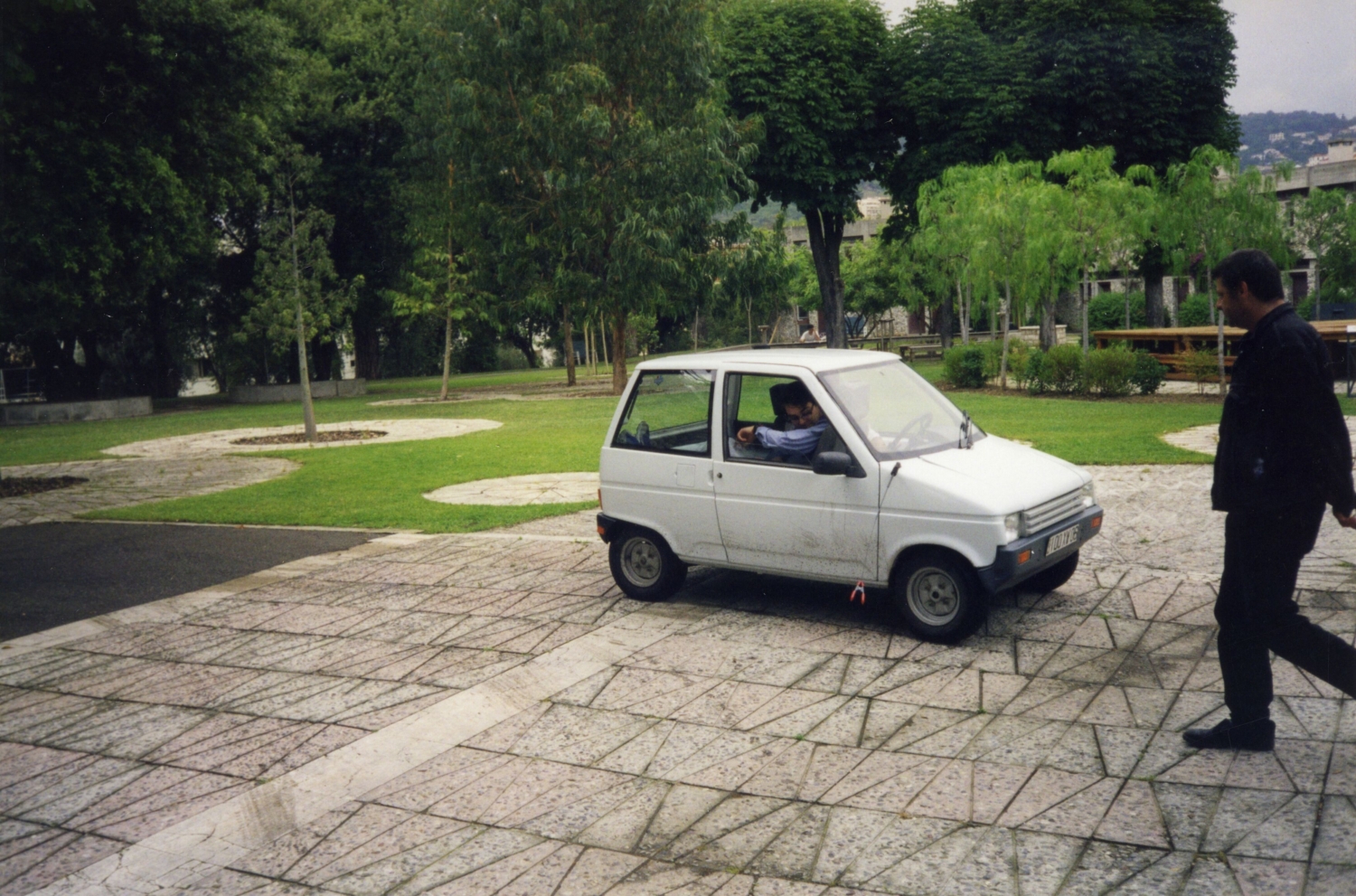
Photograph for Jason Rhoades’ Ligier (Conversation Car) (1997) in Nice.
|
|
|
Cinema takes a trip there too. Eisenstein draws from reality its many-mini rabbit holes and tries to map the system for its desperations. He would end up calling it, “the discursive method”—“a dual process: an impetuous progressive rise along the lines of the highest conceptual steps of consciousness and a simultaneous penetration by means of the structure of the form into the layers of profoundest sensuous thinking. The polar separation of these two lines of aspiration creates that remarkable tension of unity of form and content characteristic of true art-works.” Good art, this meant, made tension the psychological tie between discordant lines. Antagonisms, oppositions, paradoxes: the method was a game, a contest—a dual-tracked movie-ride. His films pre-Imagineered an “attitude towards what is seen and thought,” per Esther Leslie: that “attitude could be conveyed through the distance or closeness of what is seen, its blurriness, sharpest, its stiffness or wobbliness, speed or languor.” The effect that arises is similar to riding a roller-coaster, too many visual stimuli flying past, everything around dissolving into abstraction, yet one thing remains clear: the rhythmic wheel and track, the reel. Audiences would be drawn onto Eisenstein’s movie-ride, the Joyce-influenced, tripped-up film-strips, as if Omnimoved to perceive the world anew. The mechanism tracked the mesmerising complexity of the world crashing in ahead. As Leslie also notes, referring to Eisenstein’s literary bent: “... this meant writing characterized by urgency and precision, three-dimensionality and liveliness. Film sets the standard for a new aesthetic. In practice it meant a development of, on the one hand, montage methods and, on the other, the folding-in of non-literary, reproducible matter into the work of art. Literature imports such devices as scenic cutting or discontinuity, closeup and a play between internal and external perspectives. Filmic montage in literature consists of arranging snippets of external “reality,” just as film always bears some indexical relationship to a world out there, or external reality. “Authentic reality,” the stuff of life, is incorporated into the text.” Cinema, for Eisenstein, was an adventure through life’s atomic insides; his method moved everything under the microscope, as if searching for the unnatural “philoprogenitiveness” of the film-strip. From Joyce, Eisenstein took a language of chaos, collecting words and meanings, questions and answers, puzzles and tricks: “petty events” or “historiettes,” as Eisenstein called them—trivialities, absurdities, abstractions, non-sequiturs, “thousands of tiny details,” which, through film’s complex array of technical means, i.e., the rapid cuts, acausal sequencing, place, and pace, “tamed the otherwise overwhelming flow,” as Niox had said. The films’ roller-coaster sequencing, their race-pace sought to liberate the viewer (at least momentarily) from the bondage of daily life, tired rites and tiring caucus. The reeling landscape of film made us look . . . not only “down the road,” but . . . into its nooks and crannies, lines of sight, limited experiences. Sight-seeing, with an impact on the mind. Like any ride, the risk of accident and collision figured the core thrill. His mapping of the psyche made films from the Kafka-esque illogicality of our dreams; his cut sequences aspired to convey the unconscious as a series of interconnected roller-coasters. These theatrical machines shifted and shocked. Nature cracked open as artifice, life was drawn to the limit-experience. Leslie: “Film allows us to penetrate the secrets contained even in very ordinary reality. It is as if a microscope is held up to reality, allowing the structural forms, the interconnections, the molecular structure to be seen. We penetrate it through its mediation and through the opportunity given us for reflection.” In cinema’s extravagant beam of light, what opened was a momentary glimpse to “the motility of our thought.”
Norman Klein: “From the first, the effect of this machine was overwhelming: ‘The spectator’s imagination filled the atmosphere with electricity, as sparks crackled around the swiftly moving lifelike figures.’ . . . This is another version of the fable of the world turned upside down. It is similar to theories about the allegorical relationships between objects and story.” Motility also meant mutability. In the world turned upside down, involved in logic and changed in scale, special effects stood substitute for the invisibles of experience. Stretched necks and contorted forms, bodies changed to useful shapes, figures driven to frenzied ends, roads and lines run amok, all intimated other expressions: desire, chaos, mayhem, confusion, grief—the overwhelming sensations of our inner life. The polymorphic cartoon line drew inner experience to its extreme edge, straight over the canyon’s end.
|
|
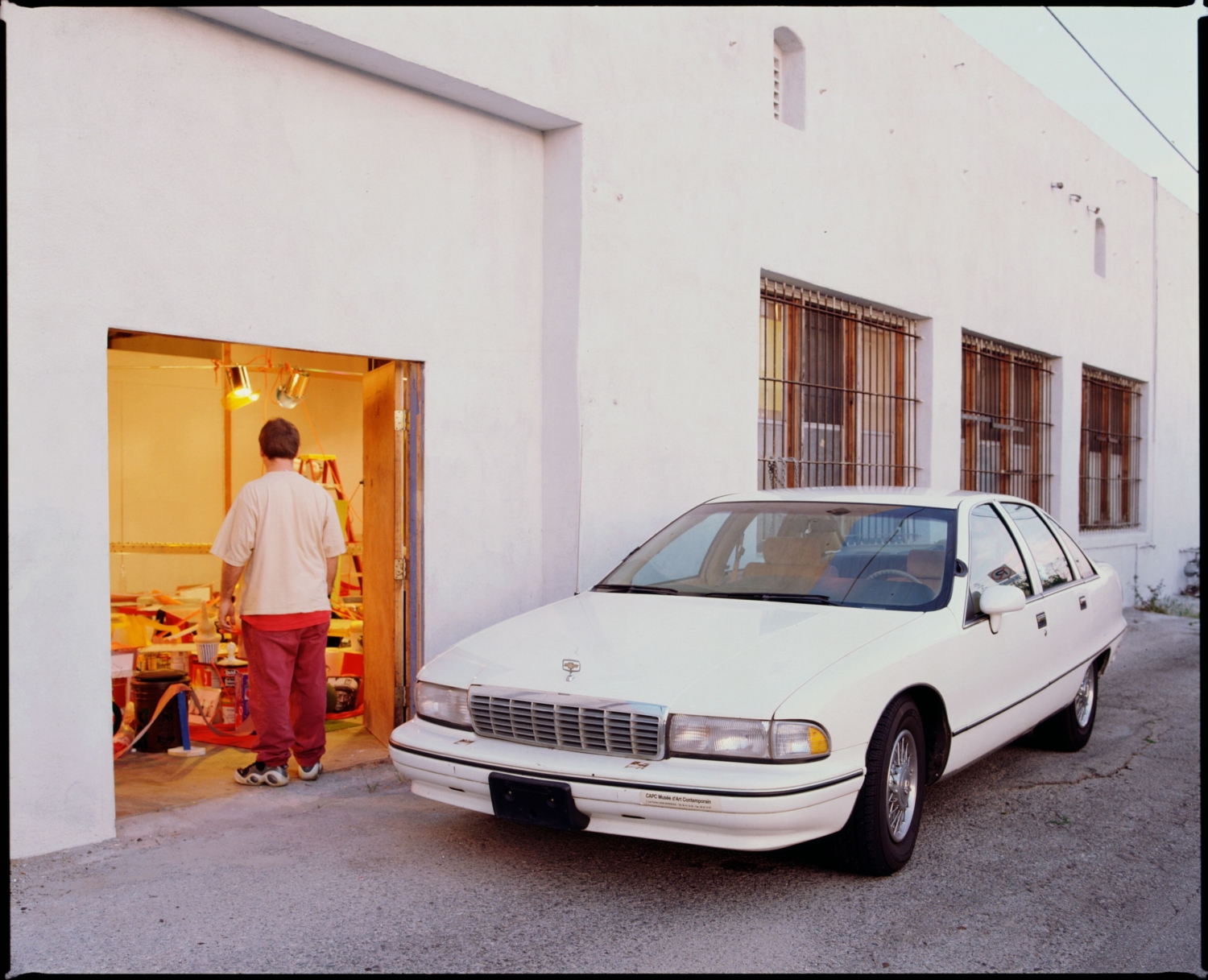
Jason Rhoades with the Caprice outside his studio in Inglewood, California, 1996.
|
|
|
The void befalls the viewer, who falls into its concealed actions; there, the groundlessness of meaning of objective reality were emphasized, expanded, made to echo. Images sequenced together would speak a private language. The gaps revealed enigmatic thoughts. By chasing thoughts into the lapse, Eisenstein felt that meaning could be rethought, locally. [NB: This did not necessarily mean that thoughts were locally real.] The cartoon line imagined a high-flown, high-speed language, a grammar of gestures, motions, and smear-frames. Each scene in the sequence operated to intensify the formers’ impact. The rotation of images moved fast, with intent. It was meant to go over our heads, so as to entice us to return to its blurred motions, vanishing points, concealed meanings, hidden Mickeys. Eisenstein, who was reading Ulysses while developing his method, owed many of its strategies to James Joyce, who’d said of his own difficult-to-read work: “If I gave it all up immediately, I’d lose my immortality. I’ve put in so many enigmas and puzzles that it will keep professors busy for centuries arguing over what I meant, and that’s the only way of ensuring one’s immortality.” The method turns into a wind-up toy, an endless puzzle, mystery-mechanism, full Rube Goldberg-machine. It entices us to ask, again and again: What plays out? What end-game? (Maurice Blanchot intimates a heading: “(perhaps playfully, but what seriousness there is in this play)... alè-théia, uncovering a meaning which could be translated as divine wandering... to forsake what shelters, to turn away, to unshelter oneself, is not only one of the major peripeties if knowledge; more importantly, it is the condition of a “veering round of the whole being,” as Plato also says—a turning which puts us face to face with the demand of the turning point.” Learned delirium, historical vertigo, dizzied lines.) “The mobility of contour is not enough,” Eisenstein cautioned. Not the mere sketches nor the proper lines, then, that alone come to promise the cartoon its enigmatic rhythm, an escape from life’s daily drag, but rather something more unexpected, some coincidence or agreement in time, that suddenly and instantaneously (and maybe dangerously) turns the psyche over to see in the debris a possibility of virtuous form. What motive drives the psyche to this (practical) effect? The unification of spirit, per Arnold? Or, the desire to fuck with the systems fucking with us, as implied in Eisenstein’s method? To focus the mind on this “mystery that traverses us,” perhaps the question is more accurately posed on the vehicle: i.e., not the where, but what traverses, transposes, moves. Eisenstein would eventually pause to ask of his elastic subjects a similar question. If the moving contour is not enough, then what is? “What, if not fire, is capable of most fully conveying the dream of a flowing diversity of forms?!”
|
|
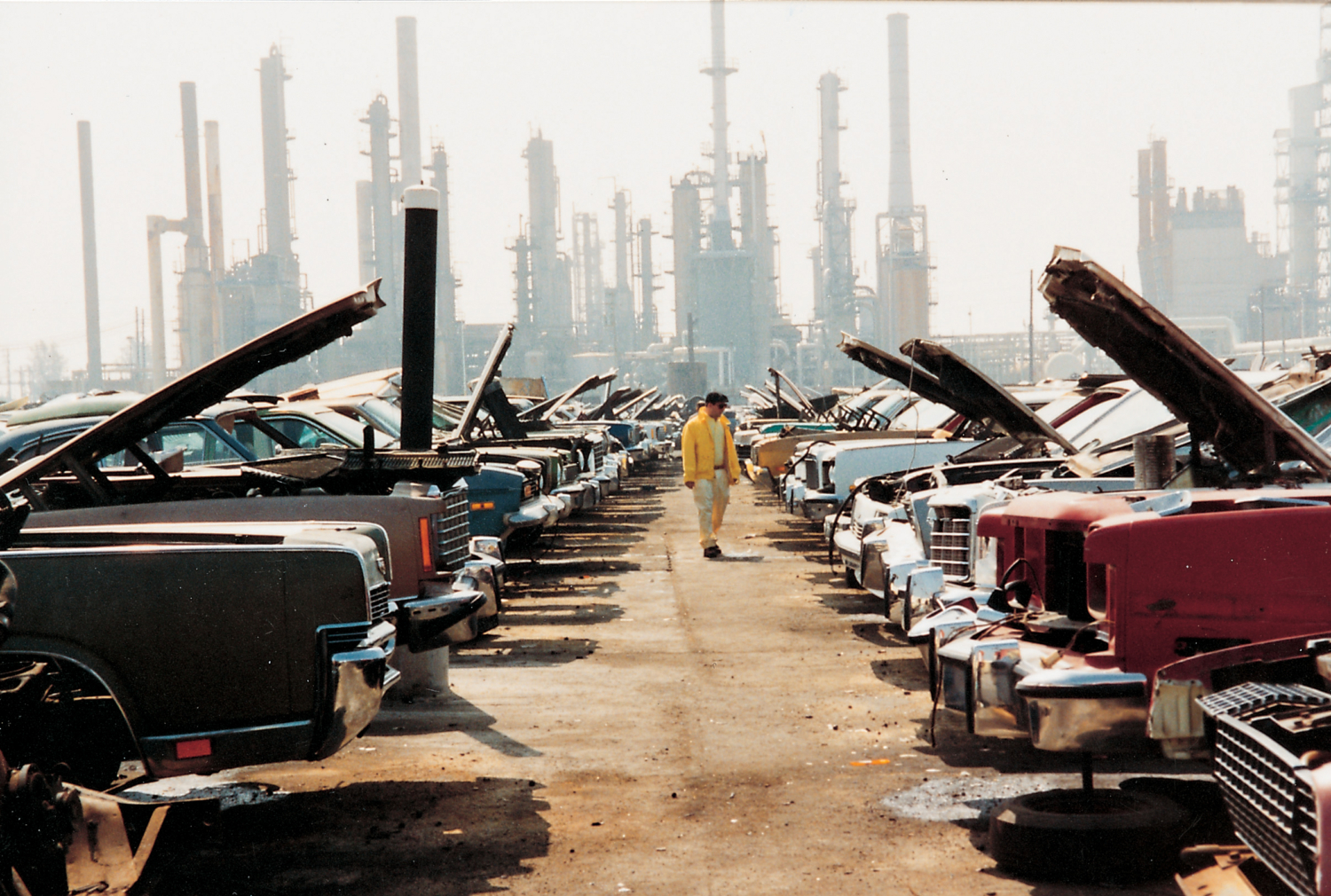
Photograph for Jason Rhoades’s Caprice Auto Project (1996).
|
|
|
David Trotter recalls an interesting detail: “Eisenstein had a great time in the Corps of Engineers building pontoon bridges—he never forgot the perpetuum mobile of the construction process.” I recall my first cause: the cry to motion, the call to cartoon—the Meep-Meep that motioned my mind to this circuitous chase: now revealed (to me) as the promise of perpetual motion. The principle operation of any cartoon is to violate, subvert, or defy fixed laws; the animated line enacts an anarchic riot against the immobility of the cel’s steady-state. To cartoon something, then, is to imagine how (that is, by what means, methods, machines) the fixed might be unfixed; it means to figure, or to characterize, the processes capable of such conveyance: e.g., arrangement, amassment, construction. Thus to dream of achieving perpetual motion is also to aspire to see life transposed, things overturned, worlds changed. And, to do so by falling into the dream’s illogical sequence. In arrangements made confusing, frenzied, or wobbling enough (like Joyce’s mind-fucking language games) to appear continuously unsteadied, we are made to feel forever afloat, askew, moving. This dream of floating freely keeps the machine going; it works on the desire to not arrive, never. The psyche is drawn to the unanswerable, the impossible limit, which motions the enigmatic of dead-ends, detours, digressions. By which I also mean, for the perpetual motion machine to work, it also has to fail. Where the mind aspires to figure things out, even in absence of a cause, the eye also follows. The eye (also an “I”) strives to see, to shape, and to see again. It returns to look at everything it missed, passed by, or lost sight of, everything lapsed. Consider, for example, Bishop John Wilkins’s Perpetual Motion Machine, a 16th-century device explicitly devised to illustrate, as Donald Simanek writes, “the futility of the quest for perpetual motion.” (It helps to remember, here, that Arnold had kept his temper “by renouncement”; his essays gained momentum in their resignation, by surrendering, perhaps, to the futility of their intended ends. Ditto Eisenstein, who never actually finished his intended book, On Method, for which his notes On Disney—also abandoned—had been penned.) For this perpetuity to play out, it first needs to build-up, it needs a form to force into motion. A place, a structure. Essay, film, site. Some figure to chase, some path to forever wander along. Something has to be constructed, in order to also be eternally returned to, like Wile E. Coyote for the Road Runner, the landscapes of Monet, the whole Chaosmos of language for Joyce. In the work that manages to escape closure, that forms, but never truly finishes: therein hides the secret of perpetual motion. It means to love the work more than its end. In an essay titled, The Engineer’s Art (maybe the Merry Melody, alchemic motion, Autopian ideal?) Tom Conley contextualises the emotional métier: “For the historian of cartography, bricoleur might designate an ‘amateur’—like Balzac’s flaneurs (without a Flaubertian circumflex over the ‘a’), who flip through sheet-maps and atlases to observe and examine worlds within and beyond their ken. The amateur would let a spatial imagination take command when they configure virtual itineraries to places unknown. Their imagination would lead them, as Baudelaire later penned in English in a dystopic vein in his Poèmes en prose, to places ‘anywhere out of this world.’” Flying, fleeing, escaping: the cartoon is a wonderful example of the amorous, frenzied attempt to place meaning elsewhere, into gestural languages that lead us to other worlds, more allegorical, upside-down. As Trotter’s anecdote suggested, the lyrical, elastic construct depends on its location to amass a life; the site cannot be separated from the work—think: cartoon cel, the film-strip, the page. And also, to extend and exaggerate the play-ground, the cartoon world, the theatrical proscenium, the world as stage, the whole crazy Chaosmos, carved from nothing but tense space. Each of these imaginative places situates a spatial imagination capable of persistent, continued motion by virtue of this one promise (“which is God’s!”): that is, the promise to be transported, traveled elsewhere, the mind transposed to sites unknown and barely-dreamed of. Norman Klein expands: cartoons come to “resemble the theatrical machines used in the seventeenth century, particularly the machina versatilis.” This versatile machine also compelled motion: emotional effects, scenic turns. “The turning machine,” says Martin Butler, “was a double-sided set that revolved on a central axis and could be reversed to disclose a dramatic new perspective.” The device staged sudden and instantaneous shifts between scenes, to the audience’s shock and delight, and did so, more shockingly perhaps, in plain view. It stood front and center, not hidden, rather poised as essential to the set-up. The world on stage, as in the cel, was rendered utterly deterministic, as Klein writes: “the more properly out of place all the cartoon elements are, the more often the medium intervenes deterministically.” Tied down by the shock of the eternal turning, the mind is moved to think into the conflict, the opposition that plays out: “to the viewer watching,” as Klein writes, “this conflict seems more like wrestling a roller-coaster—a folklore about machines that strap us down to entertain us.”
|
|
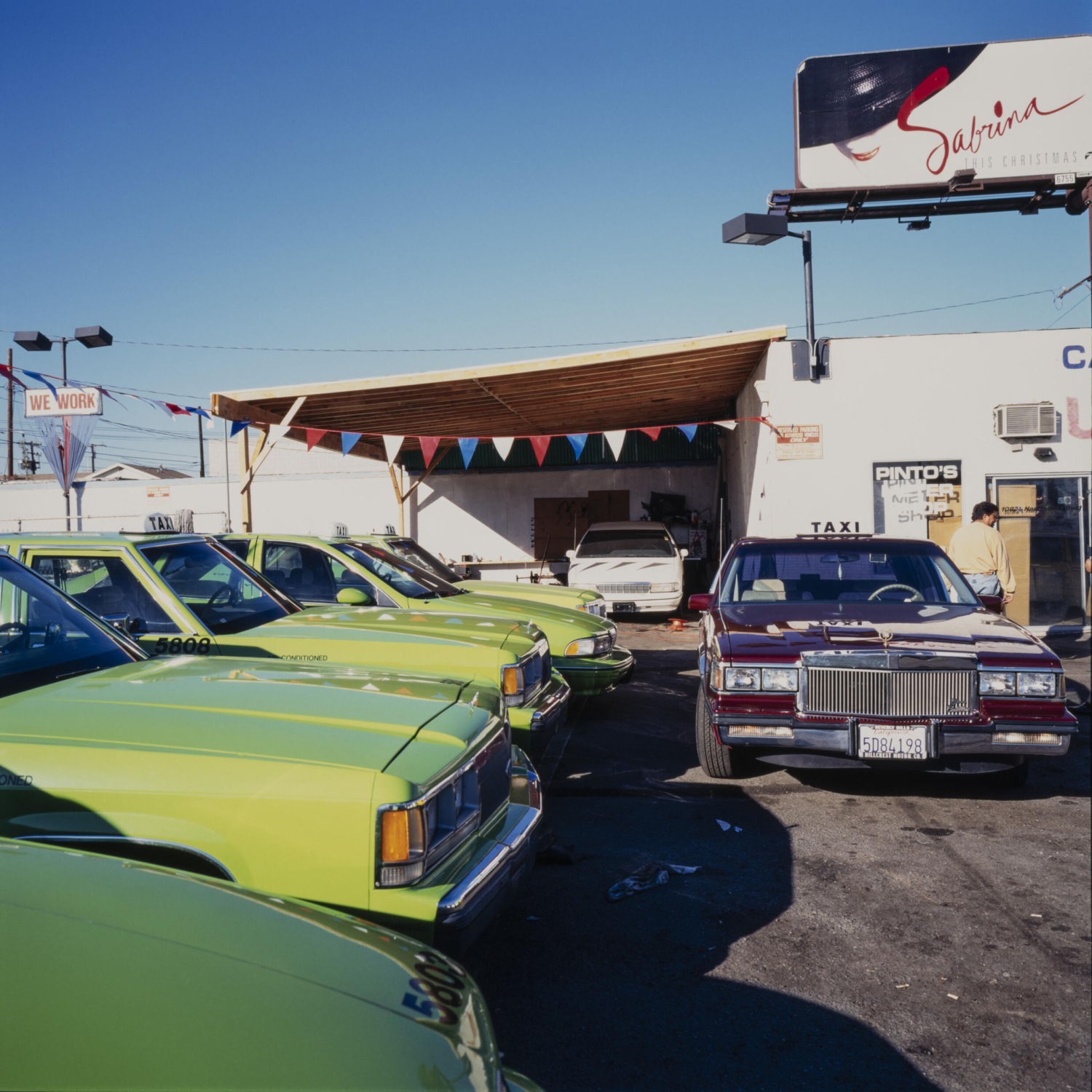
Photograph for Jason Rhoades’s Swedish Erotica and Fiero Parts (1994).
|
|
|
An equally logic-twisting machine can be found in the artworks of Jason Rhoades, whose installations, sculptural works, and performative propositions motioned narrative in agglutinative processes that also imagined a kind of perpetual motion. The perpetuum mobile was, for Rhoades, almost comically literalized: cars, engines, motors, drills. These were forms of mobility that promised a weird kind of spiritual release from art’s destined fixity. He was interested in power, control, acceleration, and mobility. This entailed, on one hand, that Rhoades was on the Modernist side of the cartoon debate: that is, more Fleischer than Disney—“cartoons were more like art constructions, where materials replaced story, . . . modeling experience in terms of the industrial machine.” Seen from this vantage, Rhoades’s artworks also sported the cartoonish aspiration to exaggerate the automagic of the motion-machine both as an exaltation of its motive powers and as a subversion of its proper use, structure, and graphic narrative. Rhoades’s installations were hand-made in a kind of montage/bricolage of mobile forms, which motioned a tension between medium and surface. “Relationships and simple drives are reduced to a visual phrase, an engine rather than plot”: Rhoades’s ever-moving machina versatilis drives relationships into circles of confusion. The machine looped the more cartoonish stretches of the mind, the annals of our inner Wonderlands. Imaginative transports were animated by more-or-less cheap means: always bricolage, a graphic language, their end-game lost in associative illogic. Everything was found and formed in motion: “When the graphic narrative, the antilogy of the gag, and the anarchic characters are all mutually and gorgeously out of step together,” as Klein wrote: “the effect is hypnotic.” The car is a unifying principle, a shelter that means to forsake what shelters thought. The car was a means to an end: futility, freedom. In the summer of 1998, Rhoades met up with curator Daniel Birnbaum to chat about his then-most recent car work, IMPALA (International Museum Project About Departing and Approaching) (1998). During their conversation, summed-up in the September issue of Artforum that year, the artist had said: “I’m not really a car person. They’re interesting tools. They’re sometimes great facilities, great pieces of architecture, but I’m not a fanatic about it. Actually, I kind of like it when they break down. A lot of my work is about this fucked-up perpetual-motion machine that seems to run on its own.” It is as Johan Huizinga said, citing from the sketchbook of the thirteenth century French architect, Villard de Honnecourt: “Many a day have masters disputed how to make a wheel turn by itself.” The clouds part, the heavenly choir sings… a white-bearded man, closely resembling cartoon tropes of God, walks past me in a t-shirt that says: “I Am Not A Toy,” . . . and so this essay’s unseen “motor,” as my dictionary had also intimated, turns into a prime mover: “a person who imparts motion” (from the Latin, literally, mover.) This prime mover, some Motor Fucker up there—inspired by Jack Skelley—shows me to a more spirited track, an unsystematic speedway, this discursive motorcade set ahead. I decide that my sympathies should not be, as Arnold had suggested: “a little repressed, a little kept under.” Instead, I would persist in this pursuit for transformed and even distorted forms of mobility, searching philosophical toys, pop cultural artifacts, and concentrated spaces, for meanings linked by likeness of motor and motive, caught in collisions and accidents, impulses and drives, operating under the assumption that these would each convey the same essential sympathy for “the phenomenon of movement . . . no longer necessarily monotonous, [but] unquestionably rhythmically essential.” Driving around Los Angeles with curator Hans-Ulrich Obrist, Rhoades would stress again: “I think all good thoughts and all good works of art, you know, run on their own, as a perpetual motion machine . . . as a mentally and, sometimes, physically . . . you know, that they’re very alive.”
|
|
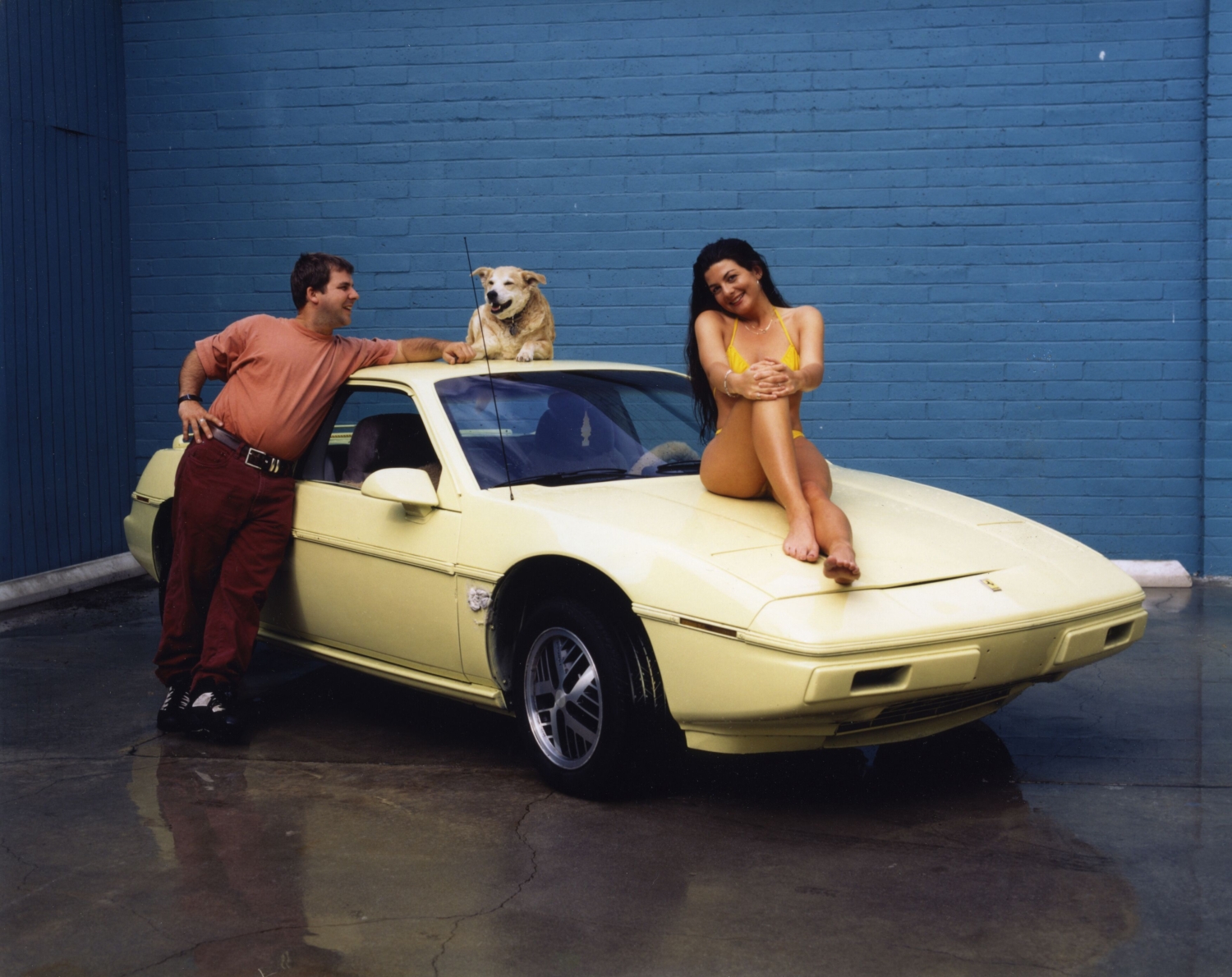
Photograph for Jason Rhoades’s Swedish Erotica and Fiero Parts (1994).
|
|
|
To borrow Klein’s delighted lines on the floating, mobile islands in Jonathan Swift’s Gulliver’s Travels: “I find this a wonderful metaphor for the cartoon: a mechanically flying island. It has a life of its own, but that life is controlled by gears. And the kingdom of these gears must be announced, like the flatness of the screen.” Something similar in Rhoades’s frequent mention of this self-running and kind of fucked motion-machine: the car. It may seem fortuitous to have just now arrived here, given the discursive route taken. And yet, my course had always been set to revolve Rhoades’s artworks, via these machinic motives, engines, and drives, namely as analogous approaches to the artist’s psy-fi attempts to achieve perpetual motion. To do so, the artist had taken to more or less literal means: motor-metaphors, as evidenced in Jason Rhoades: DRIVE, an exhibition of many moving parts at Hauser & Wirth. The show coalesced, over the course of an entire year, Rhoades’s various car projects: his motor-pursuits, machine-myths, and auto-ephemera, organized by curator Ingrid Schaffner, notable Rhoades scholar, in four thematic stages—starting from, The Parking Space, which brought Rhoades’s collected cars (Caprice Auto Project (1996); Ferrari (1998); Ligier (Conversation Car) (1997); and IMPALA (International Museum Project About Leaving and Approaching) (1998)) out from their entombment in the Mojave desert; The Pit, which aimed to re-activate something of the cars’ performative essence; The Racetrack, which focused on Rhoades’s “racing-forms,” including the “remains” of his collaboration with Peter Bonde, The Snowball (1991); and, finally, ending with, or at, The Garage (the only stage I managed to catch in person), which enclosed a full-scale reinstall of Rhoades’s “in-progress construction site,” CHERRY Makita - Honest Engine Work (1993) within framed displays of the artist’s notes, sketches, and letters. The Garage, the exhibition’s last stage, was, notably, the only one I’d manage to catch in person. And yet, something within CHERRY Makita’s complex system of drills and engines and F1 motifs had led me to ask: What exactly made this machine move on its own, anyway? And, what made it so fucked up? To search his systems for breakdowns, brakes, stalls, crashes, and accidents, I would start by expanding the essential operating metaphor, the “perpetual motion machine”: as poetic device, motor, prime mover, sculpture. The word “remains,” pried from the press release, would come to hang heavy on my mind. This perpetual motion, for Rhoades, worked out creation myths, auto-pursuits, Chevy Impalas. It provided a plastic metaphor, a means of transfer, an optical method. Cars, motors, tracks, and engines facilitated the creative approach; they provided the means to arrive at, and depart from some point, to approach and stretch meanings, and to blur, fog, and motion other ones, more secret: the hidden motifs, and concealed motives of mundane forms. As the artist had mentioned, his interest wasn’t in “car culture” per se, but rather what the cars (and, whatever else vroomed in his Autopias: tracks, race-forms, relays) were capable of conveying, i.e., communicating, impressing, transporting. “It’s all about searching,” the artist had said. And elsewhere: “Art, to me, “is just a pursuit of something.” As Carl Jung said: “[If] the connection between cause and effect turns out to be only statistically valid and only relatively true, then the causal principle is only of relative use for explaining natural processes and therefore presupposes the existence of one or more other factors which would be necessary for an explanation. This is as much as to say that the connection of events may in certain circumstances be other than causal, and requires another principle of explanation. We shall naturally look round in vain in the macrophysical world for acausal events, for the simple reason that we cannot imagine events that are connected non-causally and are capable of a non-causal explanation. But that does not mean that such events do not exist.” (Italics mine.) Eisenstein puts it otherwise: “It’s natural to expect that such a strong tendency of the transformation of stable forms into forms of mobility could not be confined solely to means of form: this tendency exceeds the boundaries of form and extends to subject and theme. An unstable character becomes a film hero; […] Here, changeability of form is no longer a paradoxical expressiveness, as in the case of stretching necks, tails and legs: here, God himself commanded the character to be fluid.” Rhoades’s aim: “To play God like in the universe,” “the big mess.” Not so unlike Arnold and Eisenstein before him, the artist had developed his own unsystematic means, through which to play prime mover. The point was to amass an animated mess, like the clump spirits of Katamari Damacy, built of ever-amassing poetic corollaries: tropic twists, lyric turns, semantic spins, and mythic metamorphoses. From this mess snowballed a whole theory of creative ‘evolution’—a kind of mythopoetic process of characterizations, associative games, and playful parallels. His perpetual motion-machine, that is, sets off an evolutionary process. Where Eisenstein was courting the cartoon’s capacity to contort historical linearity, Rhoades’s logic for art-making involved “skipping along the rungs evolutionary ladder”; his artworks aspired to a recombinatory logic that served to dizzy art’s cause and effect. In the encyclopedic volume, A Rhoades Referenz—an invaluable guide to the evolution of his idiosyncratic language—the artist had defined the concept “EVOLUTION” as: “EVOLUTION”: “Concept. Bears on a number of areas, including biology, art, and technology. It is propelled by MOTION, such as that of a small vehicle (MOTOR-BIKE). In art, Modernism is a progressive state of evolution. In technology, evolution consists in the passage from the GUN, as a mark of primitive social interaction, to the DICTIONARY (VOLUME A RHOADES REFERENZ) as the instrument of the enlightened human being, and onward to the COMPUTER and the progressive development and transmission of information through new media. A recurrent principle in the work of Jason Rhoades is the slight delay with which technological achievements are absorbed (HOME-MADE). In DEVIATIONS IN SPACE. VARIOUSVIRGINS the videophone used by V'KETAH to transmit horoscope data from Los Angeles to New York was already an obsolete device at the time. Again, the facility in THE CREATION MYTH for everyday images to be fed in by e-mail had already become history, technologically speaking, by the time it was installed. The use of outdated technologies and of metaphors of very basic patterns of reproductive behavior (BERT; PORNOGRAPHY) is an allusion to a Romantic approach (ROMANCE).”
|
|
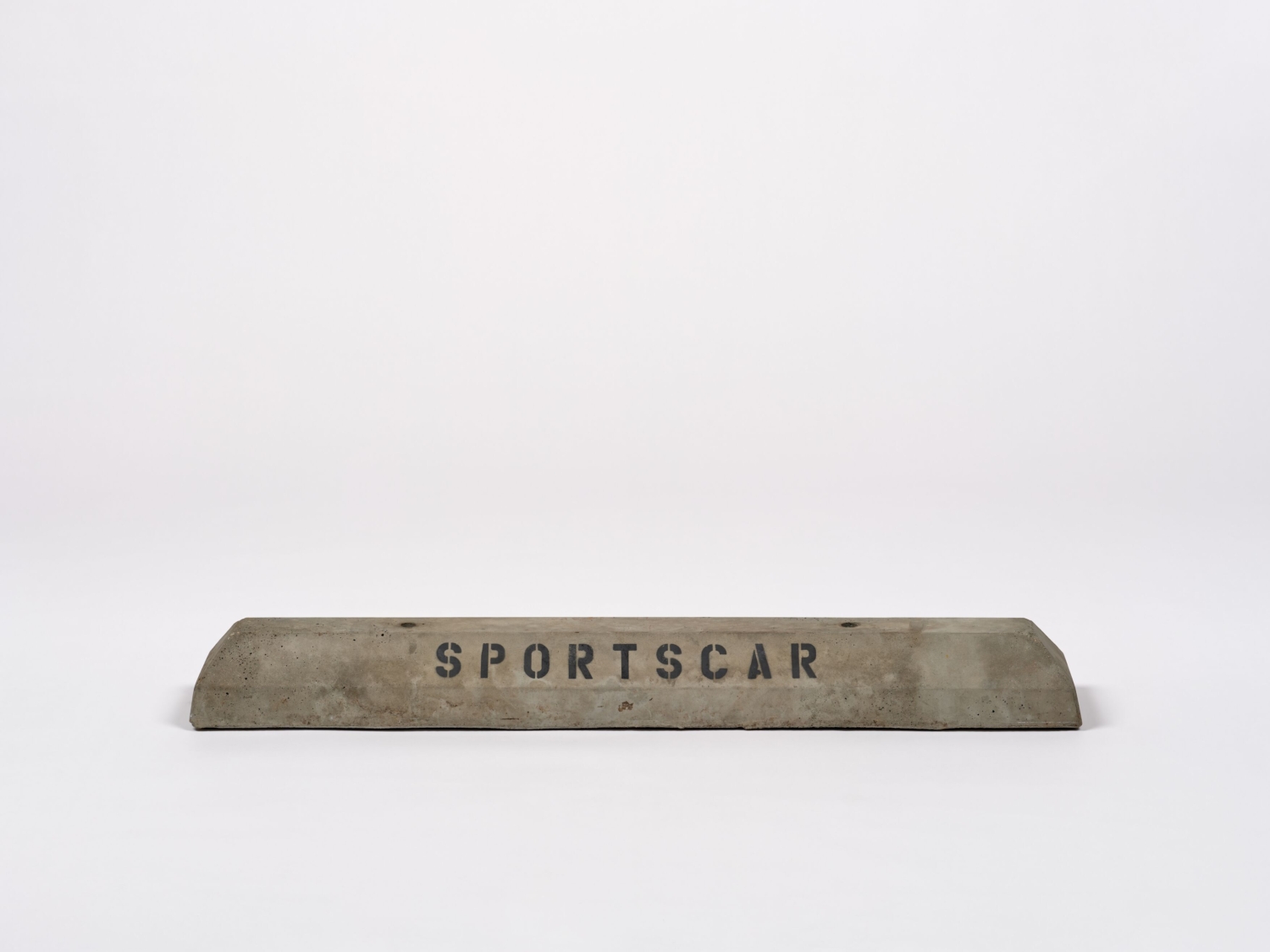
Jason Rhoades, SPORTSCAR Concrete Car Stop (1993). Photo: Keith Lubow.
|
|
|
“‘Language is plastic,’ the critic and curator Ingrid Schaffner writes; ‘Not a careful writer, Rhoades used misspelling, bungled semantics, alliteration, spoonerisms, and puns to bend words into powerful tools for driving meaning off course and into all sorts of precarious and ridiculous places.’” For Rhoades, evolution meant creation, calculated moves, the romance of automobility. The artist’s work comprised an imagined language of mutually attractive terms: words and objects tied by the psyche into a private idiolect. Moving through these interconnected passages, the relay of delayed meanings, were small vehicles, transmissions, and metaphors, which, to my way of thinking, could not be known; rather, the works asked to be interacted with (by means other to the intellect): sensed, motioned, romanced—perhaps via Jung’s “other principles of explanation.” What Schaffner describes as plasticity, Eisenstein had called plasmaticness: a quality best left to the alchemists, the art of transmutation. This suddenness of formation also describes a cartoonish “Omnipotence”: “You tell a mountain move,” Eisenstein said of Disney’s high peaks, “and it moves.” Cars were Omnimovers; they promised to transport everything, anything into perspective. To be moved to see all sights, all thoughts, all possibilities, one had only to suspend disbelief: let go, cast off, drive on. It was as Arnold has said: language was “not a having and a resting, but a growing and a becoming.” Here, too, culture coincides with something spiritual, “because men are all members of one great whole, and the sympathy which is in human nature will not allow one member to be indifferent to the rest, or to have a perfect welfare independent of the rest, the expansion of our humanity, to suit the idea of perfection which culture forms, must be a general expansion.” The expansion is alchemic, excessive, active. Jung had also noticed this, citing Albertus Magnus: “I discovered an instructive account [of magic] in Avicenna’s Liber sextus naturalium, which says that a certain power to alter things indwells in the human soul and subordinates the other things to her, particular when she is swept into a great excess of love or hate or the like. When therefore the soul of man falls into a great excess of any passion it can be proved by experiment that it [the excess] binds things [magically] and alters them in the way it wants, and for a long time I did not believe it, but after I had read the nigromantic books and others of the kind on signs and magic, I found that the emotionality of the human soul is the chief cause of all these things, . . . Whoever would learn the secret of doing and undoing these things must know that everyone can influence everything magically if he falls into great excess . . . and he must do it in that hour when the excess befalls him and operate with the things which the soul prescribes.” How to capture the moment, always passing? How does one hold onto the magic that expands and influences everything? Consider the romantic/auto-magic of Rhoades’s Young Wight Grand Prix (1993): in this early work, the artist had raced his kit-car on a make-shift track, alongside the Indy 500, and won. The piece short-circuits the NASCAR system, by means of Magnus’s magic: he masters the secret art of doing. And yet, under the artist’s influence, as DIY, bricolage, as an amateurish construct, the true magic happens in what’s undone, re-done: e.g., in the provisionality of the track, the fleeting instance of the race, the moment of Rhoades’s victory, volatile and fugitive. When forms are redrawn along transformative lines, everything is possible. And, pluralistic, polyphonic—no longer dependent on external influences, nor merely the intellect’s instant gratifications, but instead the imaginative/projective valence: being on track, chasing, searching: finishing the line (of thought). To swipe ideas from across Speed Limits, a catalogue produced by the Canadian Center for Architecture in concomitance with the Montreal Grand Prix Formula One race in 2009, the artist courted the car’s Modernist magic as a capacity to convey, at variable speeds and time intervals, power, control, excess: “time-space compression,” “accelerations in the pace of everyday life,” “approaches to construction and economic production;” “modes of organizing, communicating, and sharing information,” “attitudes regarding duration versus obsolescence, fixity versus portability, safety versus risk.” Rhoades’s racing forms tracked culture along similar lines: lyric shifts, fast changes, slow turns, sudden collision, controlled swerves. (I recall Tom Clark: “Poetry, Wordsworth / wrote, will have no / easy time of it when / the discriminating // powers of the mind / are so blunted that / all voluntary / exertion dies, and . . . ”) The exertion expended in motion was crucial. Curator Ingrid Schaffner said, in an video interview featured in the exhibition: “that’s one of the really compelling aspects of the work, this tension between the modern and the post-modern, going backwards and then moving forward, which is in the work, and made explicit through the car projects.” This propensity for more-or-less literal motion gave the car works’ their delicious surfeit, signaled in magical placement. Interviewed by Michele Robecchi, Rhoades laid his method bare: “With my work, it needs to be bigger than me to control me. ‘It just needs to be more fucked up than me.’ It’s a strange thing. When I tell someone how to do something, I often say, ‘just make it a little more fucked up.’ Then I say they’re thinking too much. Just do it like if you need to get it done. That’s how some weird spiritual thing happens—it’s like a fate or a faith. Within this piece here, it’s a strange way of working. That’s what the piece is about. Grabbing something, dragging it across, dragging it somewhere else. This mobility of things.” Rhoades knew, as Germaine Dulac also wrote, that “movement, through its rhythms, straight lines, and curves, brings us visually into the presence of complex life.” What the cars animated were prescriptions for archetypal, folkloric, mythological, and pre-figurative forms of thought. Capable of more-or-less literally “departing” from proper reason, the cars were cast off as forms of life beholden to the primacy of metaphor and sensory experience. By combining the effects of lyric devices, alchemical contraptions, wind-up toys, and language games, Rhoades’s sport was to race circles around formal reason, swerving the mind away from sense, prescriptive reason, and fixed images. (Bataille: “Entering into unexpected regions, I saw what eyes have never seen. Nothing more intoxicating: laughter and reason, horror and light became penetrable . . . In this labyrinth, I could lose myself at will, give myself over to ravishment, but I could discern the paths at will, pick a precise passage with intellectual steps.”)
|
|
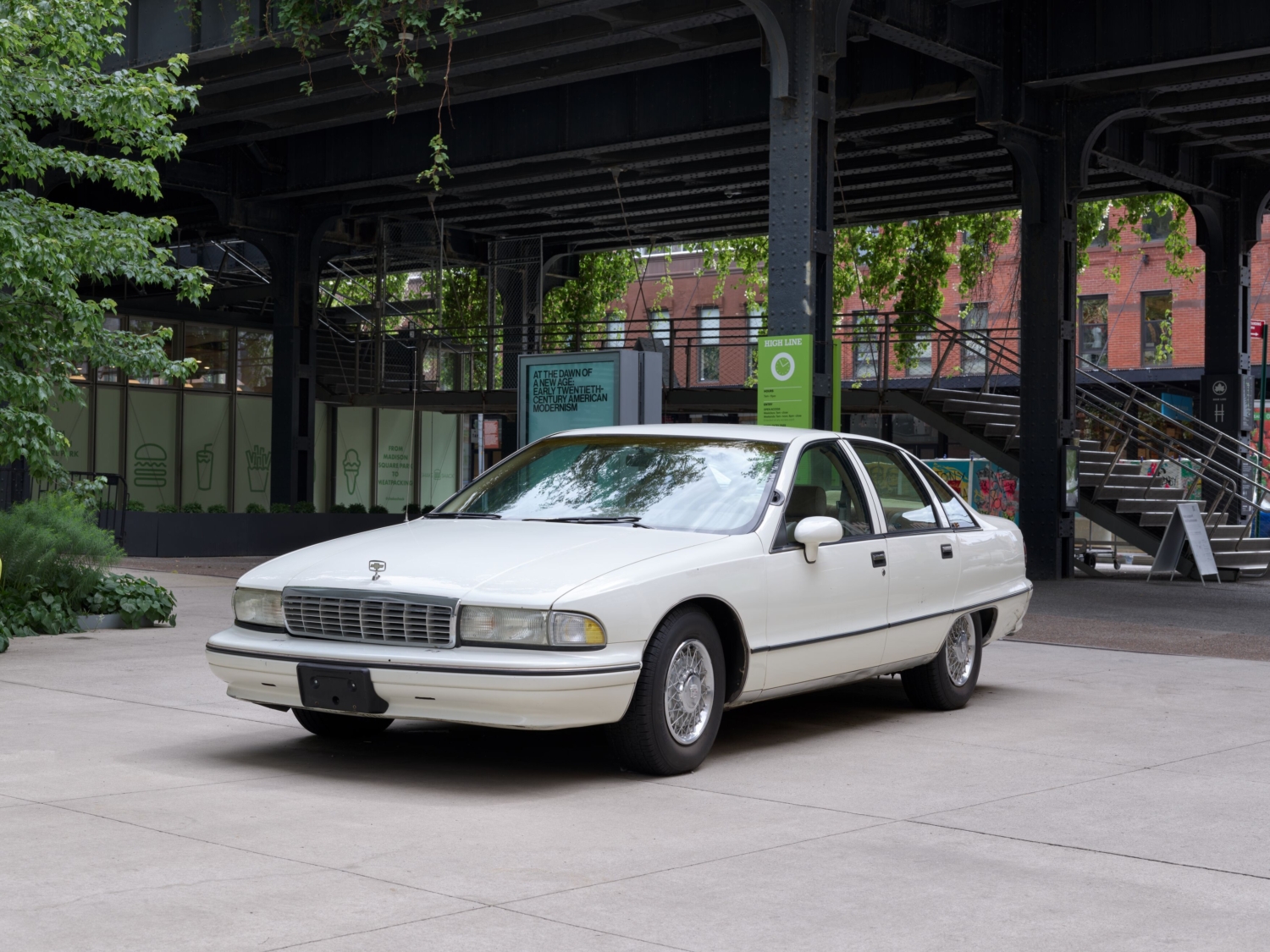
Installation view: Jason Rhoades, Caprice Auto Project (1996), “Whitney Biennial 2022: Quiet as It’s Kept.” Whitney Museum of American Art, New York, 6 April – 16 October 2022. Photo: Ron Amstutz.
|
|
|
No clap-trap, then, nor thought, but in relatively ordinary things courted into contact, collision, and correspondence, as if by some unseen mover, or motive. Correspondences are mapped by way of agglutinative methods, like montage, collage, accumulation, amassment, assemblage, shopping, construction, stretching, elongating, erecting, and collapsing. From these grew the Rhoadesian cosmos, a chaotic site always in construction, always changing, always in flux, forcing forth a relay of conceptual, physical, audible, and chaotic installations, performances, and sculptures, propositions, editions, and sketches. As animated, archetypal, myth-bound propositions, then, beholden to the primacy of metaphor and sensory experience, Rhoades’s works called for modes of reception, participation, and dialogue, other to art’s/our prescriptive reasons, the historically fixed. The cars, for Rhoades (and us) were also the automagic means into the collective psyche. As forms resembling word associations, linguistic games, and grammatical mishaps, the cars’ allusive promise was a potentially infinite end-run around the cul-de-sac of causal logic. Félix Guattari: “If [the Big Bang] exists, then it must be happening everywhere and at every instant.” Theoretically, the cars could be driven anywhere, and turned into anything. Rhoades could drive visitors elsewhere, onto other tracks, or propel them into tropic drift. He could hand them the keys, either to give visitors an experience of control, or to claim it from an institution. The key turned on the potential of the car to become something other: a studio, home, transport, or museum. The cars could be changed, exchanged, and embellished. Makes, motifs, and myths were modded. Values were amped-up, volumes compressed, points vanished, essences concealed, and released as omissions. Linearity could be rethought, in the car: driven into loops, laps, eternal returns. The car circumvented logic, for the sake of capturing chance. As Jack Bankowski had also said of Rhoades’s Black Pussy and the Pagan Idol Worship (2005) installation: “No detail was left to chance—all in the interest of fostering chance, or tricking serendipity into taking the lead . . . and serendipity did indeed take the lead.” Each work followed the last, always intensifying the former’s impact. Rhoades’s game of relay stretched out in space as proof of concept of this kinetic force: the “fucked-up” motion of thought, which goes on its own. To build his process in the image of a contraption, a game, a form of interplay, he searched his own lines for meaning lost in the drift. I thought of Jack Skelley’s Motor Fucker: “Now you drive into the dump. The dump is the ground of absolutist fictions that dissolve into apologies for ways you fuck each other: The devastation which is th rear-end of desire, that warm fog over the ocean at the start of another summer, the debris of ideas—you drive deep into them.” Sensing a heading in the debris, I thought to consult Dr. Jung. Particularly, the Swiss analyst’s somewhat outré/out-there essay, Synchronicity: An Acausal Connecting Principle (1955), the result of his life-long pursuit of the enigmatic phenomenon he’d called “synchronicity.” By this term he meant to designate life’s more elusive insights, coincident meanings, and psychic intuitions, forms of knowledge caught in chance events and strange encounters, the accidentally captured and inexplicably present phenomena (qua “expressions of resident forces constituting nature in uncertainties and probabilities,” per Mark S. Lussier), which never seemed to leave, as Jung wrote, any “demonstrable traces behind them except fragmentary memories in people’s minds.” For all the possibility contained in any/every enigmatic point of convergence, the concept had still, for so long, seemed to Jung too clouded by its confused ontology, too inconsistent, slippery, blurred. Synchronicity proved nothing but the defiance of its logical inversions, which drove meaning through a life, not by the clarity of cause and effect, as common reason would contend, but by these seemingly random and still somehow irresistible sympathies that seem to call us from the “deep structure beneath the play of surfaces”—say, corresponding with the collective unconscious, some cosmic schema or quantum cohesion, the fantasy of divine intervention. As Lussier also noted of Jung’s “synchronicities,” these moments spoke to an attempt to “grapple with a seeming acausality as the expression of ‘quantum reality’ . . . [suggesting] that synchronistic effects point to a deeper reality wherein mind and matter—always split within Enlightenment epistemologies defined by Cartesian dualism and Newtonian mechanics—find harmonious expression and experience cohesion.” This other reality opened a void, into which Jung fell deep, mesmerized, fascinated by the split; he would slant into the chasm, and venture deep into its debris. There, he would find something “of great importance,” the relative defeat: “The psychic state was characterized as a situation in which insight and decision come up against the insurmountable barrier of an unconscious opposed to the will. This relative defeat of the powers of the conscious mind constellates the moderating archetype, which appears in the first case as Mars, the emotional maleficus, in the second case as the equilibrating axial system that strengthens the personality, and in the third case as the hieros gamos or coniunctio of supreme opposites. The psychic and physical event (namely, the subject’s problems and choice of horoscope) correspond, it would seem, to the nature of the archetype in the background and could therefore represent a synchronistic phenomenon.”
|
|
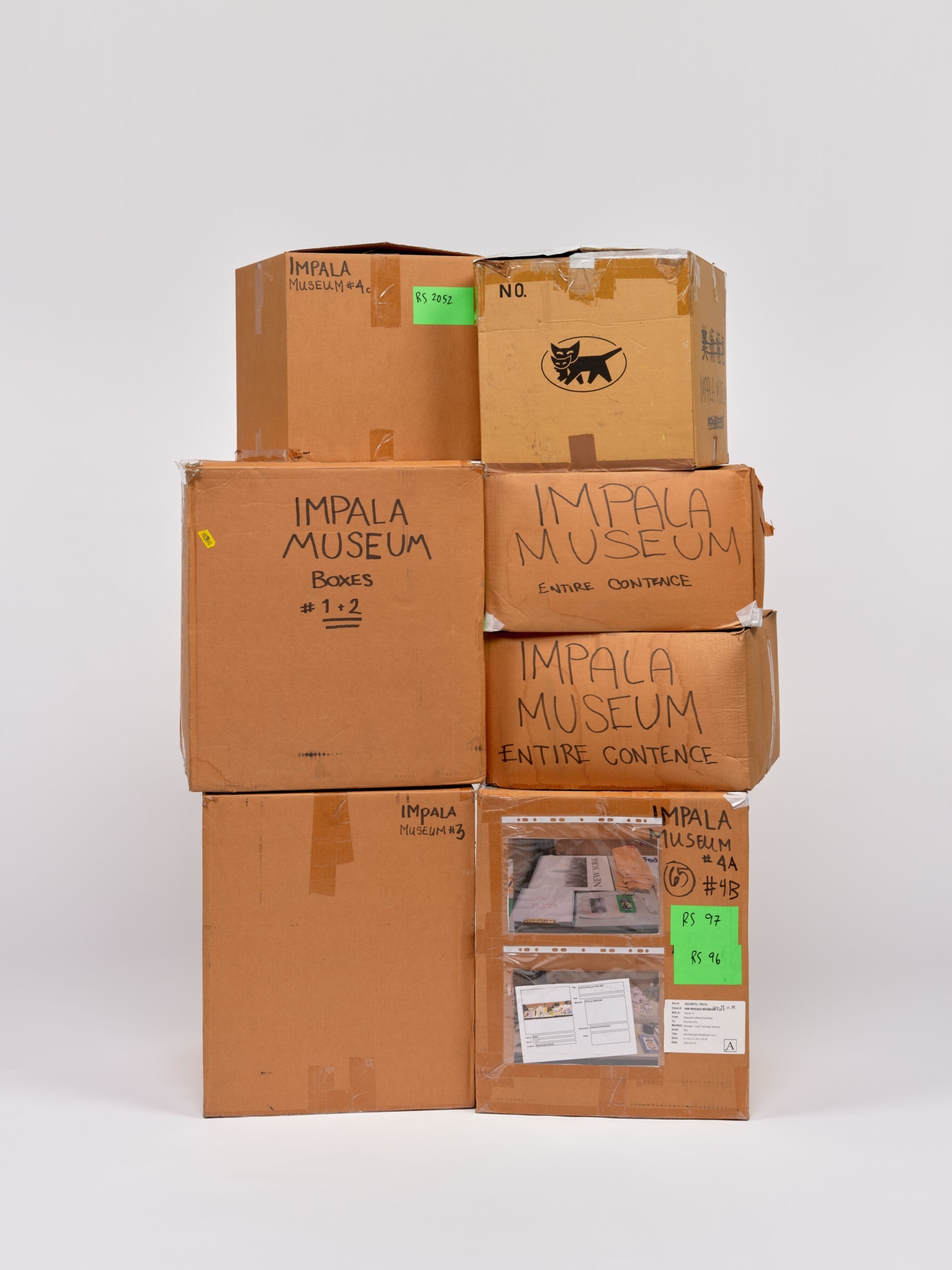
Storage boxes of archival material from Jason Rhoades’ IMPALA (International Museum Project About Leaving and Arriving) (1998).
|
|
|
The cars were archetypes, moderators, constellations. It figured opposites on axial systems (four-wheeled drives?) that compounded psyche into the stretch of road, the motor-vehicle into the creative act. There, problem and chance would commingle in full transformative momentum. His cars tracked unsystematic paths, “meaningful cross-connections,” per Jung, which radiated throughout and beyond the works, like meridian lines forming maps of mishap, misreading—lyrical, metaphorical, metonymic re-routings of prescribed forms of thought, ideation, creative actions. The complexity of these quasi-metaphorical operations, mobile forms that dragged and grabbed and stretched and elongated, conveyed a stake in more-or-less Jungian word associations and parallels between myths and fantasy. Rhoades had intuited that processes of fragmentation professed the capacity to contain multitudes, which moved thought elsewhere, forced thought to change directions, maybe even toward transmutation. Read as “cases” (like psychoanalytic patients, or the inflected parts to a grammar) each of the cars, the Fiero, Ligier, Ferrari, Impala, were carefully chosen for what they expressed as formal change. Cars contained the special powers to become something other, to be magically changed by their transience and modulation, from actions to associations, items of use values to poetic function, form of transport to communicative tools. Their use was always modified by context. This meant, for the artist, not only acknowledging, but also fostering fate, chance, and fortuity as essential to the operative logic of the work. The cars found their essence as metaphor; they moved, turned, spun meaning in action, and as actions (and, also, inaction). “Inertia,” as Jung wrote, was also “the property of persistence.” These vehicles transport viewers between the inherently restrictive operations of a mechanistic culture, which threatens to stall into convenient categories, and the more imaginative pop myths we have come to understand as tokens of freedom. The cars then drag and drift through questions and puzzles, chasing lines of chaos and control, spinning ideas that get drilled into our heads, fixing on motions that persist, to more or less failed ends... like, the attempt to write about their infinite complexity. The drive to write about the motor-works means going for a spin, being throttled through uncontrollable turns and speeds, swerving and detouring, getting lost; and then, suddenly made to break—fast, as if to avoid stalling, or . . . crashing, exploding. Driving around Rhoades’s mind, or what remains of it, implies that dangerously, rhythmic drift . . . thoughts stretching on and on, the imagination transported by flows, materials, and communicative means, through psychic situations, collisions, crashes, and accidents, only to swoon at these inner states: feeling shocked to suddenly see the whole system shift, game over. These are works that operate on our desire to drive, and to be driven—to the vanishing point: madness, desire, frenzy. What plays out on the stretch is the amorous game of trivial pursuit that is creation’s motive force. As Eisenstein clarifies in a footnote within On Disney: “Play—Variability.” The works comprised, as Klein wrote of cartoons, “the machine-made elements [that] announce simultaneously the power over the audience”: as in the make-shift motorbikes in My Brother/Brancusi (1995), which aspired to both embody “fast forward motion” and alter perception while on-the-go. The mini-motorbike was not equipped with brakes; in its elemental stance, the bike signified, as Rhoades noted, “the relentless advancement associated with Modernism.” The form signalled speed, the potential for advancement. The motorbike’s logic is later pushed through to the collaborative piece, RANCH (1996). Created in collaboration with Jose Pardo, Rhoades had written of RANCH’s motor-bikes: “‘Modern mini-bikes’ that have no breaks and move forward optimistically become ‘postmodern’ toys.” The meaning, like their mobility, is slowed, made to break, and fragment; the precautionary change curbs enthusiasm, inhibits the optimism of speed. As Klein noted of cartoons: “their ominous sense of technology is reduced to the charm of a toy, like those uncanny German automata from the nineteenth century, or a zoetrope, or Méliès sending a rocket ship into the face of the moon.” Iwan Wirth suggests the same: “The car becomes a rocket ship, but also his home, his studio, in his journey throughout other cultures, and the world. And the journeys that he undertook as an artist in the ‘90s, and in the early 2000s, were very unique to him.” The motor forms, as motor-metaphors, are tools, transports, lyric devices. But they are also toys, or, what Jonathan Cracy once called, “philosophical toys”: optical/perceptive machines, which make clear both the constructed and hypnotic nature of their branded image and the rupture between object and perception. Again, what’s revealed is an attitude, a thought process, an approach to history. These toys (maybe “models”: set-ups, tools, playthings) are intended as play-things: situations can play out, systems contested and reversed, speeded, and slowed. Thoughtful forms are stretched by the imagination, to become something other. Like so, they also act to modify their proposed archetypes: that is, through their modded/pimped-up means, they reveal a whole system of invisible agencies and energies. Rhoades’s racing forms throttled the creative brain into a sphere of critical action: a play of surfaces. The cars and parts, parked thoughts and spaces for the racing mind to rest, convey a language of immediacy, a private idlest forged in the contact with other principles of meaning: mythopoesis, consumer culture, Modernism, spirituality, semantic gestures, sculptural tongues, morphological renewals, reversals of intent, flows, materials, laws, prescriptions, aesthetic experiences, meaningful moments. The romance of automobility, automation, of what we can imagine in his Autopias, throttles the mind up and onward—to the feeling of infinity, the thrill of possibility. Time spent in the car spills into ideas on the scripted space—propositional, tropic sites which were filled to the brim with specific objects and forms, materials acting analogously to some existential reference. Finding the appropriate means of transfer, the proper metaphors, drive reference to play out more indirectly, probing reality for new rules, constantly changing.
|
|
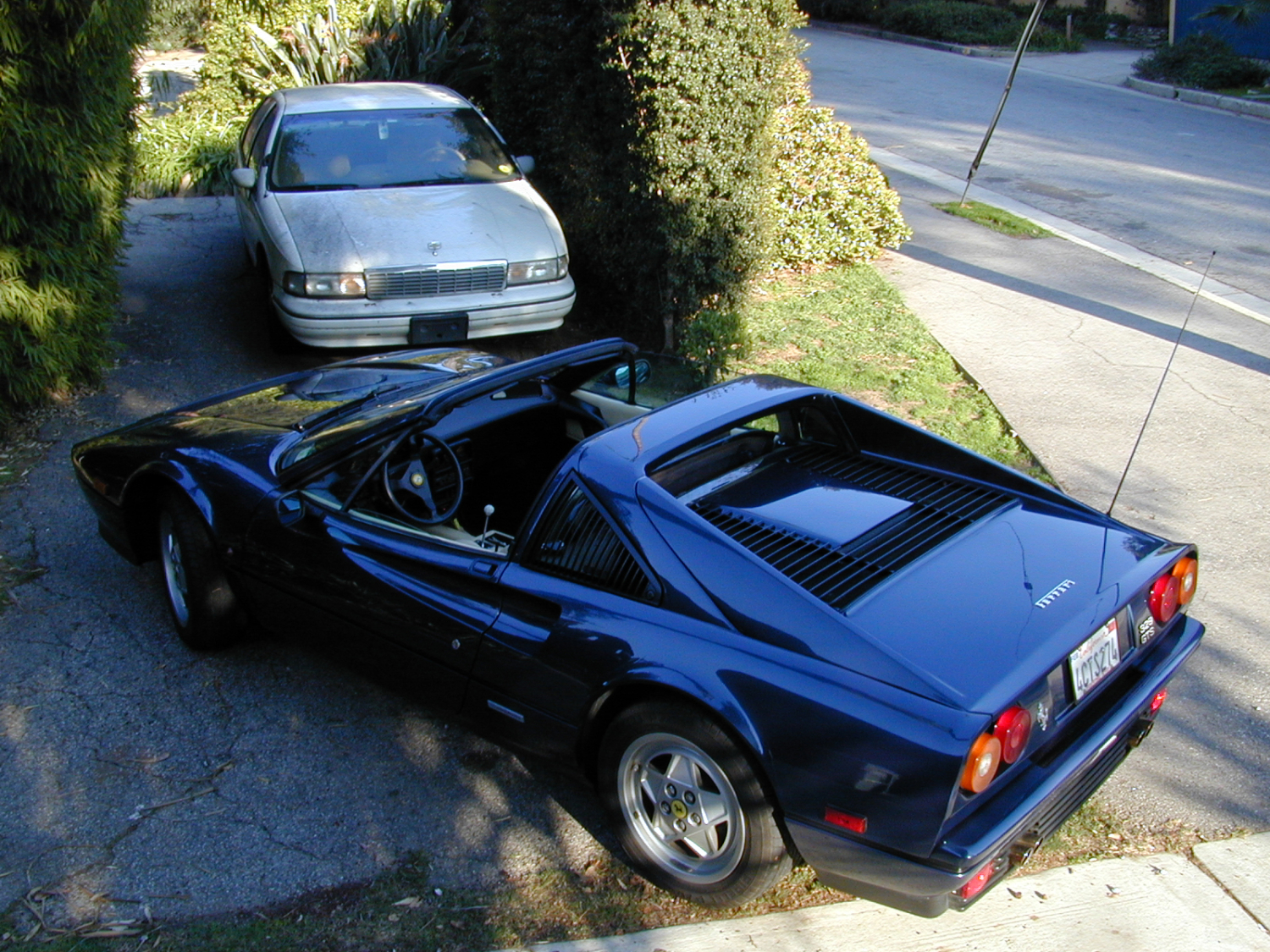
Jason Rhoades’s Caprice and Ferrari parked outside the artist’s house in Pasadena, California, 1998.
|
|
|
Rhoades’s works, at each separate stage of the exhibition, were accompanied and/or extended by performances, lectures, and screenings, interventions by friends and fans, and tune-ups—“substitutions,” per curator Ingrid Schaffner, a notable Rhoades scholar—to the works, which aimed to transect and trouble, and to continue—to convey, to communicate, that is—the meaning-making within Rhoades’s kinetic systems. Watching, from afar, The Rhoades Variety Show, a series of talks and performances organised during the exhibition’s course, I paused on an essay by artist Alex da Corte, delivered as a voice-over atop a still image from the opening sequence of The Simpsons (1989-today), Bart punished to write lines on the classroom chalkboard: “Next time it could be me on the scaffolding.” I wasn’t totally sure what that meant. The narrator recounts driving his Caprice throughout an infinitely stretched Brat summer, listening to Charlie XCX’s track for the nth time. The Brat-peak begins to wane, the mind drifts, he sees the Simpson’s sky, and he asks: Are we all born brat? The enigmatic question poses another problem: collage—as an artistic form full of problems, gaps, cuts. Instead of polishing the apple, “the garden grows, it is still summer.” (I think to Wittgenstein: When language goes on Brat Summer, philosophical problems arise.) Driving, thoughts peak, crash, reach high-voltages, become radio-active, windows are cracked, potential accidents are considered, and precautions taken. Da Corte says something like, it is impossible to think of Drive—the exhibition, the movie, the act?—without hearing its onomatopoeic effects: vroom, swoosh, crash. I remembered Gerard McBoingBoing, the UPI cartoon brat, who could only speak in special effects, follies, folly. “Tombs die too,” as Barthes had said. Scaffolding, I realized: the transient structure, a temporary platform given, something raised, like a question, artwork, career, or monument, for a brief moment—an essay, film-strip, installation. If there was a felt melancholy to these tour de force tokens of Rhoades’s mythic/motive force, perhaps it was (in part?) because of this transience, the precariousness stressed in hand-made or mind-altered forms, the cartoonish testing of the fixed boundaries of form. The cars, returned to us from rifts in time-space, taken out of entombment, context, and/or circulation, stretched thought around their roving contour, which Rhoades had commanded to life: by testing theories, transposing thought-forms, taking Modernism’s myths and folklores to the limit, which always snapped, fragmented: fucking-up one system, so as to show its futility, its failures. By which I also mean, the car was a tool, a facility, a functional form. To fixate too closely on the car risks missing the point. Jung seemed to get it: “He needed a constant renewal of interest, an emotion with its characteristic abaissement mental, which tips the scales in favour of the unconscious. Only in this way can space and time be relativized to a certain extent, thereby reducing the chances of a causal process. What then happens is a kind of creatio ex nihilo, an act of creation that is not causally explicable.” Now, the artist is gone. The animating hand is absent. What becomes of the work? What moves without its motor? The frame-rate slows, maybe, but perhaps not to a standstill. The experience instead starts to resemble that of watching a cartoon frame by frame, without the motion-machine to cohere their actions. We begin to notice other details, signs of labour, proof of past life. The decommissioned machine turns us to consider the impact of time. Kairos, as the Greeks called it: urgency, turning points, critical moments. And yet, how hard it can be to trust time to create new momentum. Just when we are about to grab hold (of the thing, the concept, the line) we also seem to lose grasp—the thing, the point, escapes, departs, casts off on its own. The animator is erased. So many of life’s more alluring thoughts and momentums, whether those of lyric drift or mobile forms, psy-fi insights, or sudden shocks, pass by us too fast to truly realize what’s happened. So, we construct, deconstruct, re-construct. The past weighs on us with impatience; the gravity of what we get to remember is not lost on us. It feels melancholic, but there’s also a thrill to this risk of losing track, forgetting an origin. What we decide to make of the lost things means tipping the scales again, “by touching an unconscious aptitude,” as Jung meant, and so “[to] stimulate interest, curiosity, expectation, hope, and fear, and consequently evoke a corresponding preponderance of. . . . ” well, that irrepresentable, psy-fi factor, the motive we cannot place, and the connection we feel, which draws us near. Drive. If the mind can “maintain a potential in the direction of consciousness,” Jung had also said, then it is possible to still know something, even if arising from nothing: “‘Nothing’ is evidently ‘meaning’ or ‘purpose,’ and it is only called Nothing because it does not appear in the world of the senses, but is only its organizer.” Rhoades’ motor-sport was a distraction, a diversion. A means to drive into the sub rosa ‘nothing’ of his work: its fogs, motion blurs, smeared words, misspelled meanings. Clouds upon clouds, mind against mind. When I’d asked Schaffner how she felt about this melancholic shift in the reception of Rhoades’s works, she emphasized the artist’s allegiance to modernism: “And yet, the work is so fucking postmodern, its Future-ideals defeated by this fragmentation. It loses its elasticity, loses the drive, going further and further away from that drive, from the original drive.” She also said, true to spirit: “Nothing is everything, Sabrina!” To hang up the brain, accept the inertia, free time to float. Rhoades had described the hang-up, the flurry of decisions, as critical to the work, noting that the events, decisions, and insights that, objectively, are of the highest quality, are also ones that “do not necessarily stick in one’s mind (CONTROLLABLE-UNCONTROLLABLE.)” What remains is the intuition, the faint sense of something significant. He advised to pay attention to these moments, the fuck-ups of a tired mind. Stop thought, he’d said. Hold onto the moment, remembering that “‘Moment’ and ‘Monument’ are really antithetical concepts—for Rhoades, sculptural categories . . . that are not necessarily mutually exclusive. . . . An invisible moment can assume the presence of a gigantic monument. In the creative act the intellect is called upon to search for visible essences, physicality serving to make the ephemeral visibly manifest (DYNAMIC). . . . Sculptures that were bound to their context, and which therefore took on monumental proportions (in the countryside) as well as fleeting states (dematerialized as ideas), developed from a purely formal view.” Sometimes the epiphanies appear to us naturally, par for the course. But, more often, they emanate from thick fogs and blurs, smeared frames, and forgotten thoughts, spirits emanating from assholes and wisdoms lost en route. To reach these strange insights involves some decision-making. These moments of renouncement become choices; they become the armature of a work of art, a scaffolding that caches and raises the construction, from mundane form to animated life. What, when, and how things are remembered, as Rhoades noted, is hardly within our control. And still, as Emily Dickinson once wrote, “Time does go on—”
|
|
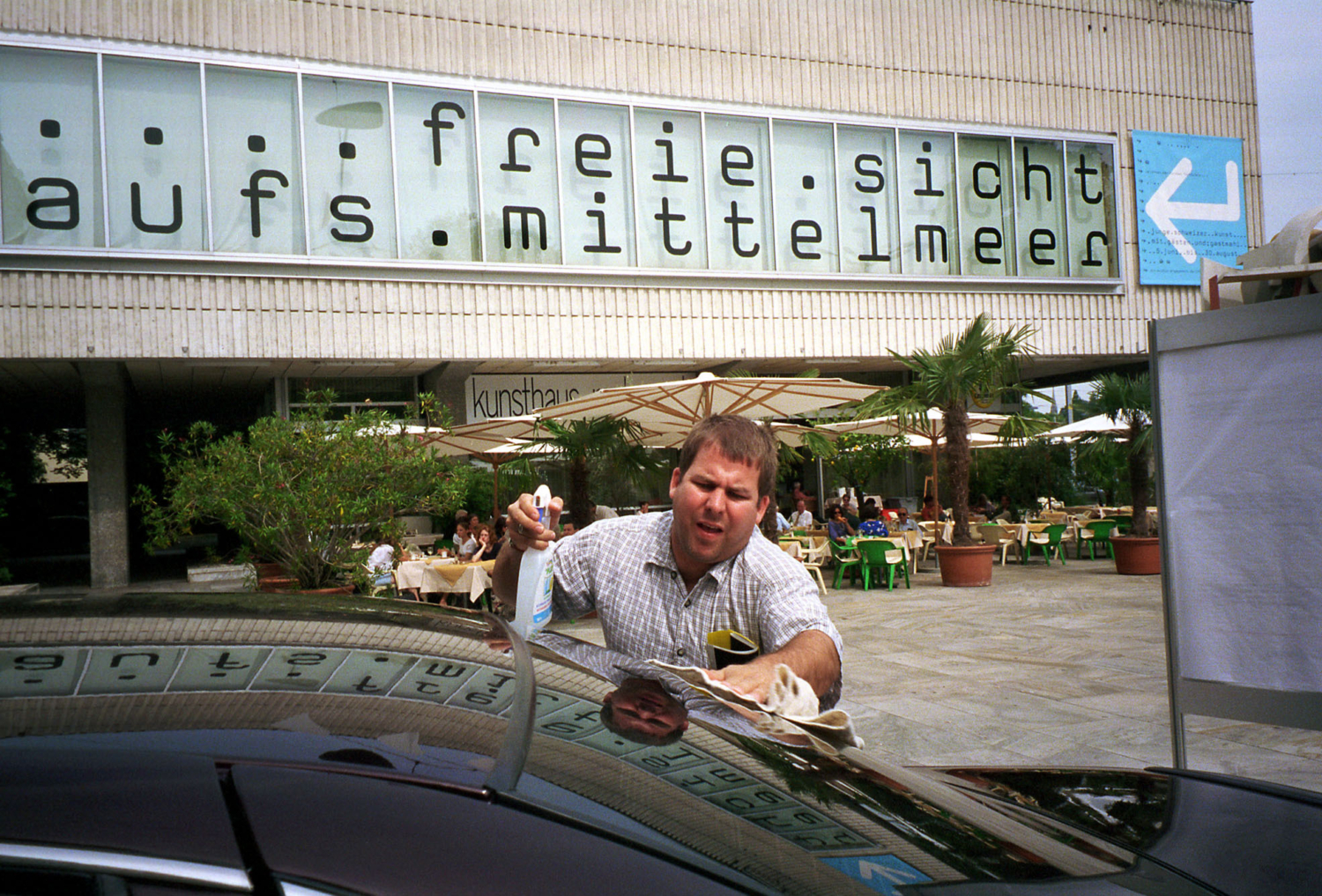
Jason Rhoades with IMPALA (International Museum Project About Leaving and Arriving) (1998) at Kunsthaus Zürich.
All images ® The Estate of Jason Rhoades. Courtesy the Estate of Jason Rhoades and Hauser & Wirth
|
|
|
|
|
|
|