Lyrical Rizz and a Pang of Marouane Bakhti’s (Auto)fiction
|
|
|
How to Leave the World—Marouane Bakhti’s debut novel sprawls with the staggering clash of lyricism and hybrid prose in an apt portrayal of the social, cultural, and natural landscape. Tinged with gentleness as much as hatred, this is a story of chrysalis. Affection, violence, sex, and love pressurize between the pages and characters, reeling into a non-place where fear beats alongside desire.
|
|
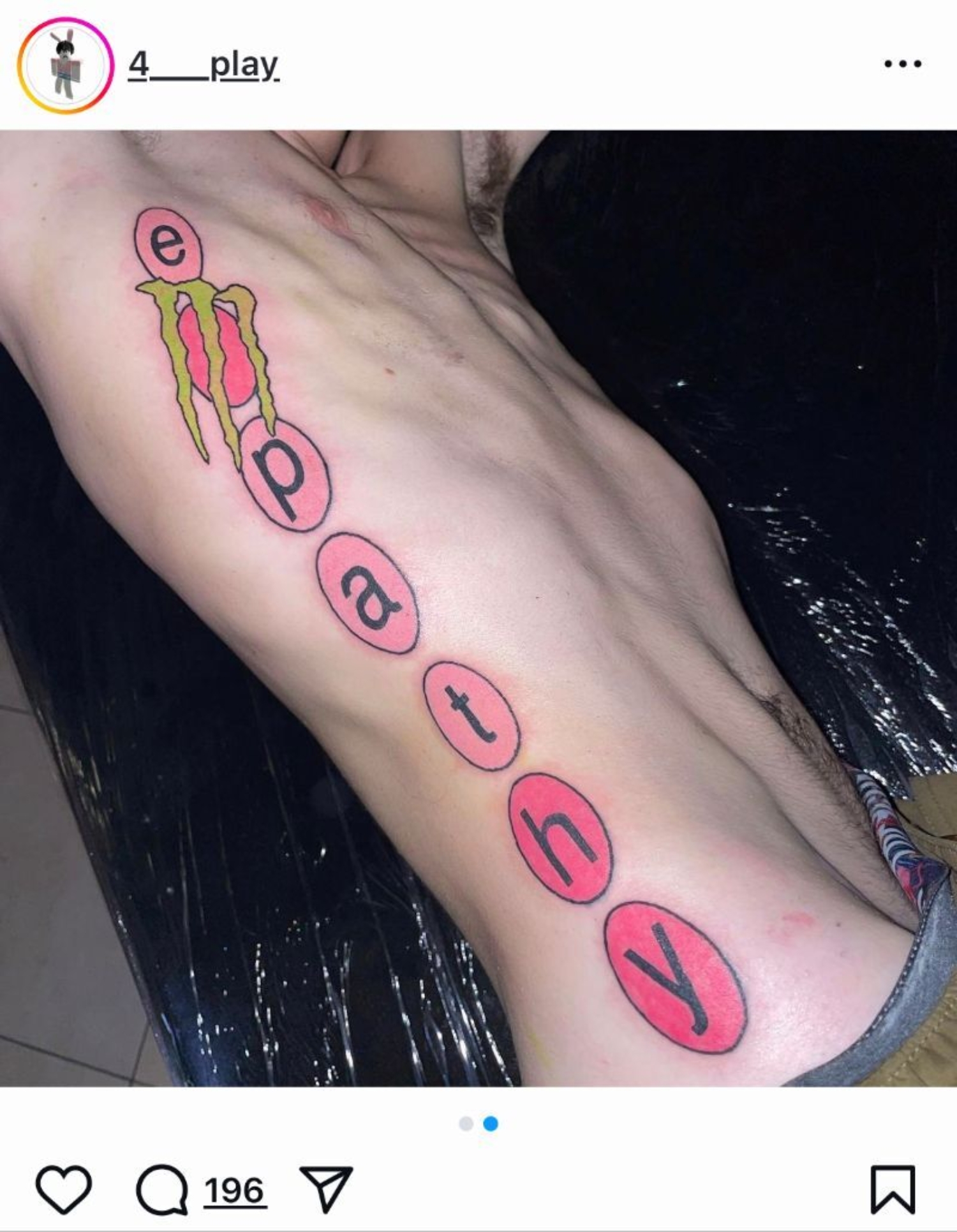
Screenshot: @4____play, Instagram.
|
|
|
When I requested an ARC of How to Leave the World from the publishing house [Divided Publishing], I had no prior knowledge of the author or his writing. In fact, I was particularly drawn to the novel’s plot solely by [noticing] a blurb on the back cover that was posted on one of the publisher’s social media accounts.
“Everyone is asking about his identity. Gay? Muslim? French? Moroccan? Instead of choosing a side, he writes a book. A book about the forest and the city, Paris and Tangiers, shame and forgiveness, dating apps and spiritual discovery. A book about growing up as a diaspora kid in rural France, with desires that want to emerge at any cost. Told in mesmerising prose, How to Leave the World is a beautiful non-answer.”
|
|
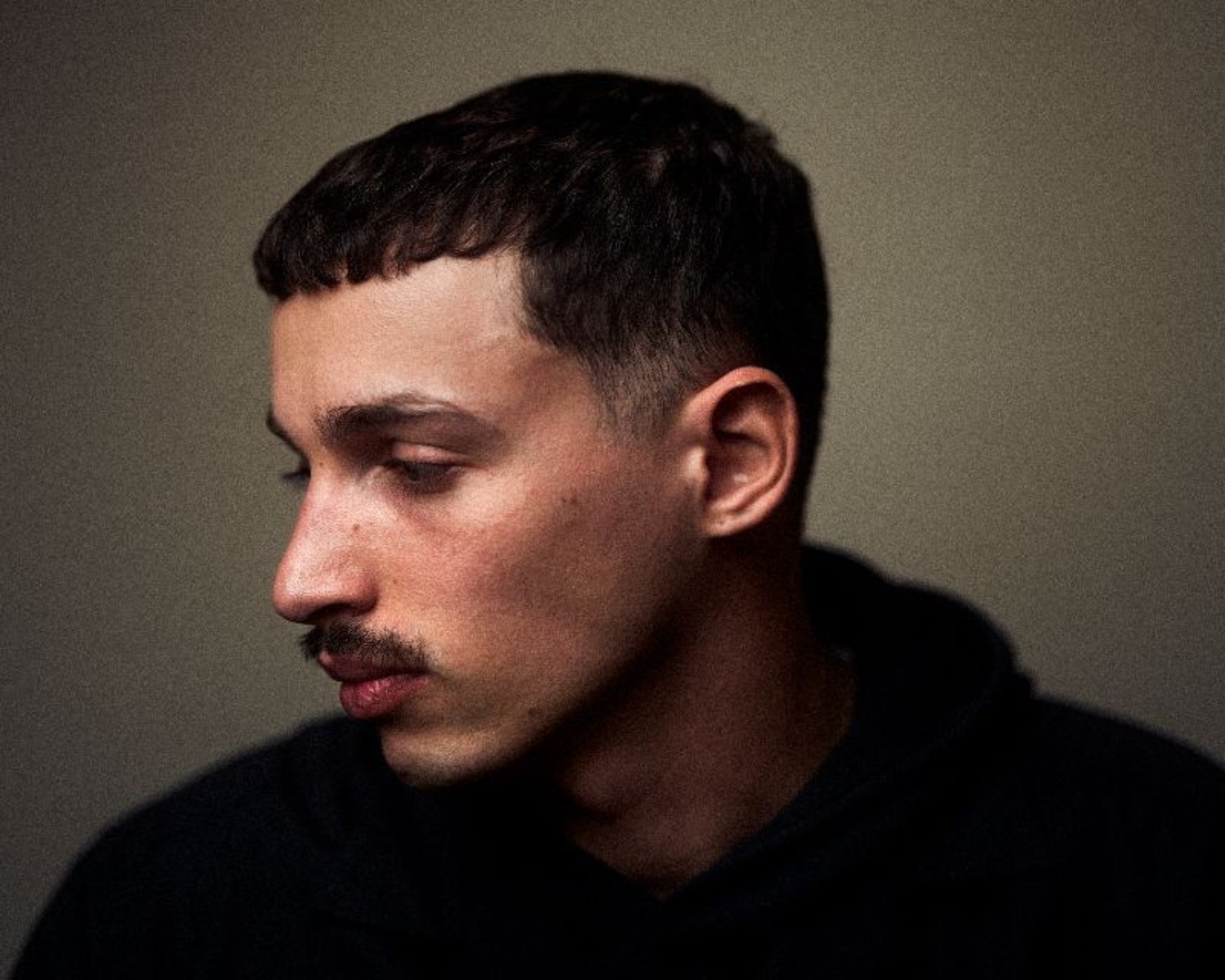
Marouane Bakhti. Photo: Manuel Braun.
|
|
|
What propelled me to read and watch sentences unfurl as I squinted through the pages—returning back and forth—had to do with the novel's deeper subconscious and the sensation that I (as well as many other readers, writers, etc.) may or may not have, in some instances, experienced a story akin to Bakhti’s.
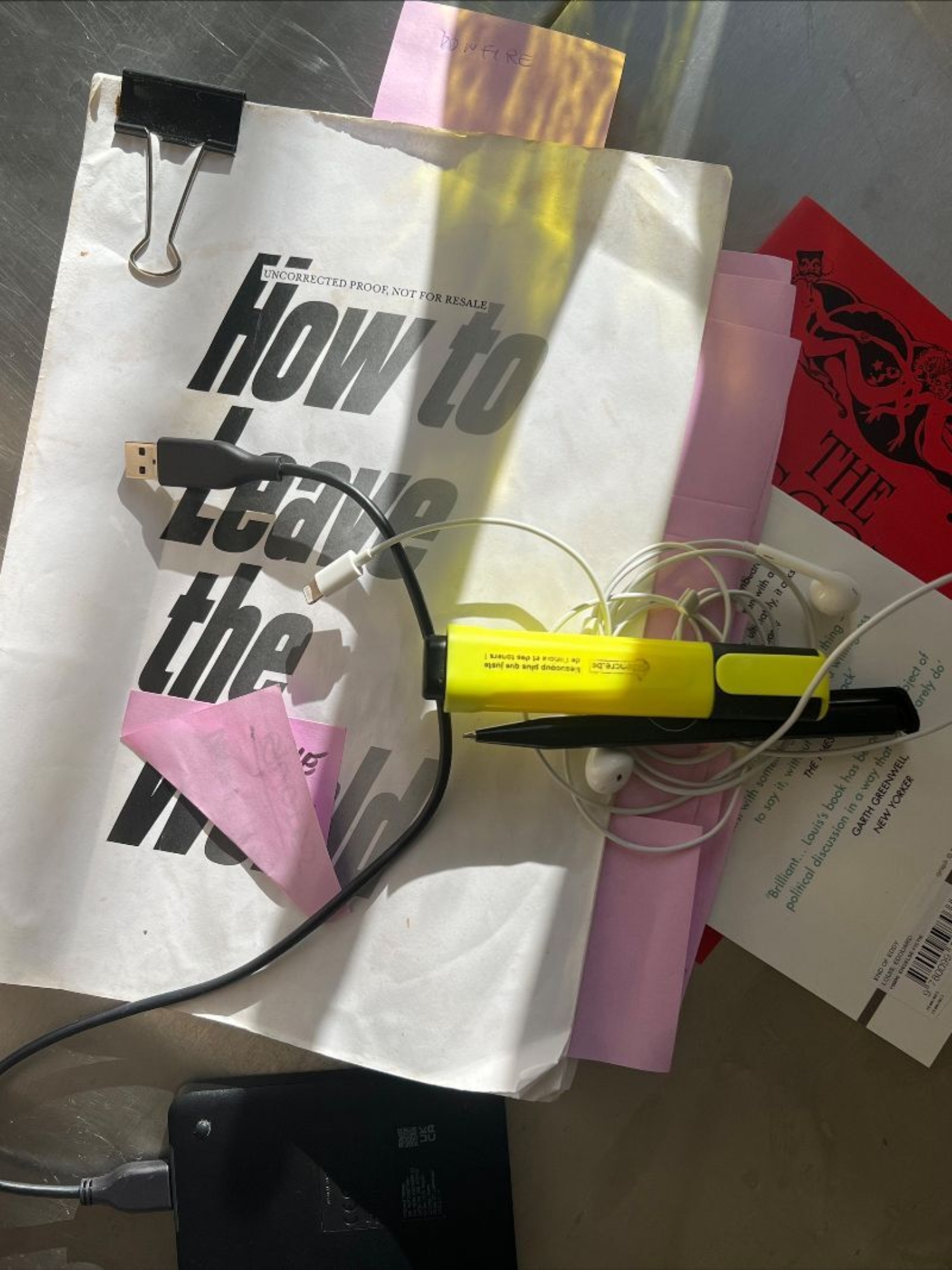
It was mid-August, and the heat was overwhelming. I escaped from civilization to my parent's summer place. The radio in the garden blasted 'Big Exit' by PJ Harvey. It was also the time when I flipped the last page of The Shards by Bret Easton Ellis, and my body shuddered to the point that I thought I might throw up. Days later, I found myself miles away from my western home in Brussels and its usual inhabitants. It seemed like perfect timing; I was glad to start reading Marouane Bakhti’s novel. I received the unpublished manuscript of How to Leave the World by email and printed it the next day in town.
As any reader, I had some hopes and expectations. I moved through a clipped manuscript over the following days I spent in the garden. While the pool’s chlorine hovered around me, I carefully studied syntax and tempo, made notes on post-its, and took note of the significant use of flowery descriptions in the narrator’s voice.
“The tragedy of not seeing another creature like me, anywhere. … A boy at the edge of a field full of livestock, barbed wire against my legs.… My heart is a copse of trees filled with black stones, the looming terror of being caught redhanded in desire. … The narrow house facing the willow and birch trees that sing in the wet wind.”
I could read undisturbed, were it not for my grandmother requiring my attention or a dog wanting to be petted. I’ve been baffled by the vivid scenes and descriptions, the use of lyrical sentences that confirm Bakhti’s assertion that “the poetry leads the narrative.”[1]
|
|
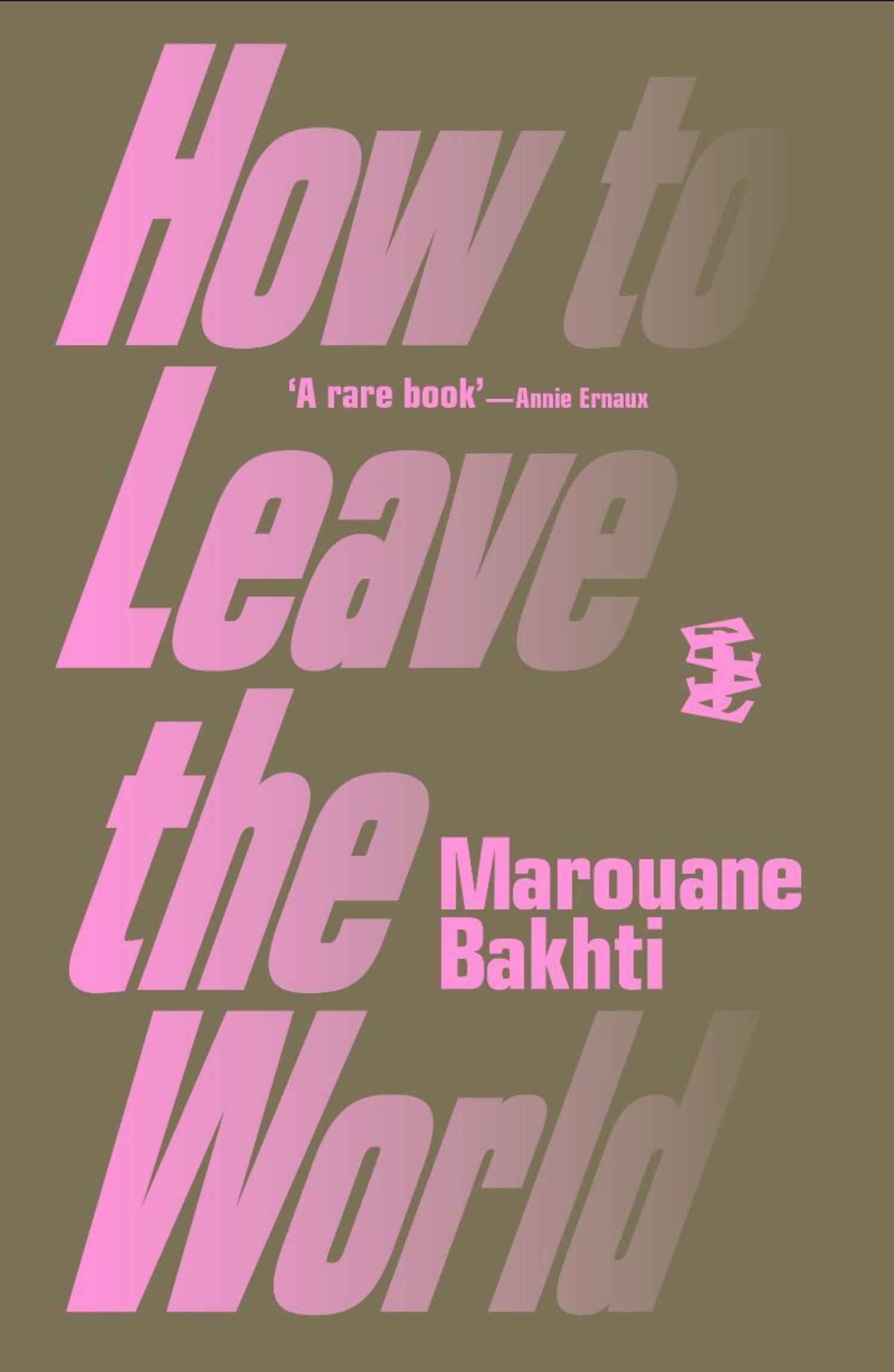
Marouane Bakhti: How to Leave the World, 2024, book cover. Courtesy: Divided Publishing.
|
|
|
Emerging amidst the French gay literary scene, Bakhti stands as a contemporary of Abdellah Taïa, Edouard Louis, Pol Guasch, and Ocean Vuong, among others, as well as part of the first row of renowned queer-lit predecessors such as Guillaume Dustan, Hervé Guibert, Dennis Cooper, William E. Jones, Nate Lippens, Kevin Killian, Robert Glück, and David Wojnarowicz, to name just a few. However, by reading Bakhti, one is also almost instinctively reminded of Modern Nature (1991), Derek Jarman's meditative, diary-form work composed of poetic yet painful entries.
Described as 'the new sensation of French literature,' (respectively) and originally published in French in 2023 as Comment sortir du monde by Nouvelles éditions du réveil, the novel has allegedly been nominated for both the Cheval Blanc 2023 Literary Prize and the Marcel Bleustein-Blanchet Foundation Vocation Prize 2023. Translated into English by Lara Vergnaud in 2024 and written in five consecutive parts, the plot unfolds in the countryside while painting the character’s profile and those who surround him.
One by one, his almost diary-like entries take me through bushes, willow trees, swamps, woodlands, muddy cow fields, houses, living rooms, parents, Arabs, faggots, haters, lovers, and gobs of spit, etc. Bakhti equates his exterior descriptions, rife as they are, with alluring sentences that allow for self-mythology and introspection of the interior.
For example, he recounts his first sexual encounters.
“I see his Airness jacket on the ground, covered in mud. His taste and smell stayed with me for a long time. The freckles on his skin and his thick rad body hair. We met up a couple of times like that, … It lasted a few weeks at most. He was the first one to put his dick deep inside me.”
|
|
“One by one, his almost diary-like entries take me through bushes, willow trees, swamps, woodlands, muddy cow fields, houses, living rooms, parents, Arabs, faggots, haters, lovers, and gobs of spit, etc.”
|
|
|
I think of Stranger by the Lake, a 2013 gay cruiser-killer thriller, and I wonder which direction the novel will take. Is anyone going to get stabbed?
I continue reading and am confronted with the inexorable fear and shame of the character regarding desire: “I’m terrified at the idea that someone might find out what everyone already knows.”
And then I set the manuscript aside and wonder about my coming out. I feel my nerves grow as I dig into my mushy brain, like it's pudding. I'm 19, facing my mother in a cheap sports bar where you can still smoke inside. 'I have a boyfriend; I’m gay…,' I yell. My mother lifts her glass of ersatz Chablis and takes a drag of her cigarette. I'm stunned that she’s not appalled. Instead, her face looks too relaxed when she says, 'I knew, my God, I knew… I’m your mother.’ I sneer at her because all I wanted from her was to scream, burst into tears, or run away. I yearned to see her worst; I wanted to burn people the way they burned me too… but all I got was her dull, airless face.
While slowly observing Bakhti’s narrator, I was reminded of my own 'now self-altered' versions of memories, clotted in my past—feelings of otherness and magnified solitude, of inevitable loss and departure for some, if I may argue, a questionably greater good.
Yet, prior to reading How to Leave the World, I wasn’t aware or prepared for what the novel could reveal or deflate. In fact, I wouldn’t have guessed at all. However, after some time, it occurred to me that by reading further, I could wander alongside the narrator as an invisible passenger and witness his world on my own.
After realizing that 'nature ceases to be a refuge,' the main protagonist flees the doom of a 'sexual wasteland' to discover city life (Paris). A shift occurs through a forlorn bravado as the narrator's father manically burns his diaries back at home: 'Flames licking at my memories… consuming sketches of my first lovers… detailed outlines of their facial features and their dicks.'
This passage demonstrates that Bakhti does not only employ natural elements to purify; rather, he quintessentially alters the rhythm of a new reality by bringing such elements to life on the page. He evokes respect for his ancestry, the land, and tradition.
“We feed the fire and then we feed ourselves.”
At first, the narrator’s autonomy seems to have a bitter, downbeat taste—the city life is marked by solitude, writing, therapy sessions, and occasional gay app hookups. He speaks of “men who search for sexual power, for the pain of exile. They search, they scrutinize, they desperately sniff for the savage, … the police that hate me, or the gob of spit on the ground, or that piece of Arab trash who comes to your house in the middle of the night to make you come.”
|
|
|
One world crumbles for another to rise—through his various sexual encounters, described as near 'note' entries in the novel, Bakhti's character probes the racism, violence, and indifference of dating and sex app users, hookups, and cruising. And although the narrator seems bereft of affection, he claims that 'intimacy with others is the only way his body can handle the fear and shame.’
As candid and self-mythologizing as the novel's premise feels, Marouane Bakhti's reliance on poeticism, coupled with rhythmical syntax and fragmentary passages, seems as if it lingers in a realm that feels needlessly experimental. In that sense, it sparks with what it (initially) offered: a beautiful non-answer.
Perhaps, that is my projection as a reader, one I make to explain why the novel of such a lurid voice did not make my heart fully crush. I craved a deadpan crescendo so utterly unexpected (and perhaps even perverted)—something that would leave me shivering in awe long after that late August night and for many days after that.
|
|
[1] Q&A with Ned Green, June – July, 2023.Marouane Bakhti’s How to Leave the World is available now from Divided Publishing.
Filip Jakab is a fiction writer based in Brussels. He works as a freelance editor and contributes to several publications, including Los Angeles-based Flaunt, Public Parking, PROVENCE, Violet Papers, and posts for On The Rag. He reports on the "gossip, culture, and sex" scene in Brussels via his Substack. In addition to writing columns, interviews, and celebrity profiles, he is currently outlining his very first homoerotic thriller.
|
|
"things want to make an impression too"
|
|
Hug Dress, 2024. Photo: HULFE.
|
|
|
HULFE: Hi Fiona!
Fiona Bate: Hi HULFE! Please tell us how HULFE first came into being?
HULFE: I was born on a rainy day shortly before the year 2020. Daphne Ahlers and Lilli Thiessen shared a studio at the time and needed a vessel for their collaborative creations and so I unearthed. An umbrella, a hybrid, a label, a lifestyle. I create pieces that aim for longevity, accessories and collectibles. Most designs follow a concept that entails the spirit of support. HULFE sees accessories not as minor or secondary things, but as companions going back to the Latin meaning ad cedere – to join.
Fiona Bate: Collaboration is part of the beating heart of HULFE. How do you balance it with your other singular artistic practices? Deciding which interests go where etc.? I imagine it’s quite organic and unfolds as you move along … but I would love to hear more about this from you!
HULFE: HULFE has a very clear DNA. Everything I do is conjured by conceptual, material, and social aspirations. The girls have their individual art practices, and of course they are overlapping in interests, textures, materials, and themes, but it is very clear where HULFE starts and their respective art practices begin. HULFE creates products with a utilitarian purpose. Art is free of utility. HULFE hangs out in the art world, but its reach goes beyond its borders. Art is often afraid of contaminating its special standing in the world with proximity to design, applied art, or commodities. But I think good art is very strong and you know it when you see it. HULFE is not afraid of blurring the lines. Operating as a brand gives you certain freedoms, such as shameless self advertising. Operating within the artworld gives you conceptual and aesthetic freedoms and an open and sensitive crowd.
Fiona Bate: I think seeing HULFE as a brand – rather than a "project" – is significant, crucial. The topic of "collaborations" and particularly with artists — in other industries and with global corporate brands for example — has had a lot of momentum for some years now. To be honest I’m kind of surprised about the lingering interest since it’s not how fashion tends to operate. What do you think lies behind the appeal? And who would be your dream collaborator in any other field? I would be very excited to see something like HULFE x Tchibo. I just read that their slogan is Jede Woche eine neue Welt – which explains a lot! To me, the best collabs are the most unexpected and wild collisions.
HULFE: I like the lingering of collaborations. Even though the main reason for the lingering might not be a creative one but more a corporate one. I think the result is almost always a creative plus if you combine two things, minds, energies, designs that come from different angles and histories, and I agree the more unexpected the better the outcome. On the side of marketing and production it has a lot to do with reach. People collaborate to profit from each others’ pools: knowledge pools, skill pools, follower pools…It's a great tool for expansion and the conquest of new demographics. Collaborations can also be seen as something communal in which people can share and grow together. The different skill sets open a wider range of actions and possibilities. It’s give and take. The more you can solve together, the more autonomy you have over your process and actions. This is what I feel when HULFE collaborates with friends. Besides that: more brains, more fun!
I really like the idea of HULFE x Tchibo. Looking at their page now, I see the “Towel-Dress”. It’s a match! Teaming up would be so fun. But I already have an all-time dream collaborator. There are these shops called Sanitätshaus – shops that you usually only come in contact with when you have a chronic illness, disability or are getting old. The aesthetic of their products is very depressing. So my dream collaborator would be bständig – an Austrian Sanitätshaus and brand. To find ways to soften the edges of the harsh hospital aesthetic and come up with practical and also joyful designs for serious needs would be a dream.
But this is a long term goal. For now I pretend to be a big global brand and ask artists to collaborate with HULFE for my line of logo merch called logo play. So far I have worked with Line Meyer, a brilliant artist and illustrator, Cindy De Perky, a genius artist brand / corporation by artist Seyoung Yoon, and a sweater made with the always stunning and never disappointing artist Philipp Timischl is coming up in early December. I love to collaborate in all kinds of ways. The anti-stress bag designer knuddi2000 aka super artist Schirin Charlot Djafar-Zadeh is someone I repeatedly work with on projects, most notably the pillow design for the art bar Schmetterling in Berlin. Our next product collaboration will be with the designer Felix Taylor who runs the brand Platten. And then one day HULFE x bständig.
Fiona Bate: I’m here for a HULFE x bständig collab. Continuing with the prospect of more corporate crossover - what would a HULFE Venn Diagram look like? And does HULFE moodboard?
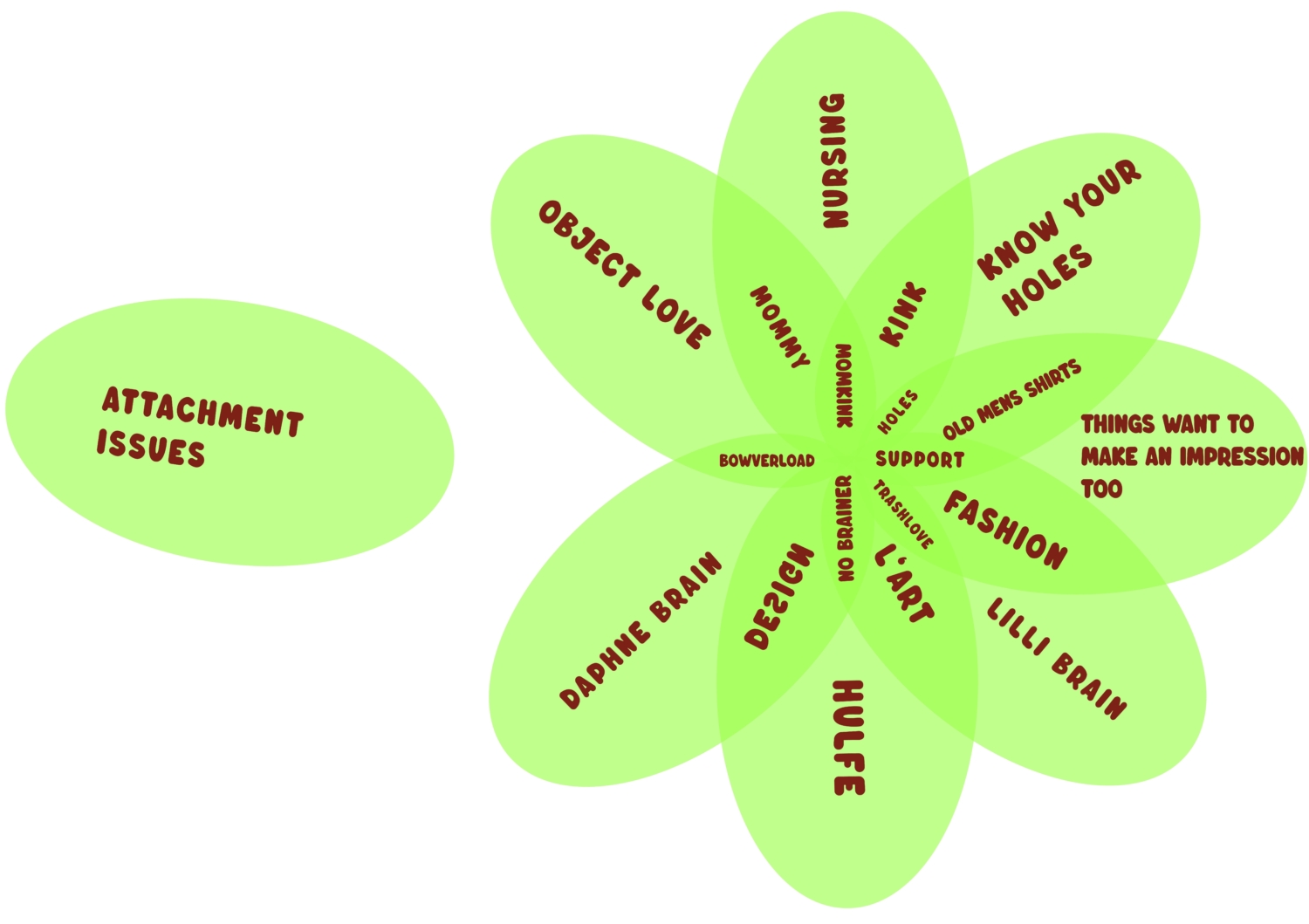
HULFE: That's easy! I am a flower! And no I don’t. I'm not a trained designer. I’m a hybrid. Most ideas come out of an intimate and constant conversation and exchange between my creators Daphne Ahlers and Lilli Thiessen, rooted in over 15 years of friendship and resulting in a sometimes scary brain melt.
|
|
|
Fiona Bate: HULFE is an organism. How do you develop new products or collections? And what are your favorite ways to release them?
HULFE: There is a concept of what I am supposed to be that is condensed in the tagline “In the business of support”. There is joy in working with fabric, where you can instantly create three-dimensional shapes. And then there are friends and objects that need things. So it is very different how new products come into being. From a business point of view it might be too much, all at once. But from a creative point of view it is pretty perfect. Often I start with a collection theme or title – this is the environment in which the ideas will circulate. For my first collection the working title was: OmiBaby, a place where babyhood and old age meet to play. I often take from what already exists and add a little HULFE. For example our Tear Box. It ́s just a Kleenex-Box packaged in a Tyvek-bag. It looks like it's wearing itself, and it makes it into a sculpture, a desirable object and a weird companion for sad and sick moments. Blowing a little life, spirit, and mystery into the inanimate. That’s also a quality which I love. Using art against loneliness! Another example is the Anti-Stage-Fright twin-set I did for Sofia Leiby. Matching skirts for the poet and her chair thus giving the performer a companion and letting her feel less alone on stage. Often existing artworks or performances inspire and feed my ideas. At the moment I am looking into the performance piece Domestic Sanitation by Helen Chadwick where beauty routines become sadomasochistic play and women become beds. My favorite way to present new lines or pieces is in a gallery setting with an installation that hosts the pieces. That’s my delivery room so far. Like I did with our first collection in 2019 at Mavra in Berlin or recently in your gallery at SANDY BROWN. These were the most elaborate presentations yet but I also like more spontaneous pop ups like I did last week at City Galerie in Vienna. Next stop will be at Galerie Kammer Rieck in Hamburg and then I have a showroom at Gammel Strand Copenhagen coming up.
Fiona Bate: At some point during our chats around the showroom at SANDY BROWN last summer you mentioned something about HULFE and kink. This is such a perfect way to describe one aspect of what HULFE does or is. Can you elaborate on what you meant by that?
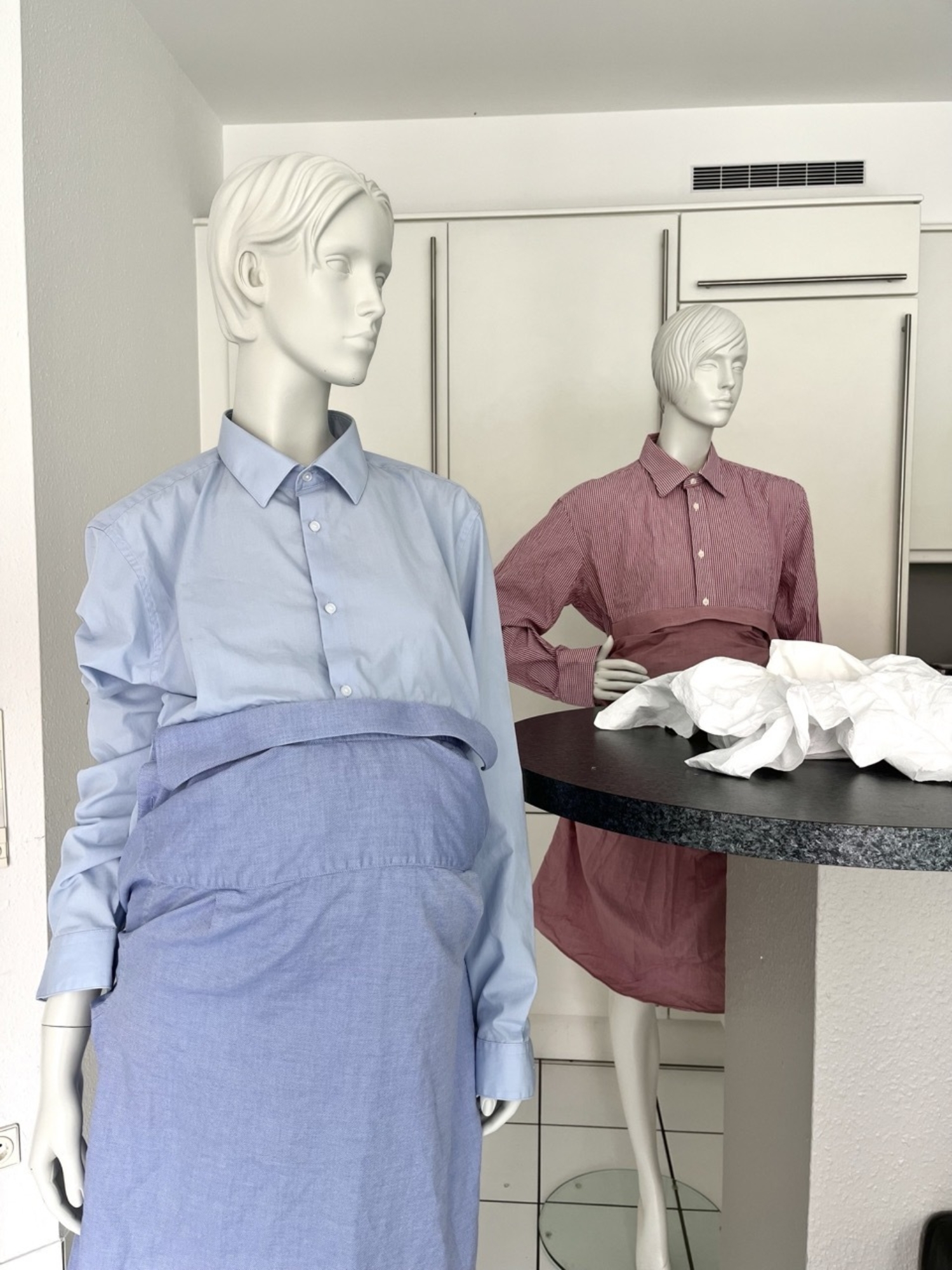
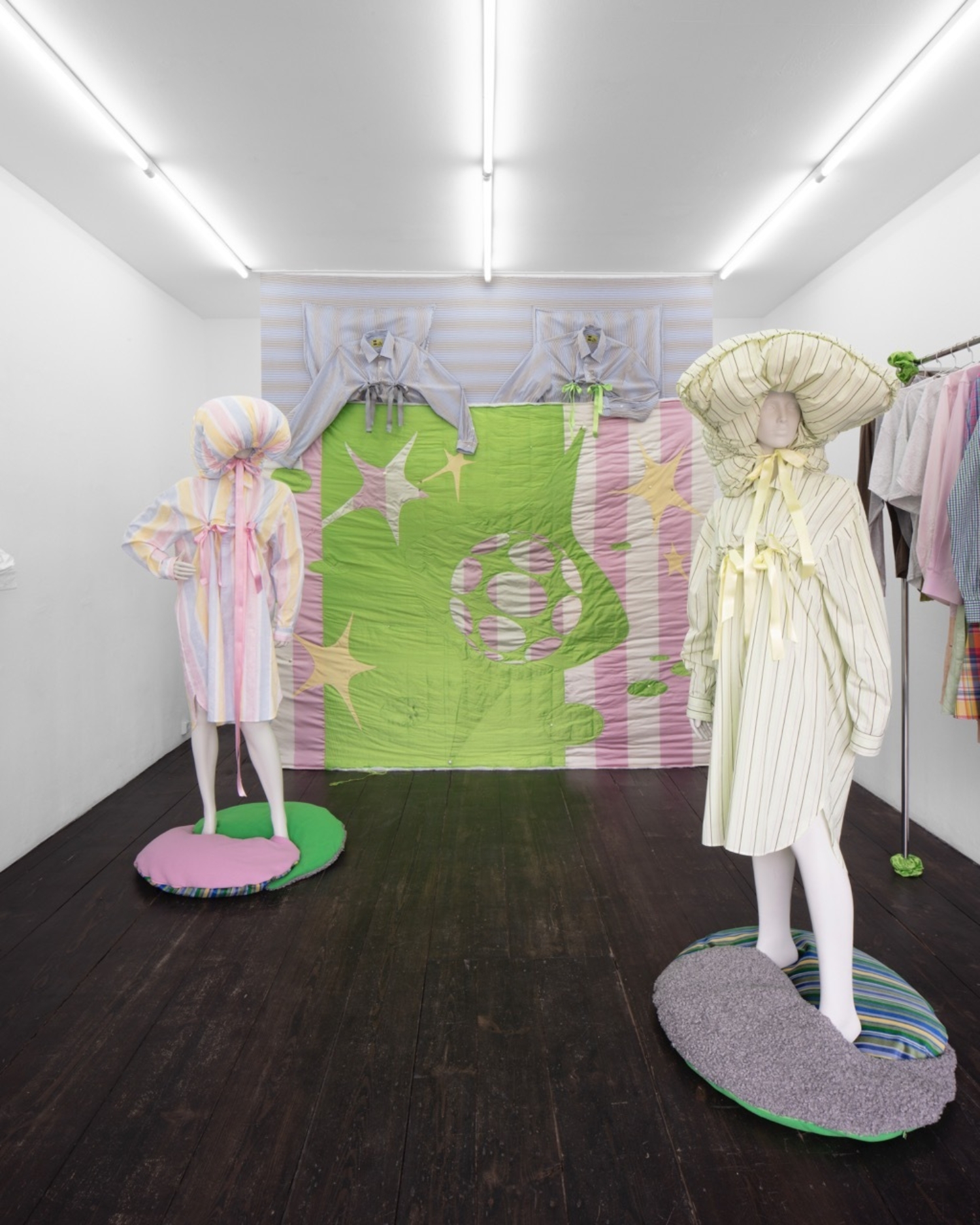
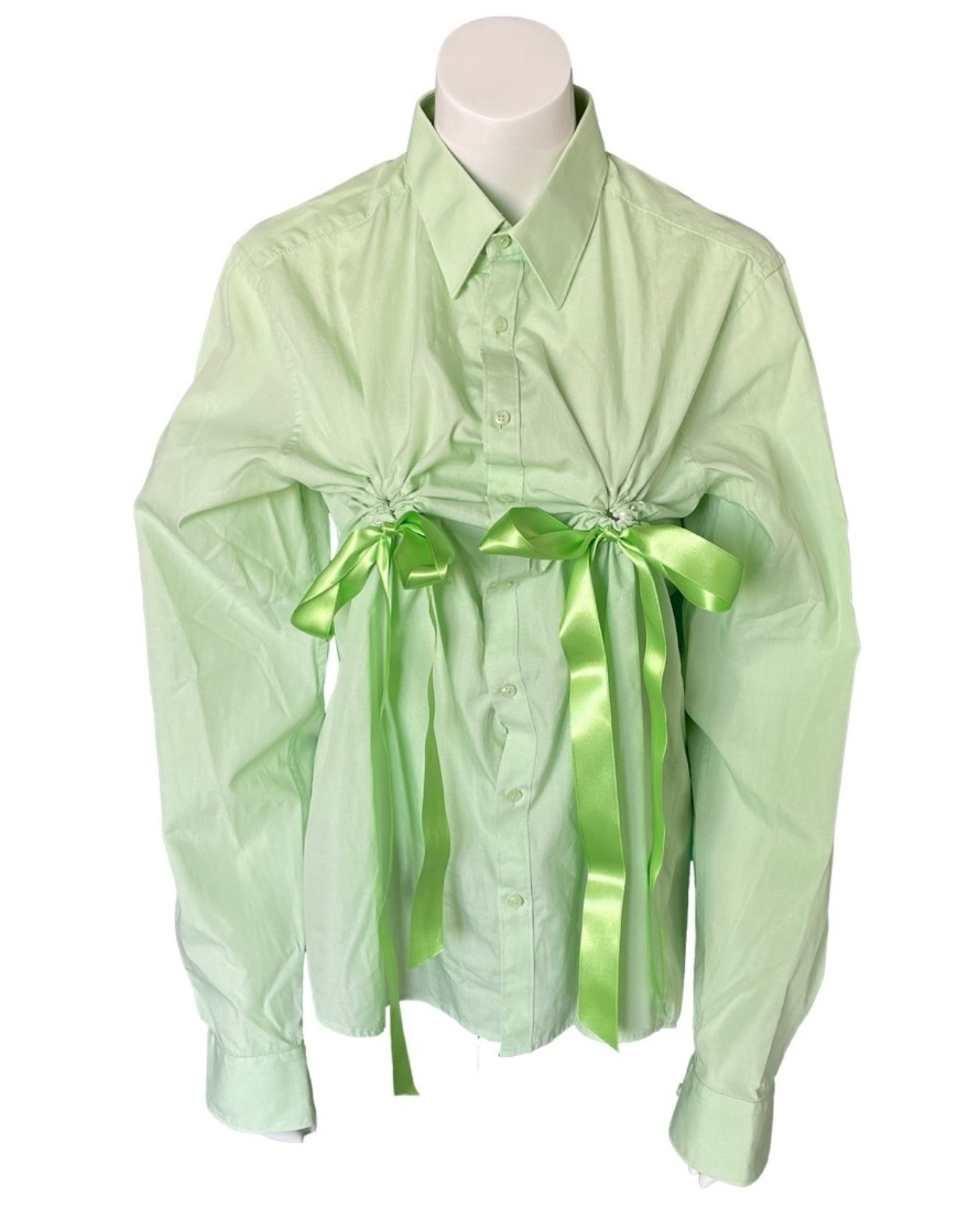
HULFE: I want to shine a light on marginalized processes of daily life. These marginalized processes are often in a feminine realm. Femininity is still frequently reduced to fuckability and yet we live in very prudish times when one can not show the female breast on the most common social networks we use. The female breast is sexualised but also condemned to passivity. The productive magical skill it entails is shamed. Our Nursing Shirts made of old men's shirts are conceptual fashion pieces with a functional note. At the same time they are statement pieces and collectibles that invite everyone into the conversation, because nursing affects everyone at one point in their lives. Nothing I do is just made for a specific group. Everything is made to reevaluate, to connect and is committed to pleasure. Kink is one way it can be read, but it can go both ways, sideways, everywhere but one way. Another example is the sensory deprivation pillow. It is made from a standard pillowcase pattern, with an inserted drawstring that makes it possible to shut out the world around you. I placed this item in a postpartum themed collection. But in reality the most common use of sensory deprivation masks is in the BDSM scene. I didn't want the master/slave attributes that are built-in to those designs, so I created a cuter, softer, and more exuberant version. The funny look of them, resembling an alien on one hand, or a stubborn, fed up individual on the other, adds a welcomed humorous aspect to the piece.
|
|
Installation view: Imperium Puerperium, SANDY BROWN, Berlin. Photo: HULFE.
|
|
|
Fiona Bate: The Sensory Deprivation Pillows are very 90s CDG. They also made me think of Hussein Chalayan. The quintessential HULFE product though – even before their viral moment ! – are your Nursing Shirts. Was this the first item you released? If not, which product did you launch with?
HULFE: I love to be in such great company :) Your associations make me happy. That there is formal similarity to the works you mention is a coincidence. The aim for these pillowcases was to stay as basic as possible so you can use them on your own pillows. Matching a standard 80 × 80 cm pillowcase with a sensory deprivation function served us this wonderful alien shape. The Nursing Shirt wasn’t my firstborn. Looking back the Belly Belt is the first product – an attachable fake belly to imitate 3 stages of human pregnancy. But the Nursing Shirt was right behind in the birth canal. And it is an achiever. The Nursing Shirt was developed when our friend Michele di Menna was pregnant and asked us for a shirt that would allow her to breastfeed and still look fab! We made one with a zipper and one with holes and bows. She liked it and used it so we continued making them in different versions. Soon we found out that there is a great demand for fun nursingwear.
|
|
|
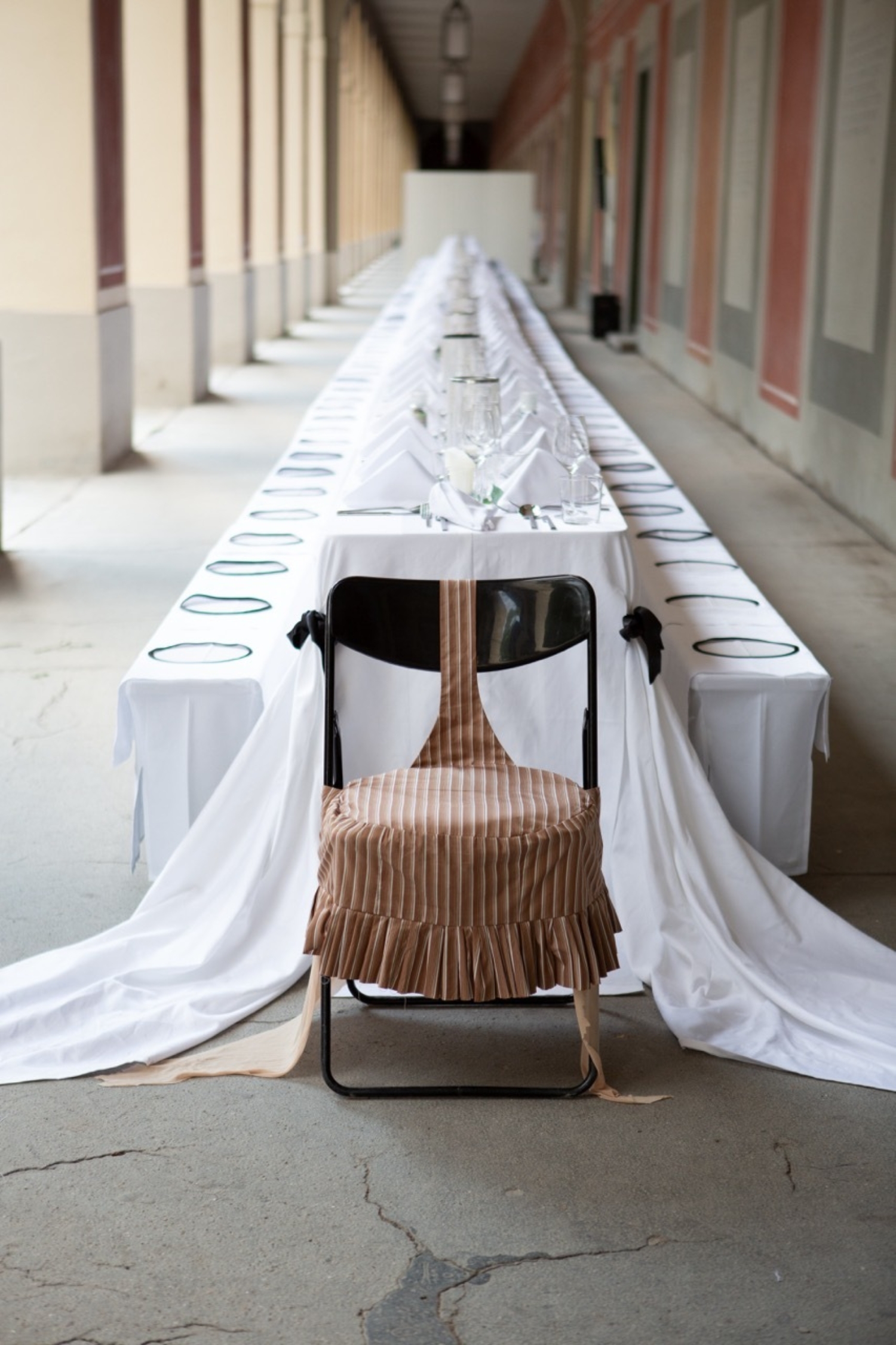
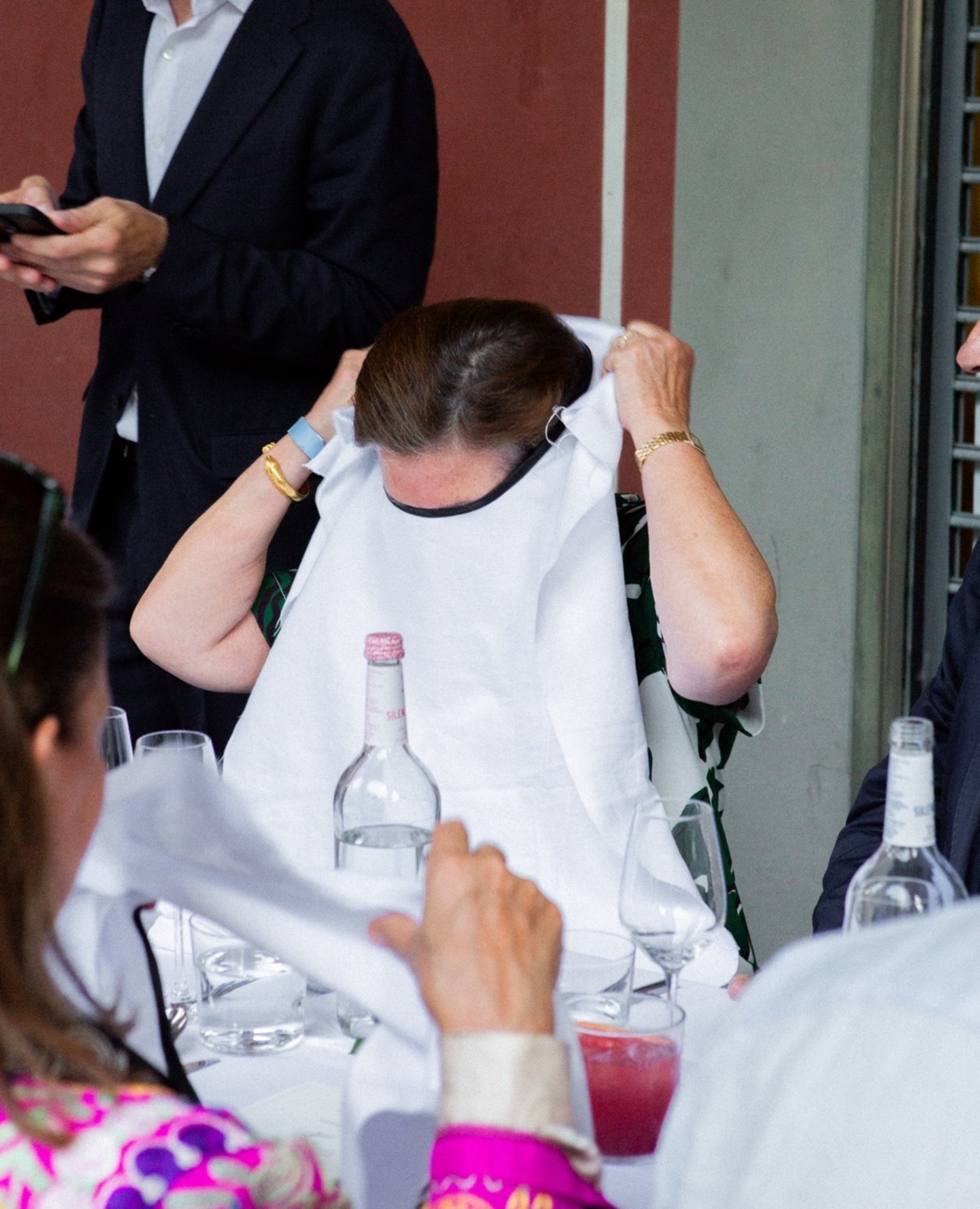
Gabapentin - Nursing Shirt (Business) 2024. Photo: HULFE. Fiona Bate: I’m looking at images of your work for the annual Arkadendinner at the Kunstverein Munich in July – you created the Tischkonzept Relational Bib. In the lead up I remember you were unsure about whether or not guests would interact with the piece as intended. It looked absolutely stunning and people seemed to really love it at the event. Tell us more about the response! And do you find that when people come to engage with your work that they’re quite open to and perhaps (some) in the art world are even missing a more playful spirit?
HULFE: There is always a spectrum in the audiences and no one can be loved and understood by everyone. The Relational Bib was a commissioned piece for the Kunstverein München that connected all dinner invitees through a hole in the tablecloth that worked like a bib. The “serious man” didn't wear the bib but most people engaged and had fun with it. In making the blanket I read a bit about Franz Erhardt Walter, since the blanket is formally overlapping with his work Kreuzverbindungen ( Nr.36, 1. Werksatz ), 1967. I found out that all of his fantastic work was sewn by his wife and he often felt disrespected when the audience did not fulfill the precise directive of the work, or acted too performatively. I found it interesting to make interactive art and then be annoyed when people interact in another way. HULFE produced the piece in many hours of manual labor and I am very happy about all responses. The “serious man” who excluded himself from the work and out of the picture made the piece perfect and complete.
Fiona Bate: That is a beautiful and generous reply. It also affirms something fundamental about art and our encounters – that it is as much about the viewer as it is about the work and artist.
HULFE: So true !
|
|
Relational Bib, Arkadendinner 2024. Photos: Kunstverein München e.V und CNP.
|
|
|
|
|
|
|