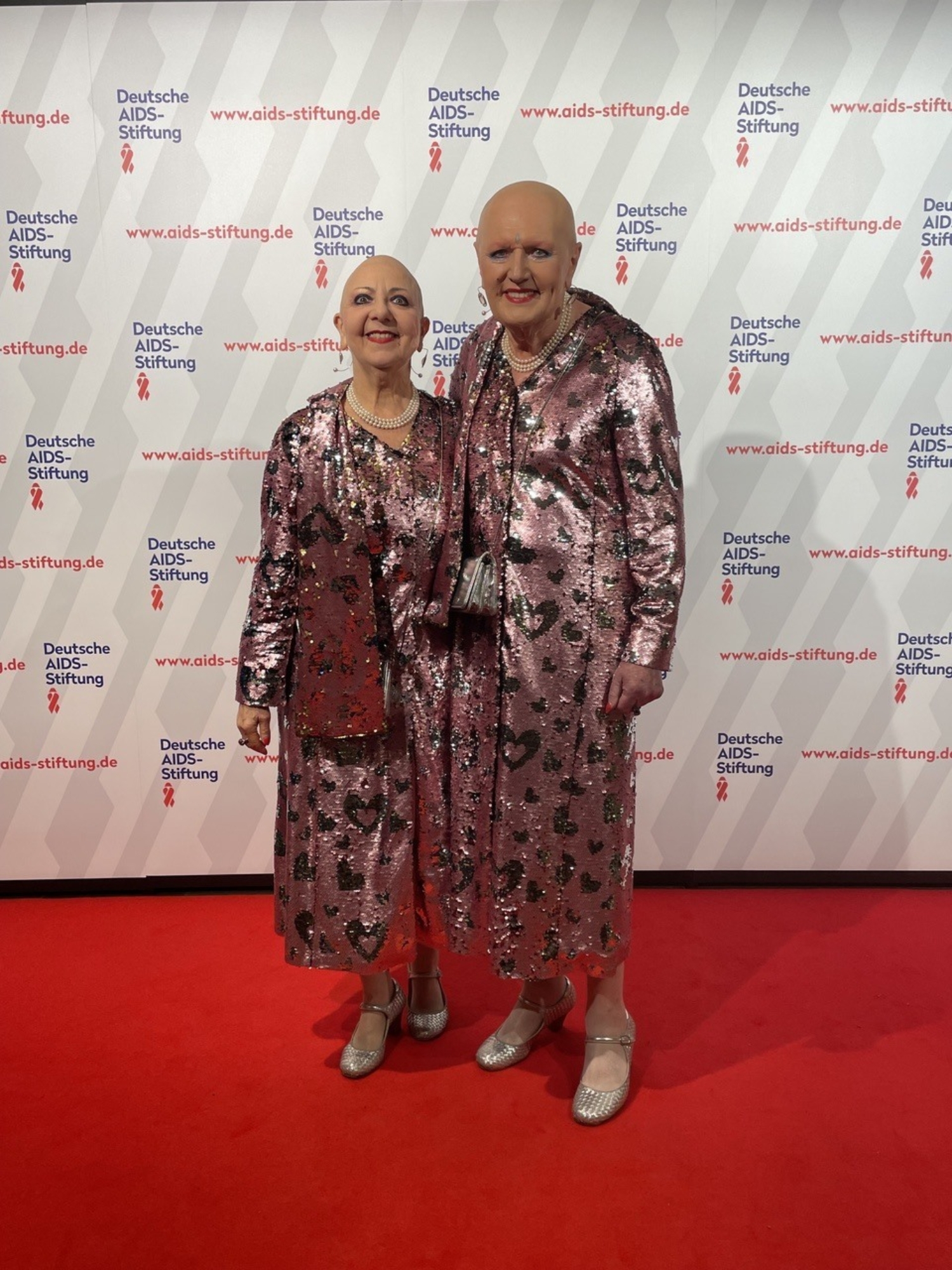
I am not the ornithologist, I am the bird
|
|
|
In the preliminary conversation before our interview, Adele says—when I ask her to tell me something about her work and the work of EVA & ADELE: “Whenever someone wants me to explain my work to them, I always quote Max Ernst: ‘I am not the ornithologist, I am the bird.’ The moment I hear the word ‘explain,’ I get very nervous. Explain is the most terrible word in art.” In this spirit, I tried, tentatively, through conversation, to formulate theses and share observations rather than asking her for explanations. As she speaks, Adele is currently by the Baltic Sea. She recommends that, in moments of artistic blockage, I literally shake myself: “Jump up and down and let all your limbs bounce along with you. Until the block is gone.“
|
|
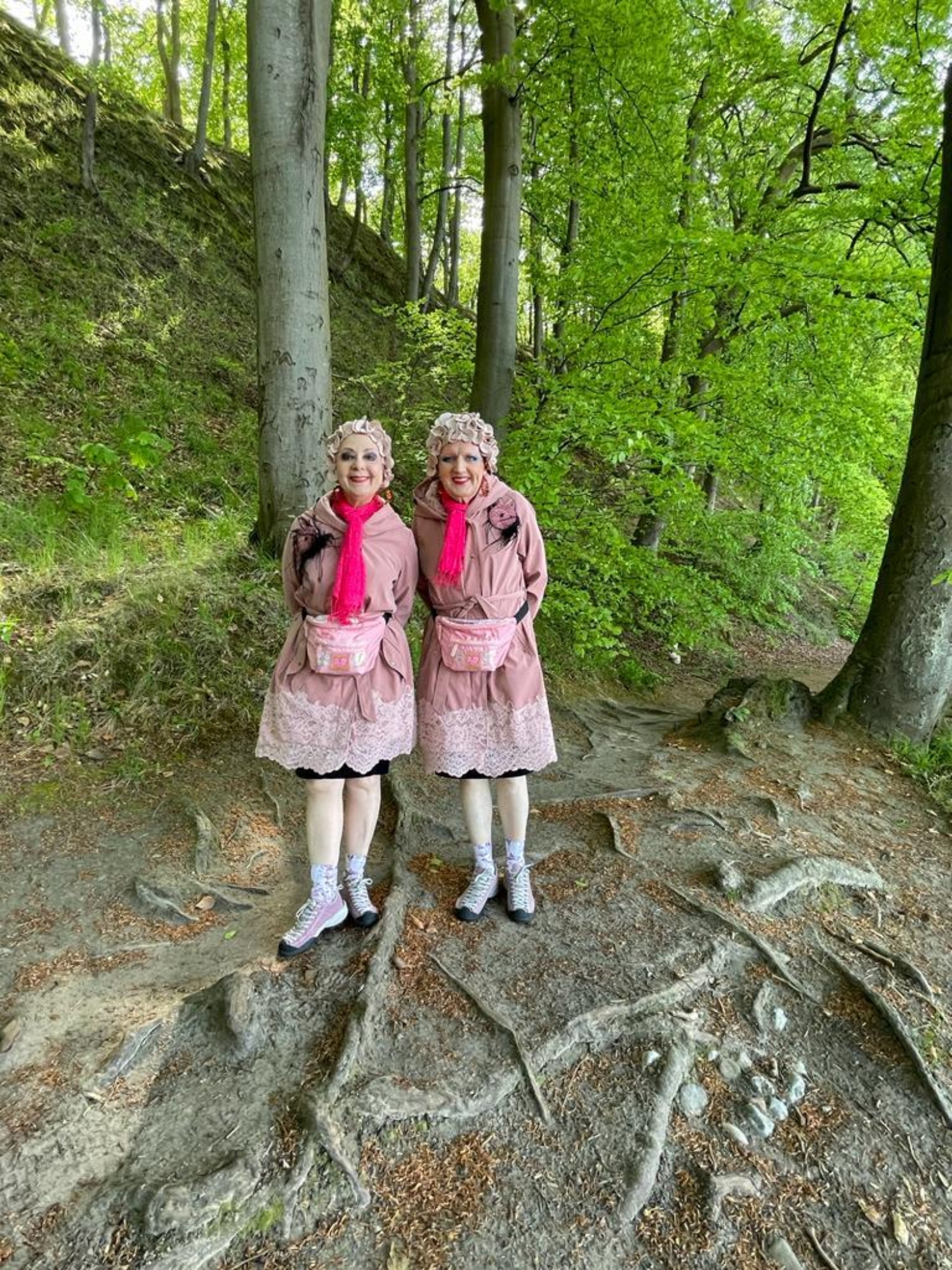
EVA & ADELE in the forest.
|
|
|
Olga Hohmann: Dear Adele, whenever I see you, you give me an invitation. Either you take me along to a great reception that you yourself have been invited to, or you pass on an invitation card that you have received. Last time, during Art Basel, you got me into a reception where I ate several courses in the middle of the day—truffle tagliatelle, beef bourguignon, and petits fours. I still remember how much it got me through the day. Of course I, too, passed on the invitation afterwards. But it’s not only for such practical reasons that I always really enjoy being able to accompany you to these kinds of occasions. I also enjoy it because I sometimes feel that it is almost a kind of social practice. As if you yourself were the admission ticket to all the rooms you want to enter. As if there were no social boundaries for you. And the fact that you want to pass this possibility on to others seems like a way of dealing with the strange politics of exclusion and inclusion that are so omnipresent in the art world. As if you simply ignored other people’s languages and invented your own. What do you think about that? Is it a conscious or rather an unconscious strategy?
|
|
|
Adele: I’m always delighted when I can pass something on. One’s own language—the absolutely personal and unique—is the most important thing in being an artist. It’s already subversion to simply asserting your own completely incomparable rhythm and your own idea of things. I get an incredible amount of pleasure from passing things on and sharing them—and also from sharing a certain attitude. Simply putting one’s own ways of behaving into a space as a disposition. As artists, we are always working on asserting our work—we have to, and we want to, make our work prevail. Owning it with elegance without defending it, fighting for it. That also always means overcoming some conventions of social norms.
|
|
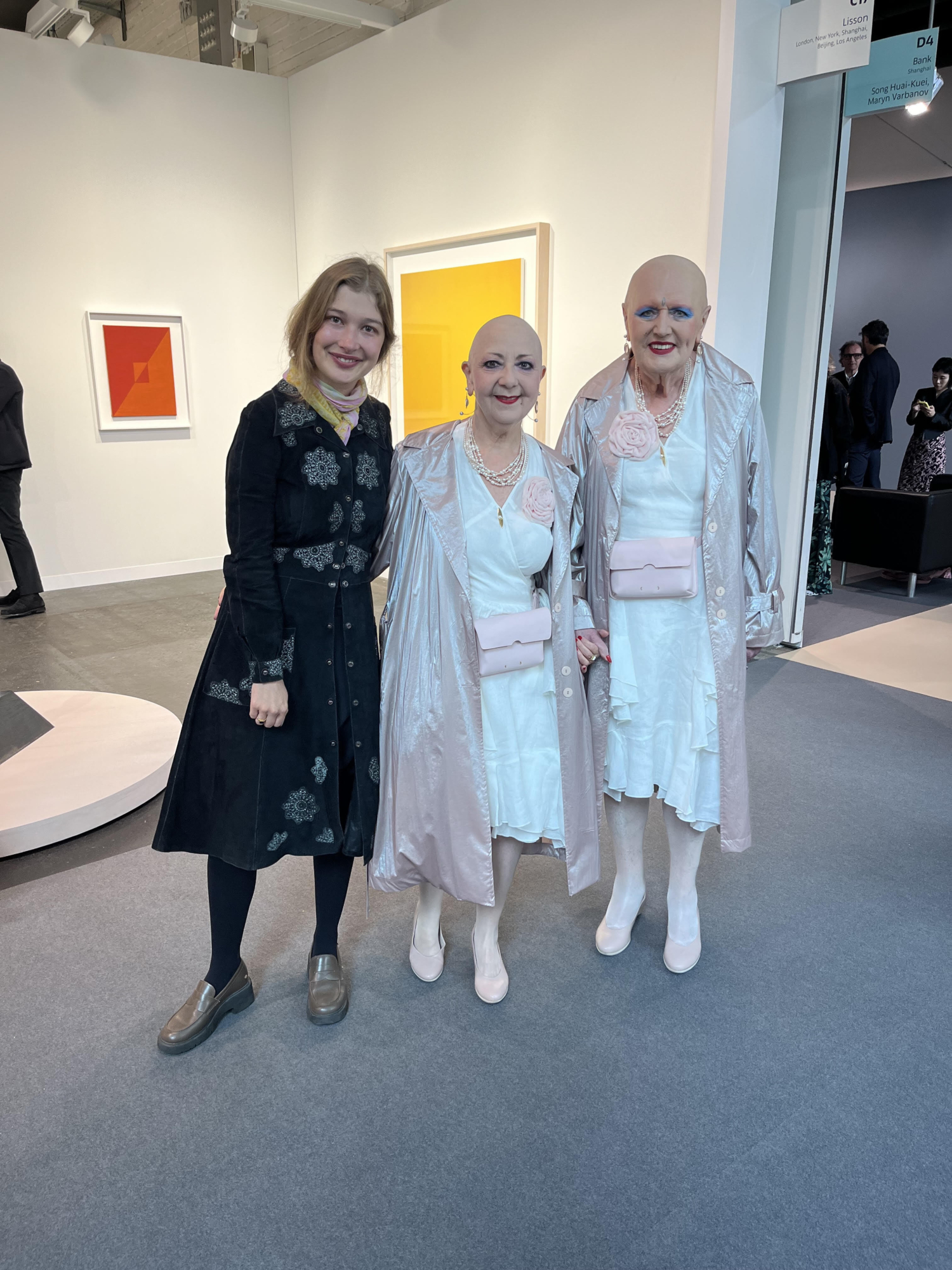
EVA & ADELE with Olga Hohmann at Art Basel, Basel.
|
|
|
OH: Somewhere I read, “You don’t have glamour, you are glamour.” And whenever I’m with you, your presence makes me feel a little glamorous myself. Which, admittedly, very rarely happens to me in Berlin. When I read that sentence, I immediately thought of you. Does it resonate with you?
|
|
|
A: The world needs glamour! For me, glamour is also a revolt. When you feel glamorous, you can give yourself an additional radiance. Although, of course, the radiance some people have comes from the creative process—from the joy they experience through their art practice. When I was a very young artist, I once read a sentence by Aristophanes: “The origin of art lies in the feast.” That has stayed with me to this day.
|
|
|
OH: A large part of EVA & ADELE’s practice involved being photographed by other people. You once told me that you had an agreement never to look critical in photographs, because it simply doesn’t look good in pictures. Playing with the public, also in a visual way, was such a major part of your work. So, for those moments when you might have wanted to express criticism, you had this kind of code word…
|
|
|
A: We agreed early on: We determine the mood—the mood in the room. That is also an artistic assertion. We don’t react to the atmosphere; we are, in a sense, immune to it—and create our own atmosphere. We always made a point of never allowing anything in the room to dictate our mood—or spoil it. Those overly critical, academic artists with their sometimes miserable facial expressions—aaah! Terrible! If something has no humor, then it’s absolutely not for me.
|
|
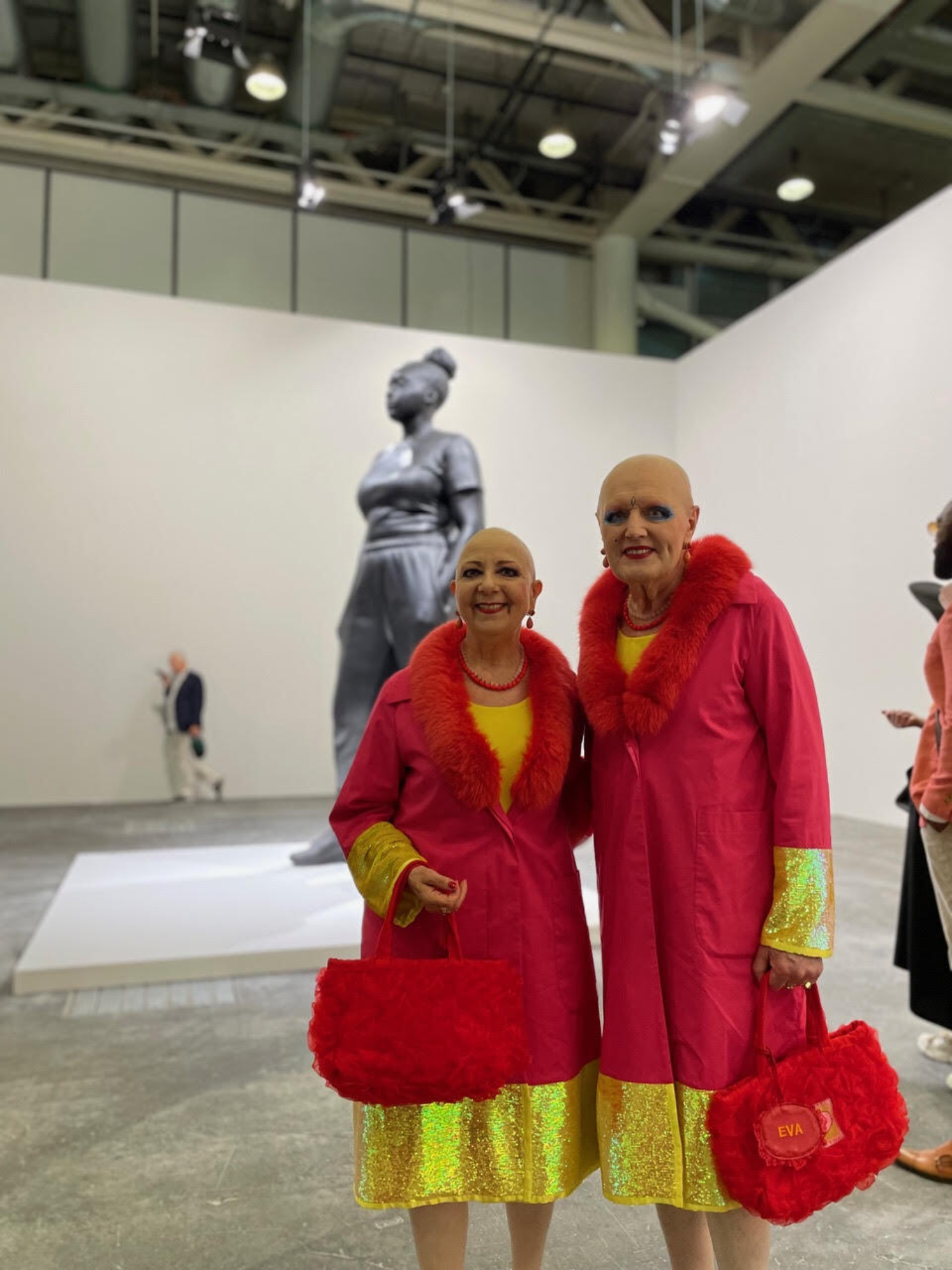
EVA & ADELE at Art Basel, Basel.
|
|
|
OH: Can you explain what “No Crisis” means? In other words—which idea of art is contained in this code word?
|
|
|
A: Of course, we reflected a great deal on what we were doing. We analyzed, thought, discussed, and read all day long. But we realized that this aspect of our work was impossible during a performance. It didn’t work visually for us to have reflective conversations while we were performing. So we decided to postpone those conversations until later—or have them in between, when we took breaks. “No Crisis” was one of the code words we nevertheless used during our performances to express that we really, really didn’t like something. It also contains a certain understanding of art as something that should always have an existential dimension. “No Crisis” meant that there was no struggle in the work, nothing being overcome, nothing being wrested from it. That it lacked the depth that could have made the work interesting. “No Crisis” was the harshest criticism we could express. And the most wonderful thing, by contrast, was when I would suddenly burst out laughing. If I could laugh at certain works of art, sometimes for reasons I couldn’t explain at all, that was the greatest compliment.
|
|
“'No Crisis' meant that there was no struggle in the work, nothing being overcome, nothing being wrested from it. That it lacked the depth that could have made the work interesting.”
|
|
|
OH: Did you have other codes and code words? Of course, I only want to know about the ones that aren’t supposed to remain secret…
|
|
|
A: There were lots of code words. “Next round,” for example, was one of them—hahaha. It was inspired by boxing matches or other athletic competitions. Some people found our appearances, or simply our proximity, uncomfortable or embarrassing, and when we sensed that, we liked to stay extra long, do another round, and then another, happily tormenting the embarrassed people just a little more through our sheer presence. That was a secret at the time. But I can tell the story now…
|
|
|
OH: When you are as close as Eva, and you were, do you sometimes need distance?
|
|
|
A: You have to have an enormous amount of respect for the people who are closest to you. Even though that is sometimes the hardest thing. That was very magical about Eva and me: We could work very closely together in the same physical space and still separate ourselves quite well and be alone with ourselves. We never disturbed each other. Our first Berlin studio was in Winterfeldtstraße in 1990. My brother Alois lived in the back building at the time, and we had our studio in the front building. Sometimes I would go to my brother in the back building and call Eva in the front building on the landline. Simply because her voice sounded so sexy on the phone. It was a game I enjoyed playing.
|
|
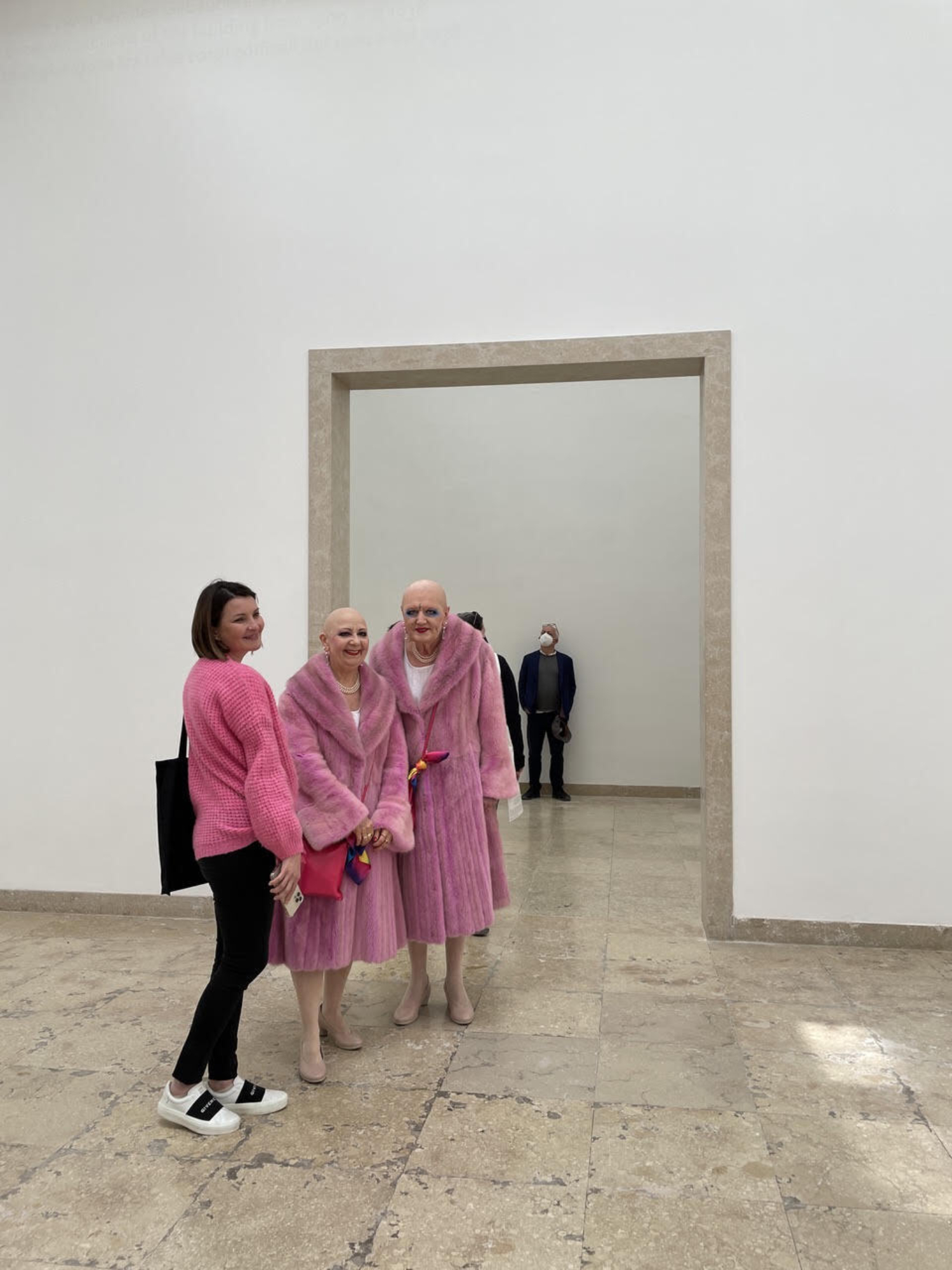
EVA & ADELE at the German Pavillion, Venice Biennale.
|
|
|
OH: You love the opera and always sit in the same seat in the front row at premieres. At the opera, you are constantly being greeted—you’re a real regular. Do you love opera because there is more grand drama, grand emotion, great craftsmanship, and sometimes a little—or a little more—camp than there is in contemporary art? „More is more“. Do you sometimes miss that in art?
|
|
|
A: Eva and I were independently exposed to opera and theater at an early age as part of our upbringing. EVA & ADELE was, of course, also a theatrical appearance, which is why we always felt so close to opera. But we had to fulfill all the professions that exist in opera ourselves: We had no wardrobe or costume attendants, no makeup artists, no orchestra pit, and no stage curtain. We were all of those things ourselves. And when we actually went to the opera together, directly opposite our home, we naturally sat together in the front row. Now I take different friends with me to the opera, who then sit beside me in the seat in the front row. That way, it never remains empty. In our performances, as EVA & ADELE, we were also, in a sense, always sitting in the front row. We were the only ones who immediately received all the audience’s reactions from every direction. The audience surrounded us. We ourselves were both the show and the spectators at the same time.
|
|
EVA & ADELE at the opera in Berlin.
|
|
|
OH: What is your relationship to the historical avant-gardes? You once said that the number “2” is always a sign of the avant-garde. And the number 2 is, of course, important in your work.
|
|
|
A: Yes, I read that somewhere once; I don’t even remember where. I simply think that EVA & ADELE was really about overcoming the cult of the individual hero. The historical idea of genius, which is very much shaped by a male perspective. It was about integrating two potentials into one work. The work itself is the boss: „Das Werk ist unsere Chefin“ we always said. Sometimes we also joked and said, “We work for EVA & ADELE.” Or, even better, when people asked us whether we had assistants, we liked to say, “Yes, two. I’m Eva’s assistant, and Eva is my assistant.”
|
|
|
OH: Can you tell us the story behind your new hairstyle?
|
|
|
A: Well, I don’t know if there’s really that much to tell. It was Eva’s wish, in the end, that I should continue wearing my head shaved. I actually loved having a shaved head and really enjoyed shaving it. When the skin on your head can breathe so freely. But I thought: I need to step out of the work visually now. I also need to reinvent myself a little aesthetically. Sometimes people say to me, “You have the same presence as before, you’re just two, 2, now!” As a young woman, I already experimented a lot with short hair. Right now it’s about one and a half centimeters long, which is actually much too long for me. When it’s exactly 4 millimeters long, I think: “That’s exactly me!” When I come back to Berlin from the Baltic Sea, I already have an appointment at the hairdresser! By the way: Two nights ago, someone left a bottle of champagne outside my door here. I still don’t know who it was. It was a mystical moment. I think it was Neptune.
|
|
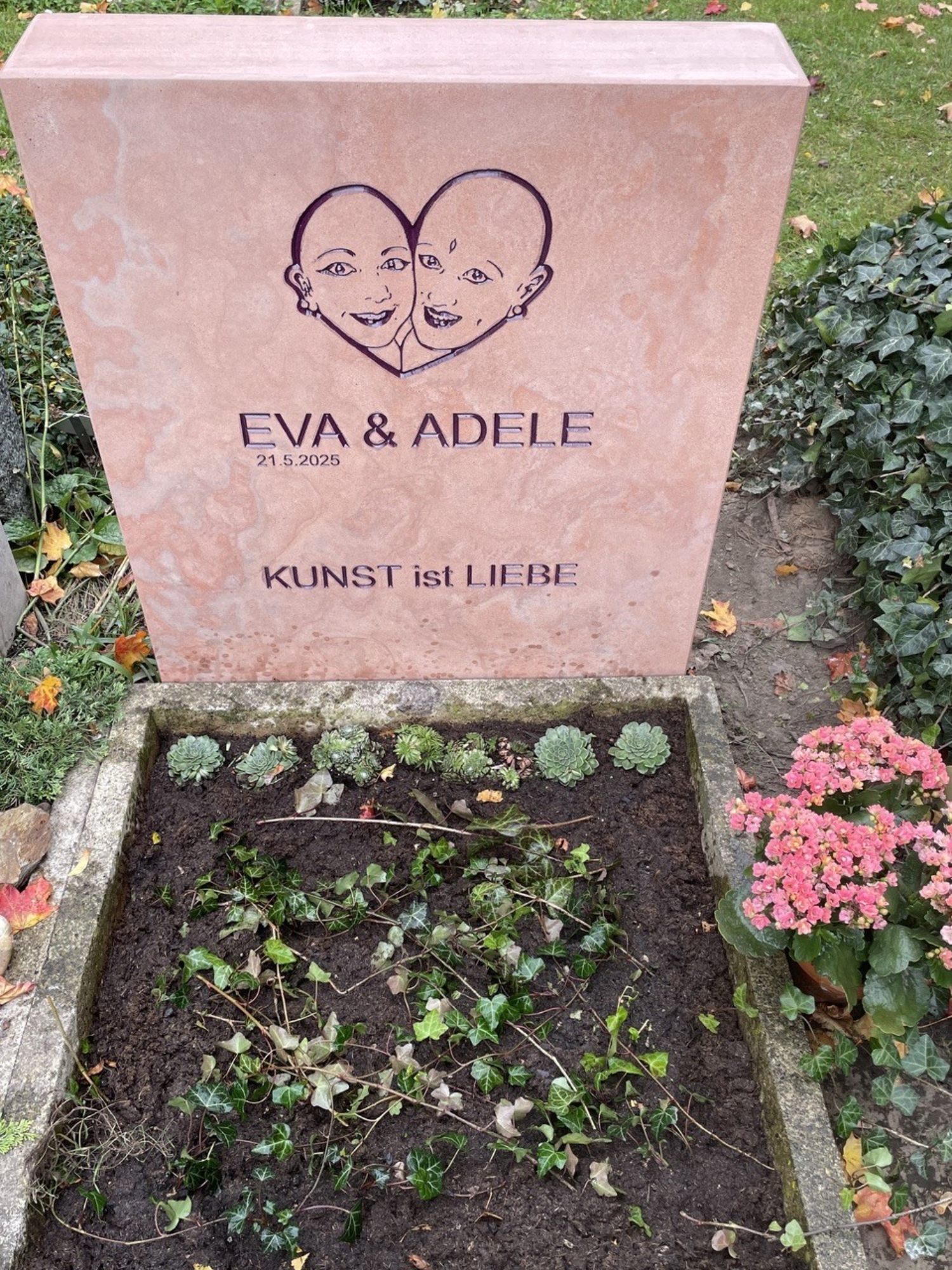
EVA & ADELE's gravestone.
The ‘EVA & ADELE’ tomb is a biographical sculpture (No. 88) in public space.
|
|
|
|
|
|
|