Hourly hotel for ghosts, or Ghosts only for hours, or When space was still a currency
|
|
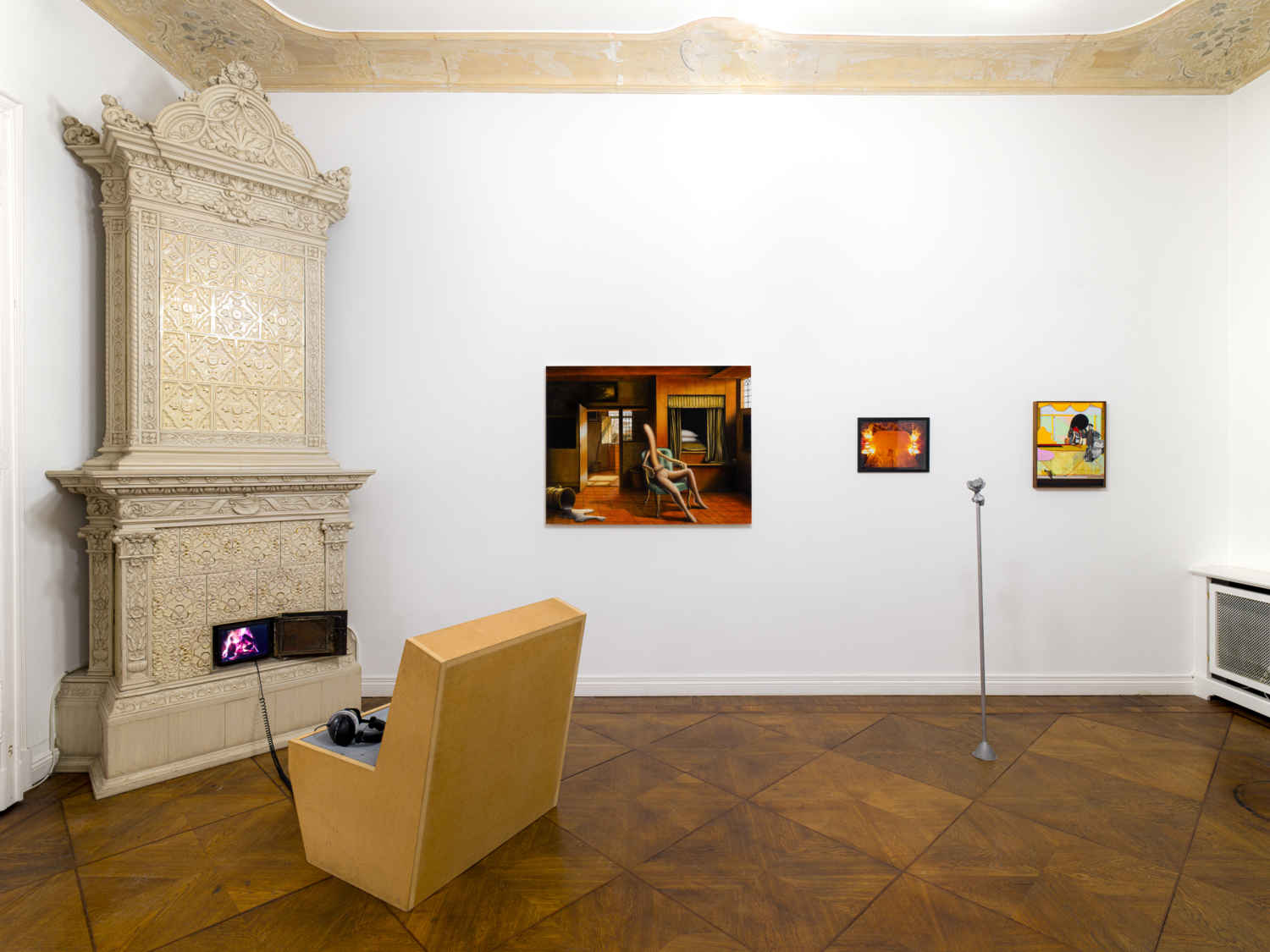
Installation view: Pension ABC, Contemporary Fine Arts, Berlin.
|
|
|
Home is where the haunt is
– Mark Fisher Ghosts are travelers in familiar surroundings. Invisible, they often enter rooms they already know. Rooms where they left a mission unfinished. Ghosts usually haunt places where they still have a purpose in their familiar surroundings, a task they can never complete in their physical state. Unless they “instrumentalize” the living, whom they secretly envy, and who then, as pathologically possessed individuals, carry out their missions for them. Just as ghosts come and go, people come and go in hotels, wandering through cities, countries, and continents. Some of them are artists, you are coming for exhibitions and leaving again when the opening is over. The local therefore sometimes plays a marginal role to them, or is observed as something foreign. Few of the international travelers know much about the developments of the cities they’re visiting over the last hundred years, or they view it as an anthropological or archaeological site. As well as ghosts, artists, too, sometimes feel as if they are fulfilling tasks that are not entirely in their hands. Tasks that have been communicated to them in one way or another by an immaterial entity. As if they were carrying out what they had been instructed to do—for one reason or another.
|
|
“Just as ghosts come and go, people come and go in hotels,
wandering through cities, countries, and continents.”
|
|
|
This reason may be very economic, very political, very social, or even driven by questions of beauty, humor, and narrative. Stories want to be told, they have a momentum of their own. Especially when they are stories of those who are absent. Stories that haunt them. But it is not always the spirits of specific people who have passed away that haunt us. Sometimes it is more of a “calling” in terms of substance. Haunting, in German “Heimsuchung”, involves the “home“ —just as the “uncanny” addresses the ”heimelig" as much as the “secret.” What remains hidden from us often inhabits what seems particularly familiar to us, the spaces where we ourselves believe we are at home. The spirits dwell in our own bodies, they inhabit our own dwellings, they are “embodied” by us, they materialize through us. And in our attempt to exorcise them, they manifest themselves in us. Perhaps we ourselves are the spirits we fear? Art historian Ernst H. Gombrich describes the process of making art as a process of growth. The work emerges from the artist in the same way that a grain of sand grows into a pearl inside an oyster. “To form a perfect pearl, the oyster needs some foreign body, a grain of sand or a splinter, around which the pearl can develop,” he writes. The foreign, the visitation by a ghostly force that eludes the individual, is inherent in his (literally “conservative,” conserving) concept of art. Only in the tranquility of the closed shell, the studio, can something that seems profane at first glance become something valuable. The moment to open the shell must be just right, not too early and not too late. Otherwise, the inside is inedible, rotten, sometimes even poisonous. Some works of art are, of course, intended to be toxic, to infect the viewer with something that they will carry with them for some time, sometimes forever, something they cannot get rid of. Here, the idea formulated by Marcel Mauss in The Gift is also appropriate: namely, that the English “false friend” of the German gift is poison. Every gift is toxic. Of course, in this scenario, the artists are hosts—they “receive” ideas and processes rather than “producing” them—but only after they have specifically invited them. However, the guests, the artworks, are not always what one might have imagined. The guests elude the hosts' control.
|
|
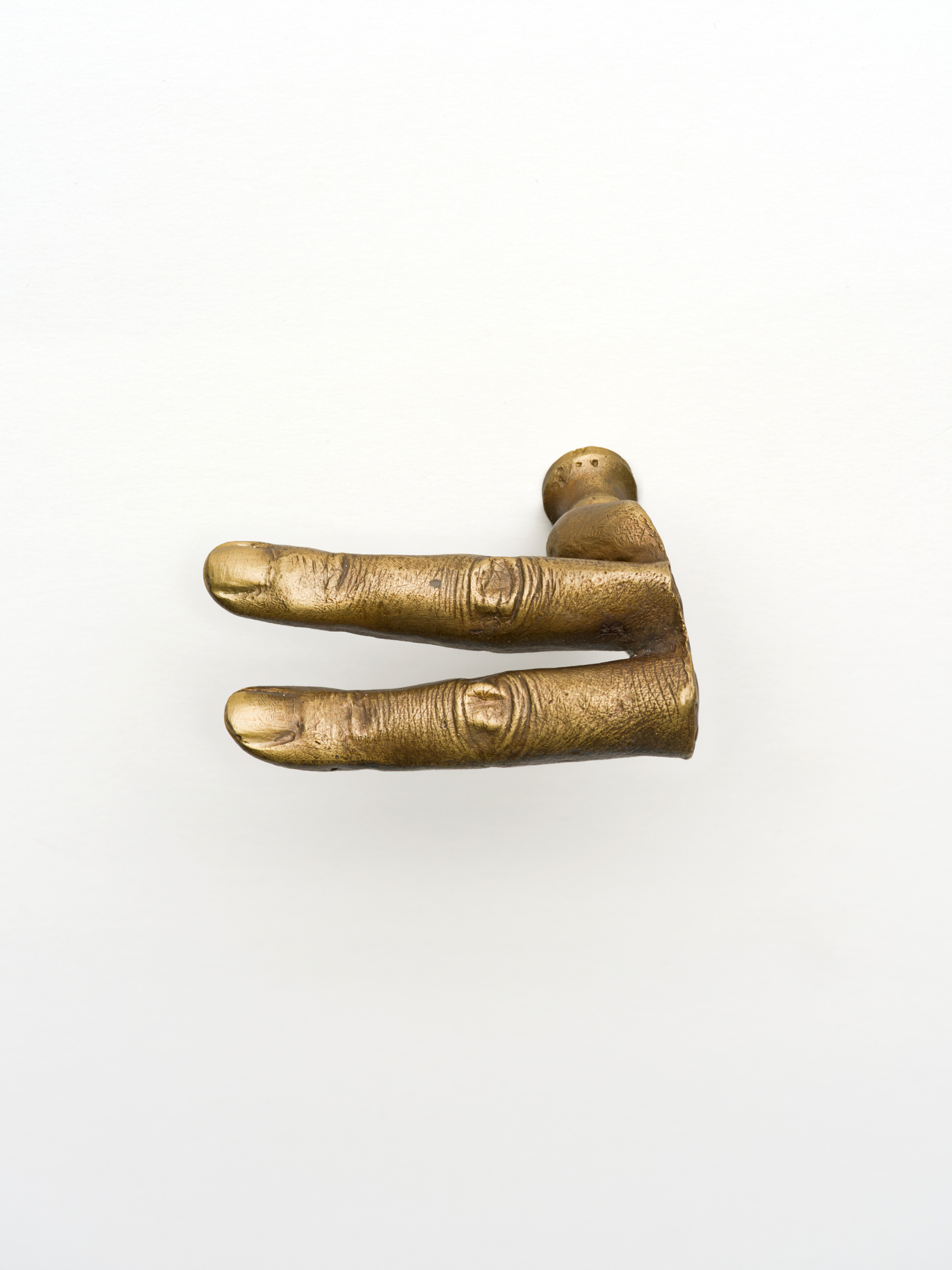
Angelika Loderer, Peace, 2024.
|
|
|
In Pension ABC, CFA offers precisely these ghostly apparitions, these artistic apparitions, a “home” and does so in a literally semi-domestic context. The first floor of the Charlottenburg Wilhelminian style building with its star parquet flooring is located directly above the gallery rooms and represents a place of classic upper-middle class bourgeoisie. What you only notice at second glance, however, is that there used to be bathrooms in several places. Traces of a time when the apartment, which was initially designed as a family home, was a guesthouse, a small hotel run by a private family, namely Pension ABC. The name was chosen for purely pragmatic reasons: ABC, written here in capital letters, naturally took first place in the telephone book, the Yellow Pages. The Yellow Pages (and their alphabetical hierarchy) are like the guesthouses in post-war West Berlin an only recently extinct, archaeological phenomenon of a past that is not so long ago – but nevertheless already nostalgic. Nowhere were there as many of these small hotels as in West Berlin before the fall of the Wall and there is a tragic reason for this. Of course, hardly anywhere else were there as many empty apartments as in Berlin after the end of World War II. So the idea of hauntings is not far-fetched; Berlin's historic buildings have often witnessed the darkest episodes of 20th-century history. Like traces of such an absent life, Angelika Loderer's brass works cling to the brass door handles. It's startling when you want to use them,because there are already fingers on the door handle - like the ones that you would have used to open it yourself. The door opens, as it were, “by ghostly hand”. But then the strange, disembodied fingers not-so-magically show you the PEACE sign. Or a mouth sticks its tongue out at you as a doorknob, as in Operator (Mouth 2). This fragmented face stuck to the door looks like part of a death mask. An imprint of something that was once alive. Zuzanna Bartoszek's Three Lights shows a view from a window, specifically, the view from a train window. A fleeting, domestic space. Perhaps the traveler will arrive at one of those guesthouses at the end of her journey. I am reminded of E.T.A. Hoffmann's The Sandman, in which the view from the window also creates confusion between a “real” person and a ghostly doll. How many ghosts dwell among us, materialized in figures, scarecrows, black cats, or objects that are heirlooms of the deceased—or even anonymous flea market purchases?
|
|
Zuzanna Bartoszek, Three Lights, 2025.
|
|
|
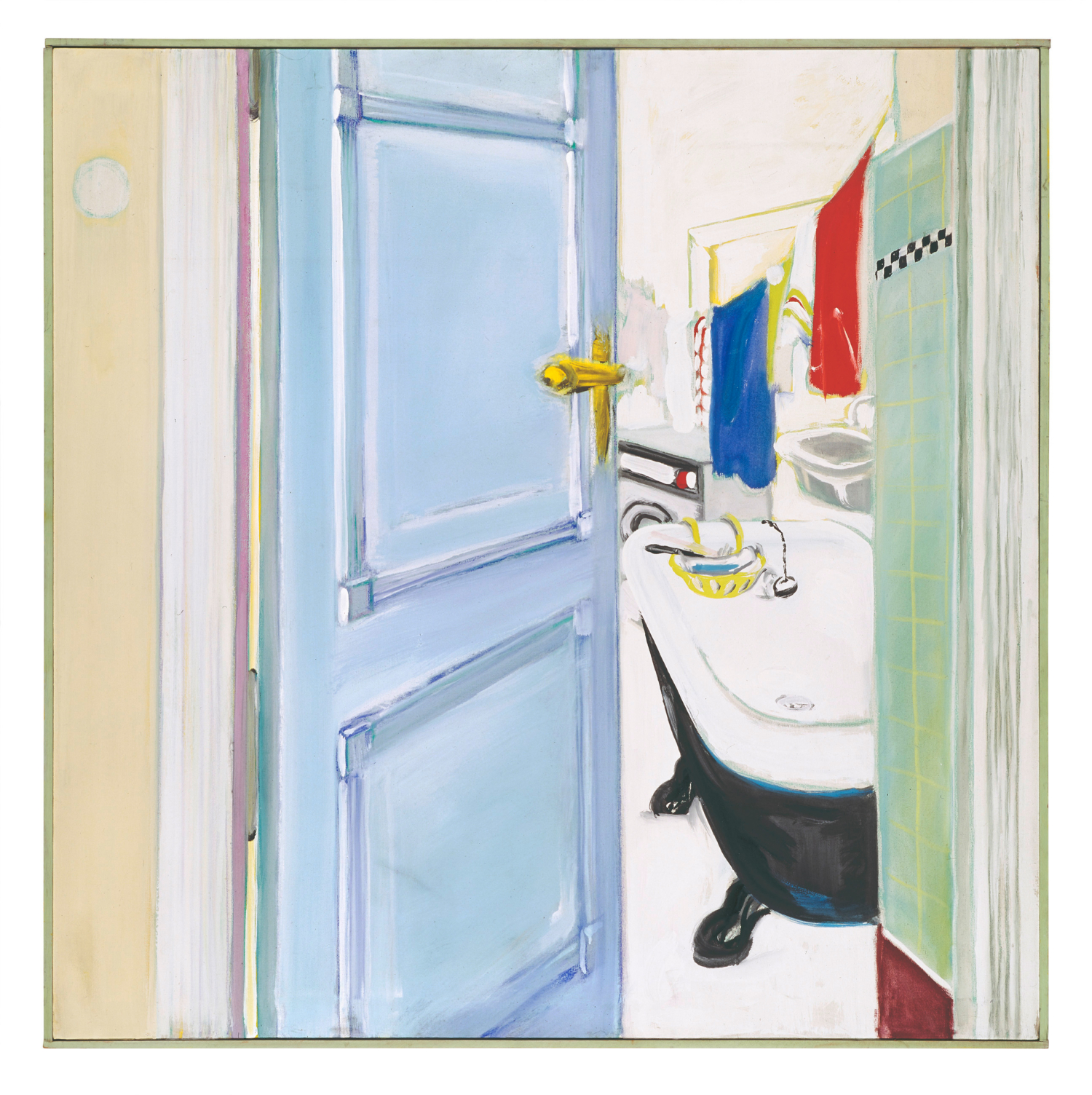
We also seem to catch fleeting but haunting glimpses through windows in the works of Cosima zu Knyphausen, which appear almost like “pictures within pictures”—framed by the wallpaper of bourgeois living rooms. Here, too, I am reminded, perhaps not coincidentally, of a literary work, namely Fleur Jaeggi's Sweet Days of Discipline. Many of the images are “read” in the same way that one reads a text. They are not merely a visual experience, but tell stories—similar to crime scenes. As a viewer, one embarks on an almost forensic search for clues, delving deeper into the scenes, which almost always remain devoid of figures. In Christa Dichgan's 1965 work, a bathrobe is carelessly thrown onto her herringbone parquet floor—an object that could just as easily belong to a private individual as it could be a generic bathing suit belonging to a hotel guest. The view through the gap in the door in Badezimmer II (Bathroom II) onto the everyday scene also raises more questions than it provides answers. What is hidden behind the door? But also – why does such an everyday constellation become the motif for a painting? Again and again, it is the surfaces of the tiles, the floorboards, and the curtains that receive special attention here. In Cosima zu Knyhausen's work, we see figures, protagonists, but they are blurred and, literally uniformed, appear more like stereotypes than subjects. We see scenes of order, subordination, and desire. Scenes from the 1958 film Mädchen in Uniform, which features the first romantic kiss between two female protagonists known to a wider public. The slightly clichéd scenes, which we observe as if through a keyhole, our position in the room placing us in the role of a voyeur, are thus emancipatory in nature, although at first glance they seem more like the image of a deeply normative context, the girls' boarding school. Gentle resistance, resistance through gentleness, sometimes arises in the spaces of discipline. In Der kleine Entscheidungsraum, Christian Jankowski actually transforms a spa hotel in Baden-Baden into a by-the-hour hotel – by having volunteers repeatedly redecorate it. Künstlerpfad 6 also deals with the ephemeral – he weaves carpets using the nostalgic technique of wayfinding, which used to be commonly found on napkins or notes lying around. The ephemeral—never intended to be immortalized—thus becomes immortal, undead. Casual, incidental messages are often the most haunting—like answering machine messages from a dead person. In this case, it is a note from his (still living) professor Franz Erhard Walther, explaining to his students how to get to a Greek tavern in Hamburg.
|
|
Christa Dichgans, Badezimmer II, 1965.
|
|
|
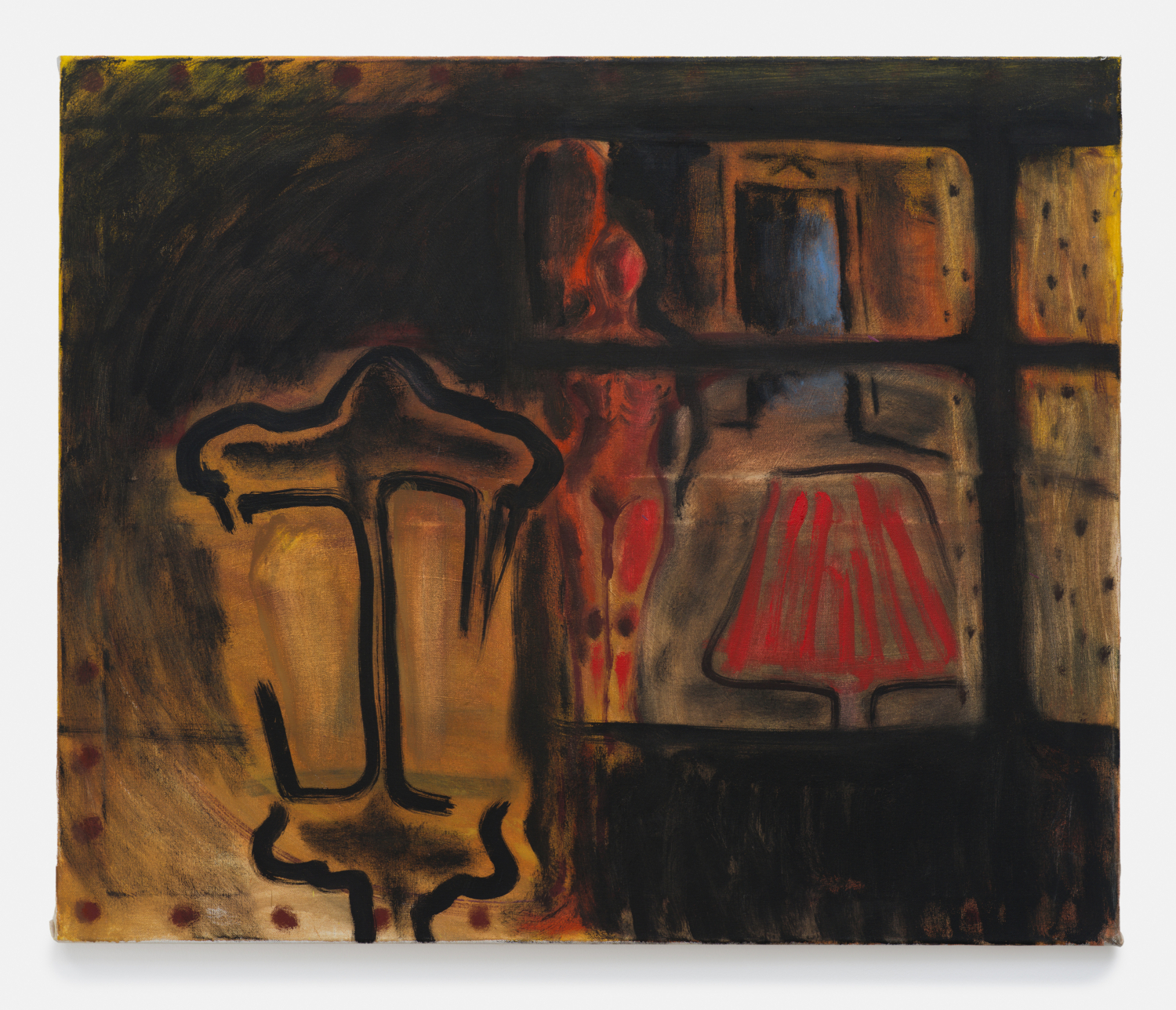
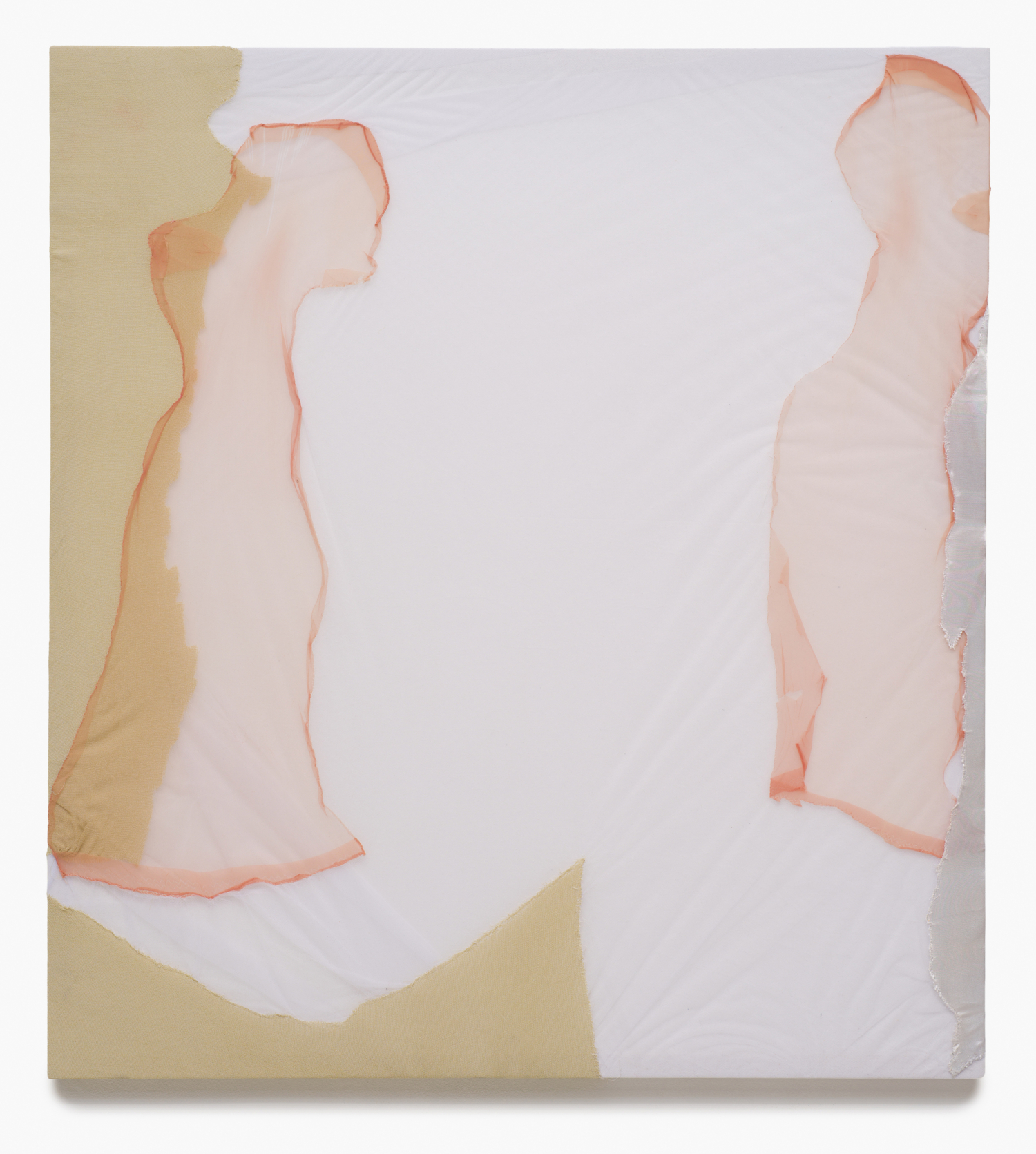
Anna Virnich explores textiles as carriers of memory: in Somnambul, sleepwalking, if not insomniac, figures emerge that almost seem as if they were merely dreamed or imagined. She combines materials of higher and lower normative value, thereby creating a fluidity in the class-specific connotation of the objects, as is often found in hotels, where ‘high’ and 'low’ are sometimes not so easy to distinguish from one another. If the ‘customer is king’, then everyone who has the money can become a king. In Travis MacDonald's Behold, a figure also appears in the form of an extraordinarily carefully transported garment, which appears more physical and “filled (with life)” than the somewhat bloodless body carrying it. A very casual-looking spirit, an everyday kind of ghost, appears here, and it could take on the form of just about anyone who wears a white shirt from time to time. A generic spirit in many forms at once.
|
|
“If the ‘customer is king’, then everyone who has the money can become a king.”
|
|
|
Nan Goldin's 1994 work entitled Honeymoon Suite, Nürnberger Eck, Berlin is one of, if not the central work of the exhibition. The fact that Goldin, despite her outsider status in the city, is a true Berliner became clear when she took on the responsibility of verbalizing what many other local actors had previously avoided to say, at the opening of her exhibition at the Neue Nationalgalerie. In this respect, her speech was also a declaration of commitment to the city, as a place where language can create reality and where people summon up the civic courage, or simply courage, to think, argue, act, and make art in a radically political way in both the intimate, so-called private and public contexts of life. The Nürnberger Eck was one of the most prominent of the countless guesthouses found in the not particularly romantic post-war West Berlin, making one wonder who on earth would find it appealing to spend their honeymoon in this deeply grey city. Was the “honeymoon suite” ever occupied by honeymooners? A ‘honeymoon’ - a love hotel - for ghosts, perhaps, or rather, the weeks in which the newlyweds become strangers to each other. It is precisely in the unspoken expectation, the imperative to now be “the closest” to each other, that one occasionally becomes particularly estranged. The uncanny can be found in the familiar, in one's own sheets and in the abysmal, sometimes dusty corners of one's character, which spouses sometimes only reveal when they feel secure enough with each other. A splinter in the domestic shell of marriage. Spontaneously, I think of Felix Gonzalez-Torres' iconic work from the Billboard series: the intimate scene of a crumpled double bed, printed in black and white on huge billboards in Manhattan. A Statement. The story of a friend of mine also “haunts me,” so to speak: in her early twenties, the Viennese young woman moved into the apartment of a friend's grandmother who had just passed away. The old lady had lived alone in the apartment for a long time and always slept on the same side of the double bed, which had left a deep hollow in the mattress on one side. Already feeling extremely defined by the old lady's very specific furnishings, my friend tried to sleep on the other side of the bed, so as not to be completely absorbed in the reenactment of this past life. In vain: gravity caused her to roll into the hollow in the bed every night, and so she woke up in the morning in the old woman's body imprint. She had a latent feeling that the lady was silently raising her eyebrows at her extravagant lifestyle, so my friend moved to another apartment at the next opportunity a few months later. The splinter in the pearl that represents artistic practice also has something ghostly and immaterial about it. A “false friend”—representing the tension that drives us, that which remains unspeakable because it is not necessarily at home in the context of language. It goes without saying that in Berlin, a city where there is historically little “old money,” available space for living and working has taken on the function of capital. It also goes without saying that this space has disappeared—and that the currency has thus experienced deflation, so to speak.
|
|
Anna Virnich, Somnabul, 2020.
|
|
|
In Pension ABC, the space itself, and its traces on the parquet floor, plays the leading role; the apartment is the main character within the realm of the exhibition. The works, certainly more than „extras“ though, are arranged in a site-specific manner in a context that could hardly be more particular, reminding us of “what Berlin once was.” Pension ABC reminds us of this in a pleasantly local-patriotic manner, and in a way closes the circle by showing us that history is cyclical. It doesn't repeat itself, but it rhymes - as Mark Twain writes. Where there is “not much to be gained” for artists in this city, either commercially or institutionally, the underground develops. Passion and dedication become the (only) mission. Mutual support seems easier when there is not much to compete for. The history of the city is written in basements, studios, squatted spaces, and above all in private and semi-private spaces that are suddenly shared. Communication about “where what” is happening tends to be oral, in the spirit of a speakeasy culture. And, without wanting to fall back into the logic of the corporate world, the new currency in the scene is perhaps precisely this information—about “what is happening where with whom.” The precariousness is not romantic, but brutal. We are certainly not „sitting in the same boat“. But there is a certain “equality” in it, or at least a tenderness and enthusiasm. Because, as Diedrich Diederichsen recently described very accurately in his Artforum article The War on Bohemia, it has simply become damn hard for artists to live in this city, which structurally attempts to eradicate bohemianism and its idea of freedom of expression through urban politics. And, simply put: It’s become damn hard to pay for one's life, every day. So there's no need to be afraid of the ghosts of the past, because they disappear just as quickly as they arrived. And in any case, you should be at least as afraid of the living creatures of the present. It's a comforting thought that new ghosts are also being created and that one day you yourself will become a hopefully "friendly ghost.” A reliable, a steady ghost. (Because ghosting people - lovers - , on the other hand, is OUT in 2026.) The more ghosts we have around us, the less lonely we are. Ghosts are actually quite good company. They put history into perspective. You won't find them in the Yellow Pages, because these are extinct. Unlike ghosts, the undead, who are still around.
|
|
|
|
|
|
|