Home Is a Foreign Place – An Interview with Sandra Knecht
|
|
Sandra Knecht – HOME IS A FOREIGN PLACE, Kulturstiftung Basel H. Geiger I KBH.G, in collaboration with Lukas Wassmann. Photo: Lukas Wassmann.
|
|
|
Valerie Keller: You live in a small village in the countryside of Switzerland that can only be reached with Postauto (post bus) twice an hour. In your work, you address the phenomenon of home. This all puts you in an outsider position – at least in the art world.
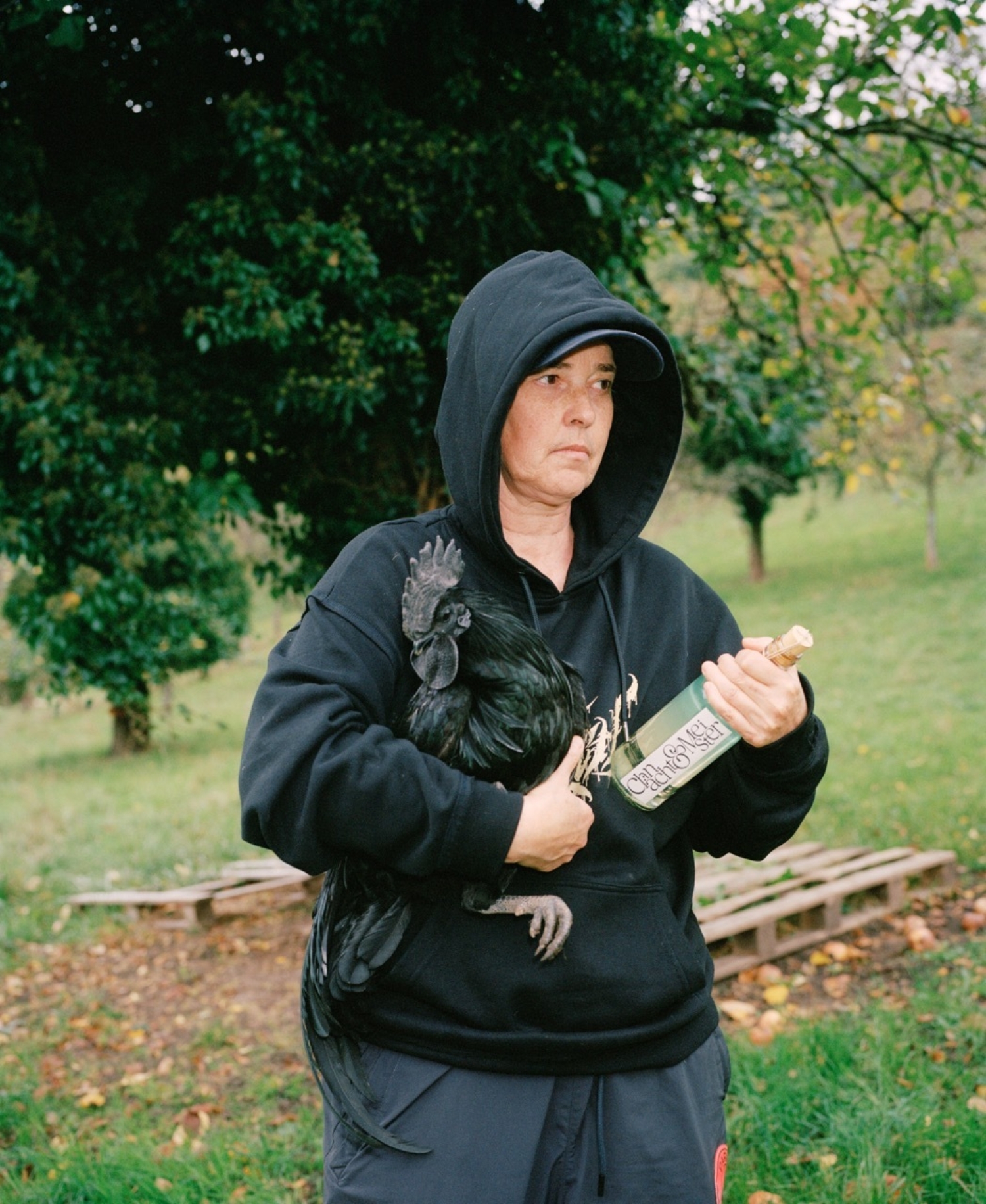
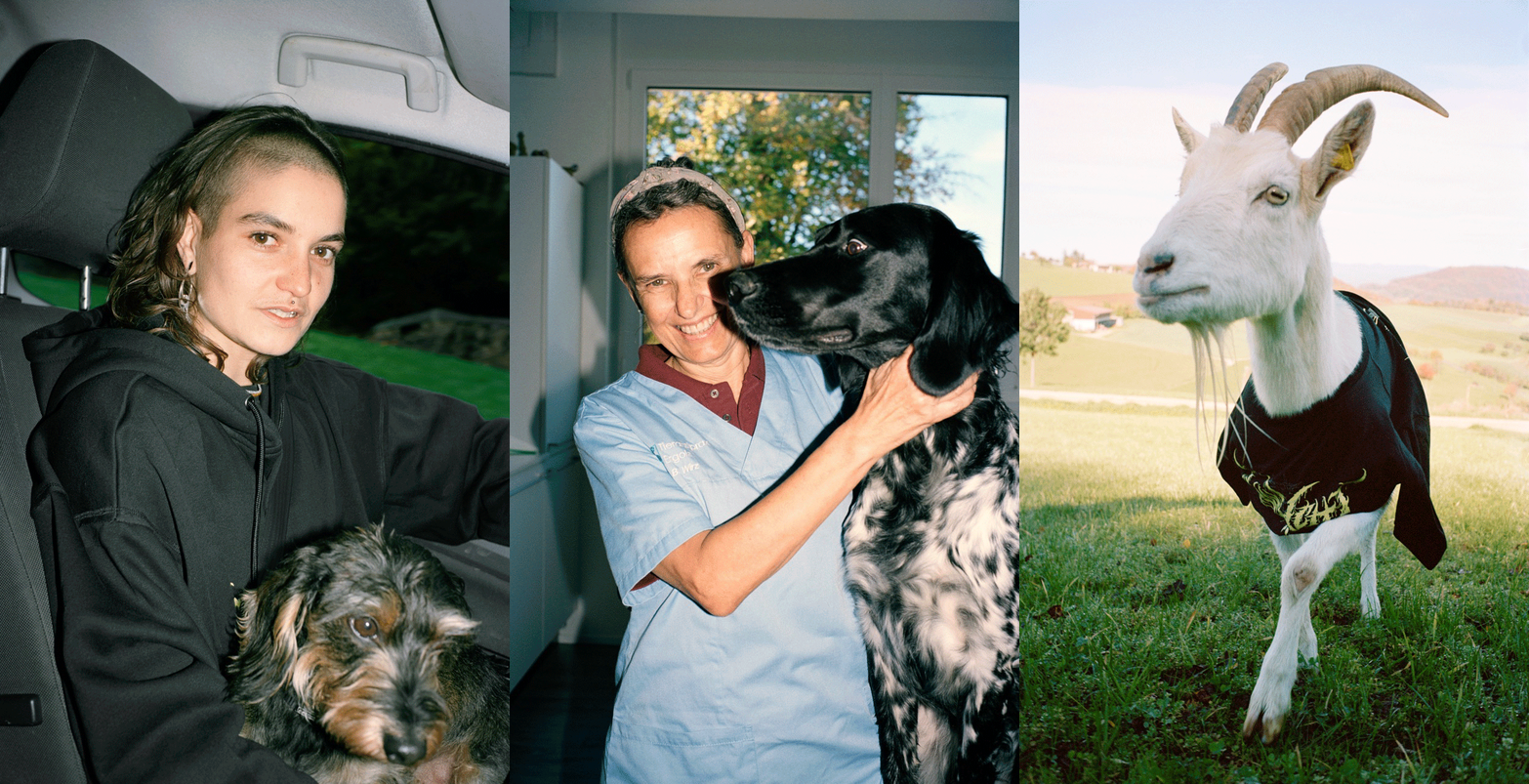
Sandra Knecht: Furthermore, I am considered an outsider because of my age. I only started studying art at the age of 43. I know what it is like to live without the art market, where you just go to work and get money in exchange. But even today, I still see my work as a craft. And it goes without saying that this craft must also be paid for. My work is far too time-consuming that I could work on top of it. I don’t borrow the animals I take pictures of. I live with them and therefore I am responsible for their well-being. What I do here in the village is documented in my art. I do have a photographic archive of what it is like to live in the countryside as a queer person. And here we are already at the heart of my work. I ask myself: How can you find your home as a person who doesn’t really belong there?
Valerie Keller: The title of your exhibition at KBH.G is Home Is a Foreign Place. For me, however, home is something familiar, something that suggests a sense of closeness. What is foreign about home to you?
Sandra Knecht: I think that there is much unknown within me, things that have been passed down to me through my family history. This element of the unknown is actually what connects the trilogy I am currently working on: Babel (2021) is centered around the history of my mother’s family, who worked as ragpickers in Emmental in the 19th century and brought forth my red-haired mother, who in the 40s, 50s and 60s wanted nothing more than get away from there. I linked this background with my own experiences in the village. Out of anger and revenge for the many hostilities, I declared the village a social sculpture. Home Is a Foreign Place (2025) is now about the child, that is, me. I act as an archaeologist in myself, searching for what gives me a sense of rootedness in life. It can't be the village, and it's not our society either. The third part will be dedicated to the family on my father's side, of whom I hardly know more than those members died in concentration camps because they were Sinti or Roma – I don’t know exactly – and worked in vaudeville theaters. This part is almost completely lacking in handed-down memory and will serve as a backdrop for my imagination.
|
|
Sandra Knecht – HOME IS A FOREIGN PLACE, Kulturstiftung Basel H. Geiger I KBH.G, in collaboration with Lukas Wassmann. Photo: Lukas Wassmann.
|
|
|
Valerie Keller: In that sense, the trilogy is also about shared values, guiding ideals, role models and ideas of communal living that we grow up with, that shape us and seem so familiar that we come to see them as home? But as a home that can also alienate us – especially when it forms a structure that makes it difficult to live a good life?
Sandra Knecht: At such times, it is especially important to be grounded, to find your own home. This also means that you create your own role models, no matter whether they come from your environment, art, music or books. But knowing that you are not alone with your needs, ideas and thoughts gives you a sense of belonging – no matter where, how and when you live. Actually, I am appealing to education, in which we can find our own role models and identify ourselves. For example, I like to explore Mirjam Cahn‘s edginess and ask myself how I position myself in relation to her writing das zornige Schreiben (the angry writing). In my work, I had also dedicated a dish to Patti Smith, and I had dedicated another dish to Nan Goldin – this is all part of a process of identification. They are my home or, through their art and my engagement with it, they create a home for me.
|
|
Sandra Knecht – HOME IS A FOREIGN PLACE, Kulturstiftung Basel H. Geiger I KBH.G, in collaboration with Lukas Wassmann. Photo: Lukas Wassmann.
|
|
|
Valerie Keller: You also preserve home in jars or spirits. What do you put in there? Are these unknown herbs and plants from your home region?
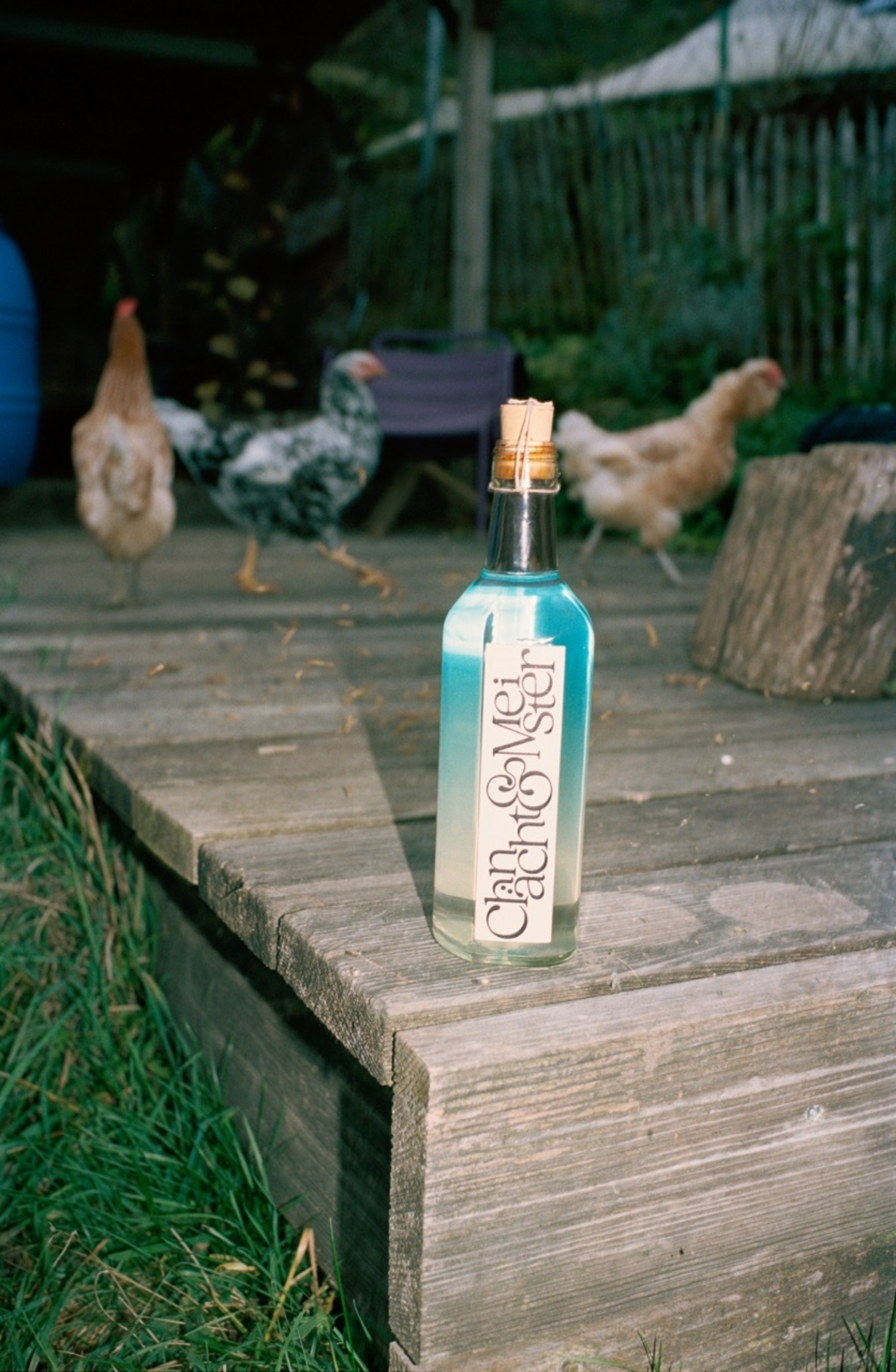
Sandra Knecht: Yes, I have preserved home in jars. But the whole thing is to be read with a lot of humor and has less to do with me preserving the rural life around me. Rather, it is about the feeling of security that we try to create by preserving food. In the cellars of farmhouses, you can often find preserves from the 1960s or 1970s. These jars have not simply been forgotten; they represent the certainty that there is still food to be found there. These are demons in the form of preserved cherries, which sit in the corner of the cellar and are not touched, so that it will remain there and provide security.
Valerie Keller: Can these bottled demons also be seen in your exhibition at KBH.G?
Sandra Knecht: Yes. There are things that I take with me everywhere. Myself, for example. And this time I’m also coming with my favorite Swiss artists, who will be performing in the exhibition as part of the Library of Performances. Katja Brunner is coming for a reading, the electro band Fiji, Big Zis and Derya Atakan are coming for concerts, Malika Kathir and Fiamma Camesi will perform a short piece, and I have no idea what will happen. And there will be a dinner party inspired by Judy Chicago, for which I have designed 32 different flavor profiles representing my favorite artists. Together with Michelin-starred chef Michaela Frank, I have developed dishes from these profiles that will then actually be served.
Valerie Keller: And who is invited to your dinner party?
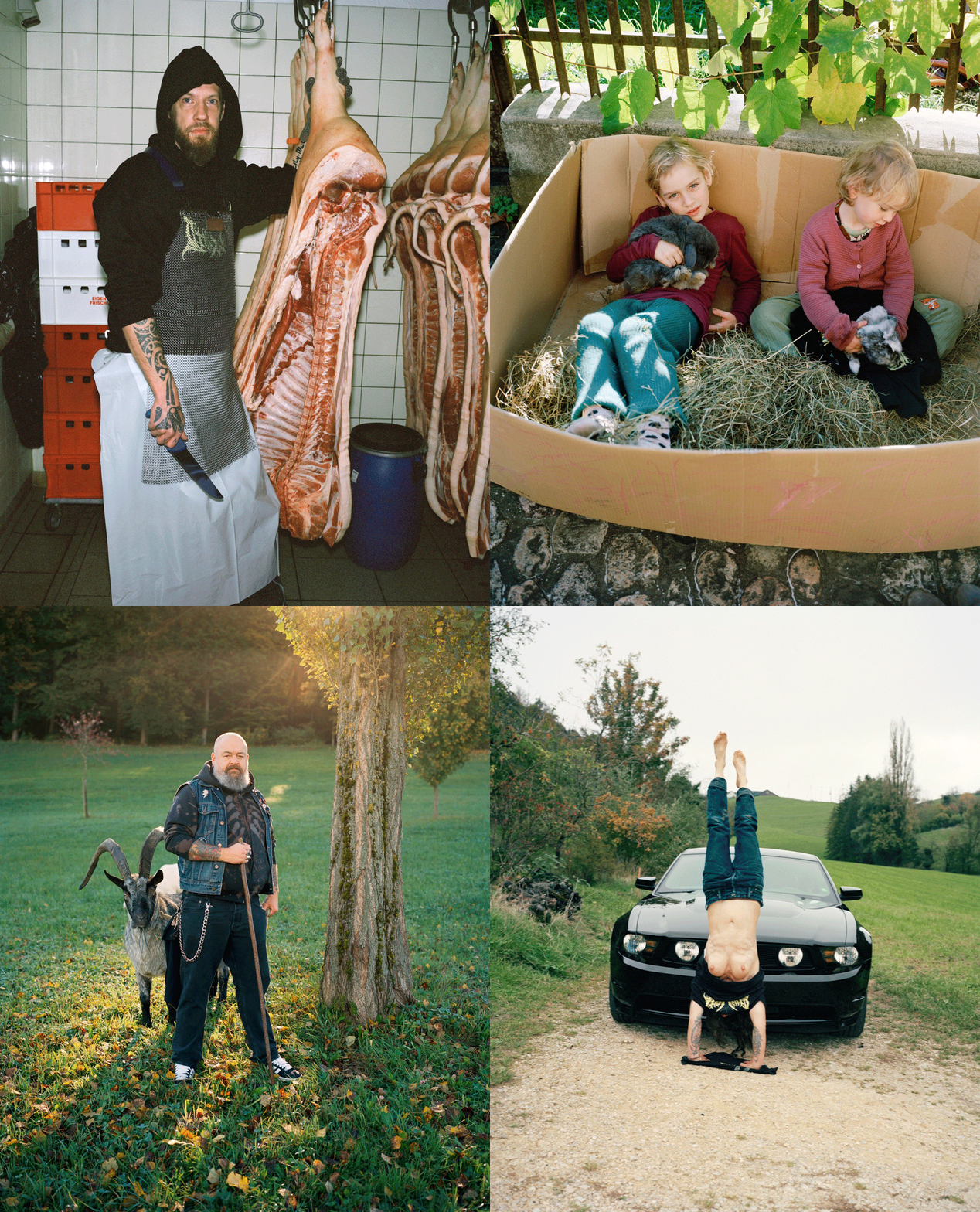
Sandra Knecht: Mostly people from the village with whom I have carried out a photography project that will also be on display in the exhibition: for example, my veterinarian, my butcher, my other butcher or the landlord of my favorite restaurant.
|
|
Sandra Knecht – HOME IS A FOREIGN PLACE, Kulturstiftung Basel H. Geiger I KBH.G, in collaboration with Lukas Wassmann. Photo: Lukas Wassmann.
|
|
|
|
|
|
|