|
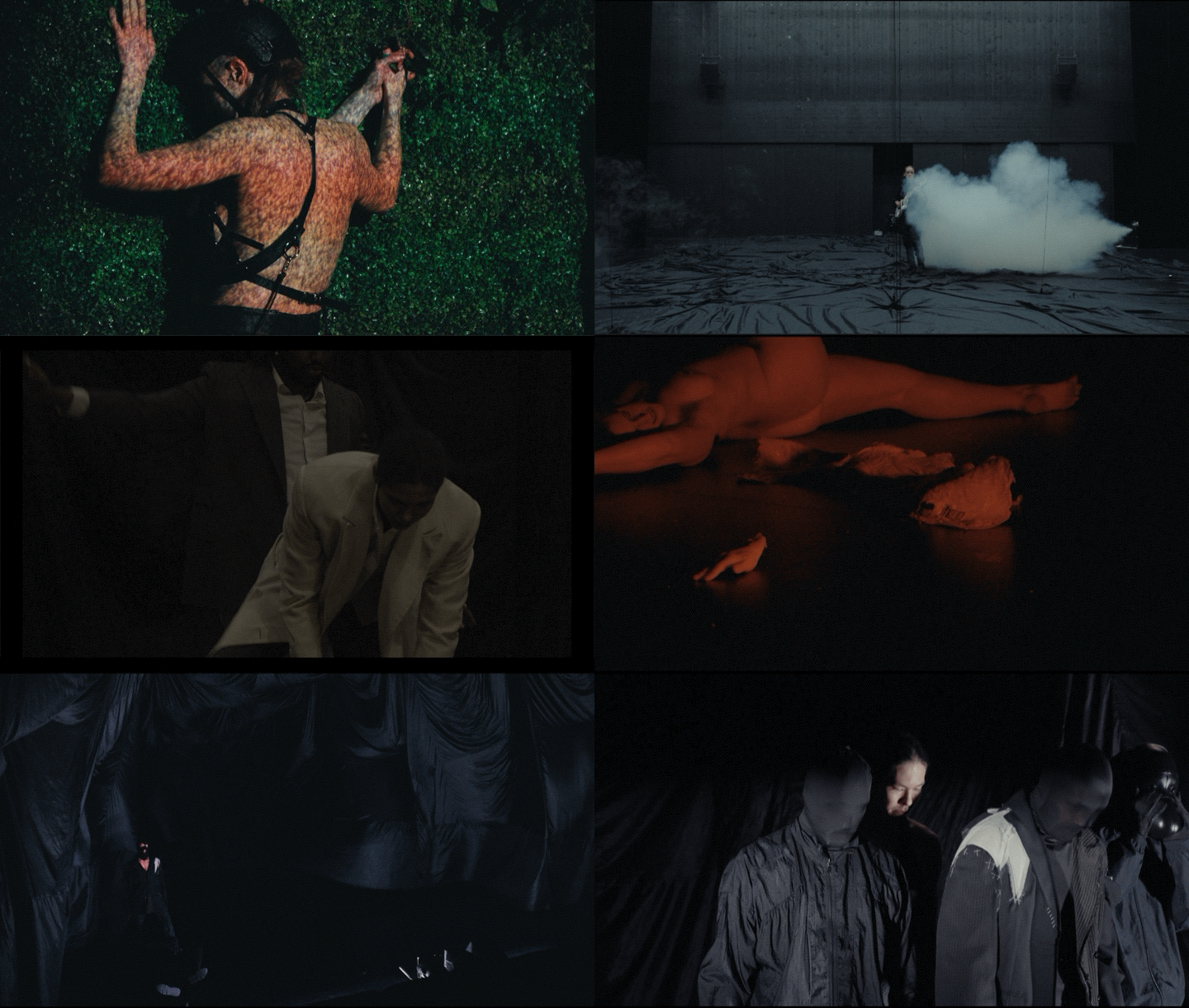
IC: We also work with a moodboard, or rather a tool between the moodboard and the storyboard. It's very useful because we work with people who handle different media. It helps us communicate, because theater and performance is always very much a collective process. It creates sort of blocks per scene, with heterogeneous elements: bits of story we've written, sketches, visual references . . . It allows us to think about the drama and visualize what's going to happen on stage. VJ: And what happens on stage is the staging of a monstrosity that I see in a form of duality. I'm reminded of the designer Sonia Rykiel, where she says you have to accept the recto-verso, give life to images that fight, and leave the disturbance, the sense of the senseless, and even the counter-sense. TG: In the writing, it's something we do by proposing story fragments assembled like a cubist collage rather than a completely linear narrative. It resonates with the idea of monstrosity. Things that shouldn't normally come together, or don't fit together, do. VJ: Is this playfulness reflected in the costumes? IC: Yes, by fragmenting the ensembles, for example by assigning the top of a certain outfit to performer X, and then the bottom to Y. It creates the illusion of impossible body postures. VJ: You sometimes quote Paul B. Preciado and Jack Halberstam, where the monster, or body-in-transition, allows us to destabilize norms, blur gender and redefine the boundaries of the human. TG: One of the points of entry at the origin of the project lies in the need to reclaim monstrosity, to turn pathologization or stigmatization on its head, to change its very meaning. VJ: A way to twist archetypes? IC: In a way, since we're reappropriating and hijacking the form of the freak show, a historically violent format because it reduced people to an anomaly, exploited them and assigned them to the margins. We work on processes of identity blurring, as in the last scene where we evoke multi-headed monsters and create an illusion in order to shape impossible bodies. VJ: An identity that is constructed in acts, in the camp for Susan Sontag or through stylized acts for Judith Butler? IC: The theater stage is a powerful playground for making visible and showing the socially constructed, performative dimension of identities. When you're queer – a stigmatized identity –, you experience almost daily micro-coming-outs that reduce you to that identity. This positionality leads you to perceive norms acutely, and to see how arbitrary, violent and essentializing they are. Whereas when you're straight, because you fit the norm, you can walk around in public hand in hand with the person you're in a relationship with without even having to think about it. VJ: Which brings Butler to the parody of identity that would prevent the dominant culture from invoking naturalized or essential identities. What use of parody do you make in FKRS? TG: We have quite a few tools that are sort of variations on the role that parody could play: exaggeration, irony and absurdity. They all function as ways of producing this de-essentialization. VJ: As does your aesthetic of horror, a camp exaggeration as a leverage to subvert dominant codes? IC: In the play, we borrow certain devices from horror: strangeness, distortion of the body, appearance, disappearance, silences and their sonic aspects. Horror and sound also play an important role in the piece as a whole.
|