Earth – Water – Air: An Exhibition Locating Activist Art
|
|
|
Galerie Eva Presenhuber’s current exhibition unites three independent yet thematically interconnected positions by Raven Chacon, Belinda Kazeem-Kamiński, and Oscar Tuazon. The artists’ works create an impressive interplay between political art, aesthetic materiality, and social engagement. Each artist is given their own space, collectively framed under the conceptual title Earth – Water – Air.
|
|
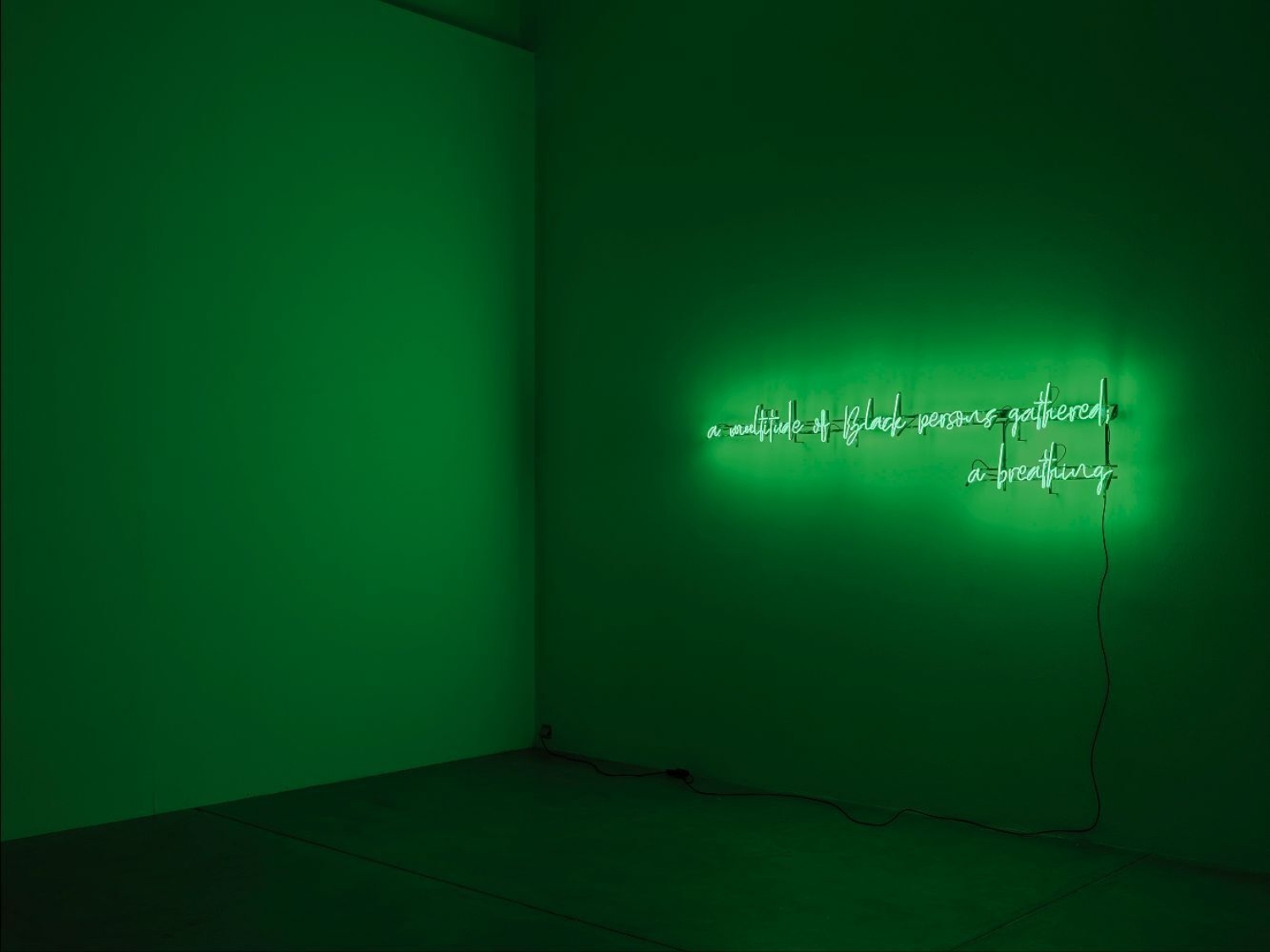
Installation view a breathing © Belinda Kazeem-Kamiński, Galerie Eva Presenhuber, Maag Areal, Zurich, 2024, Courtesy the artists and Galerie Eva Presenhuber, Zurich / Vienna, Photo: Stefan Altenburger Photography, Zürich
|
|
|
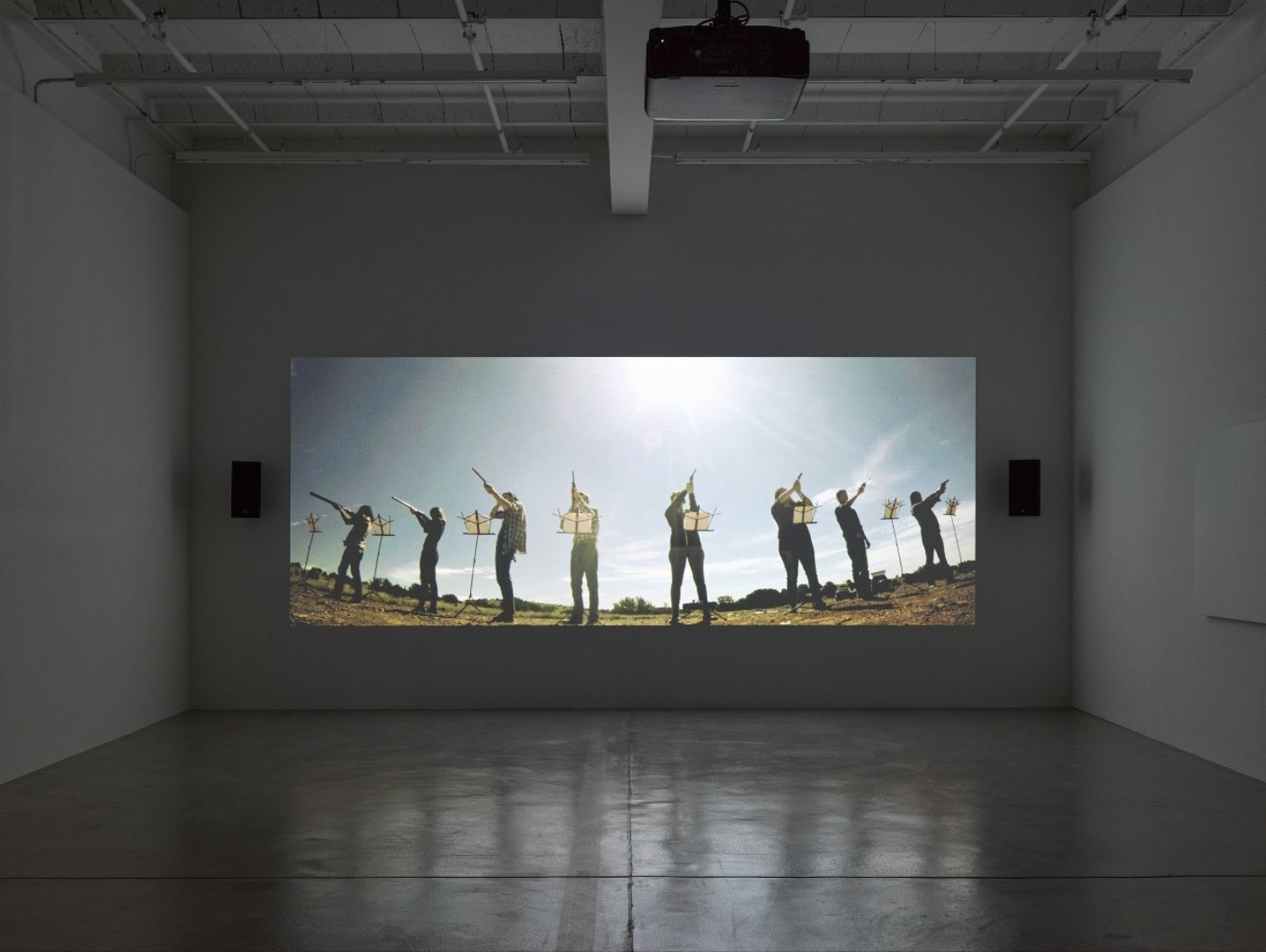
Earth: The Resonance of Silence – Raven Chacon Raven Chacon (*1977, Fort Defiance, Navajo Nation, USA) opens the exhibition with his work Report (2002/2005). Internationally acclaimed and a Pulitzer Prize winner in 2022, Chacon is known for his unconventional approaches, where sound becomes a medium for social and political reflection. For him, composition is not solely a musical practice but a method for creating conditions where objects, sounds, and collaborations articulate a political statement. In Report, Chacon uses firearms as cultural and sonic instruments. The video piece (3:48 minutes, loop), displayed in the gallery’s main room, features eight performers with firearms standing in a stark landscape in front of music stands. They interpret the compositions on the stands, with the gunshots forming the auditory body of the work. Framed scores in the entrance area allow a closer examination of the visual-musical notations, while the video piece, with its symbolic and acoustic presence, explores the intricate intersections of violence, history, and community in a specifically U.S. landscape. It prompts viewers to confront the unspoken meanings and silent histories embedded in the work. Regarding this piece, Chacon states, “I wanted the music to raise more questions than it resolved.” Chacon is less concerned with traditional musical parameters such as melody or harmony and more focused on configuring time, space, and the social meanings of sound. Elements like silence and the reverberation time of the gunshots play a central role, as they render the unspoken audible. What stories of conflict, survival, and community are inscribed in this landscape? For Chacon, this silence, even when brief between gunshots, is not merely the absence of sound. Instead, he interprets it as a resistant quality that prevents Indigenous art practices from being subsumed by interpretive objectifications. Chacon rejects the reduction of sound to consistent tonalities, challenging identity categories that inadequately capture Indigenous practices. Sound thus becomes an expression of cultural dissonance, resisting normative musical expectations. Chacon’s work—metaphorically representing rootedness, conflict, and the unspoken stories embedded in landscapes and communities—not only opens the exhibition but sets a programmatic tone that resonates through the works of Oscar Tuazon and Belinda Kazeem-Kamiński that follow.
|
|
Installation view Report © Raven Chacon, Galerie Eva Presenhuber, Maag Areal, Zurich, 2024, Courtesy the artists and Galerie Eva Presenhuber, Zurich / Vienna, Photo: Stefan Altenburger Photography, Zürich
|
|
|
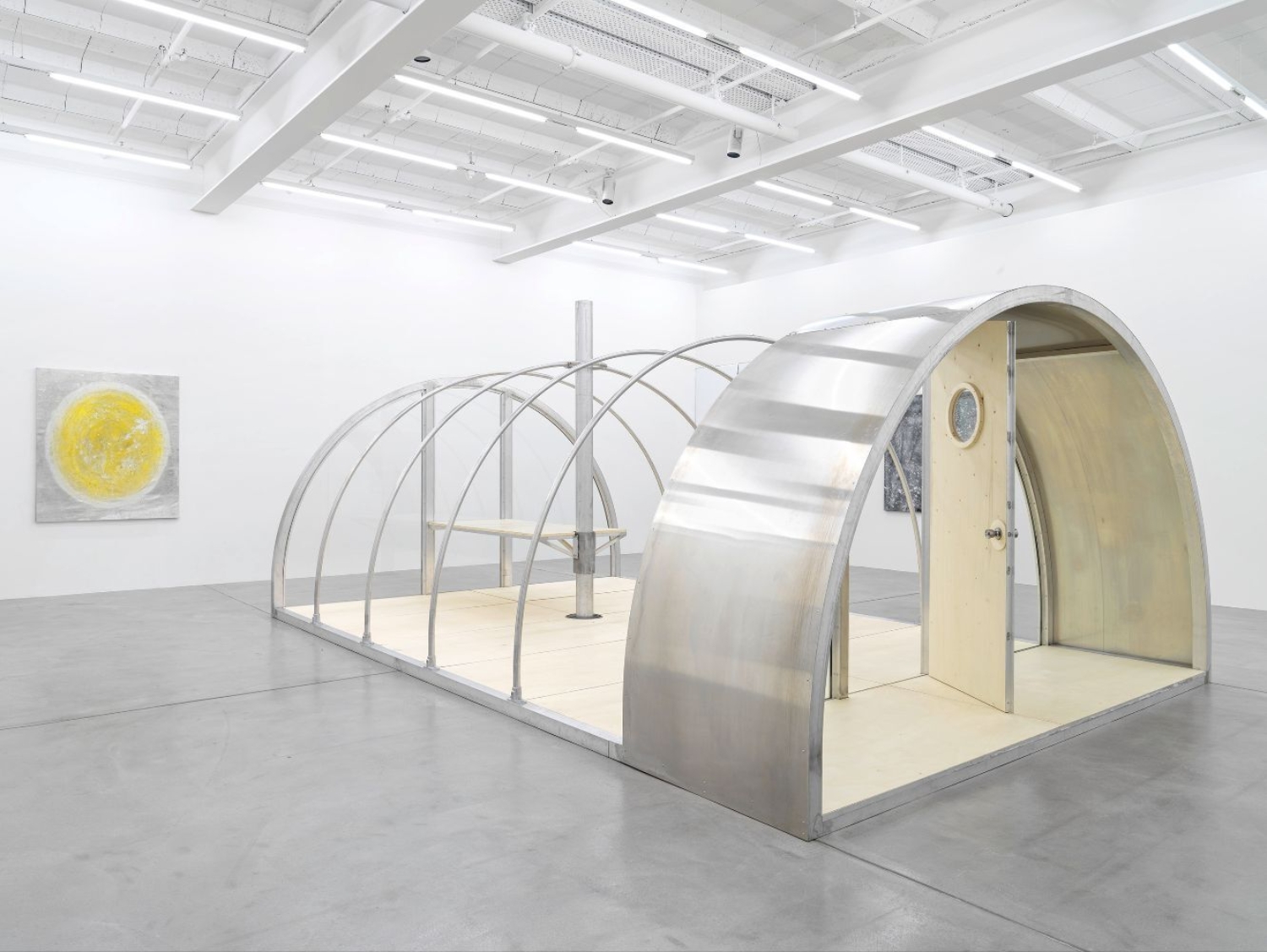
Water: Contested Resource and Uncontrollable Element – Oscar Tuazon Oscar Tuazon, renowned for his work at the intersection of sculpture, architecture, and socio-political practice, is represented by Galerie Eva Presenhuber. His works navigate the tension between functionality and critical reflection, inviting engagement with ecological, social, and aesthetic questions. The Quonset Tent (2016) draws on the iconic form of the Quonset hut, a modular, semi-circular structure originally developed during World War II for military purposes. Tuazon appropriates this typology, transforming it into a sculptural installation that functions both as a physical object and as a symbolic space. Constructed from industrial materials such as corrugated metal and steel, the work evokes the raw aesthetic of Minimal Art while referencing DIY practices. Yet, the Quonset Tent is more than a visual reference; it embodies the dynamics of social interaction. During the exhibition’s opening, the structure served as the site for a performance by Raven Chacon, activating its open construction as a platform for collective activities, discussions, and performances. Tuazon emphasizes the historical and social functions of such architectural forms, which have been employed as shelters or temporary structures in military, humanitarian, and civilian contexts. Complementing this piece, Tuazon presents his new works, the so-called Water Paintings, which explore water as material, metaphor, and physical substance. Works such as Daylight Moon (2024) and Zone (2024) offer an aesthetic engagement with the fluidity and transience of the element. Using enamel, acrylic, and marbling inks applied to water surfaces, Tuazon creates unpredictable, alchemical formations in which the movement of the medium becomes the central design principle. In Zone (2024), whose surface evokes the cratered texture of the moon, Tuazon reflects on the uncontrollability of the creative process, underscoring the limits of human control. Tuazon’s engagement with water extends beyond the aesthetic. Since 2016, he has collaborated with various partners on the interdisciplinary project Water School, which integrates art, architecture, ecology, and activism. The initiative interrogates the power dynamics governing land, water, and infrastructure use, with a particular focus on the history of water rights in the western United States. The founding of the Los Angeles Water School (LAWS) in 2018 established a space for interdisciplinary exchange among artists, scientists, activists, and local communities. This initiative aims to foster knowledge about the cultural, political, and ecological significance of water while advocating for Indigenous rights and the protection of natural resources. For Tuazon, Indigenous perspectives are essential for developing alternative resource management models grounded in respect and sustainability. While the Water Paintings foreground the aesthetic dimensions of Tuazon’s practice, his artistic work remains deeply intertwined with issues of ecological justice and political responsibility. By emphasizing water as a dynamic and uncontrollable element, Tuazon draws attention to its pivotal role in social and ecological conflicts.
|
|
Installation view Quonset Tent © Oscar Tuazon, Galerie Eva Presenhuber, Maag Areal, Zurich, 2024, Courtesy the artists and Galerie Eva Presenhuber, Zurich / Vienna, Photo: Stefan Altenburger Photography, Zürich
|
|
|
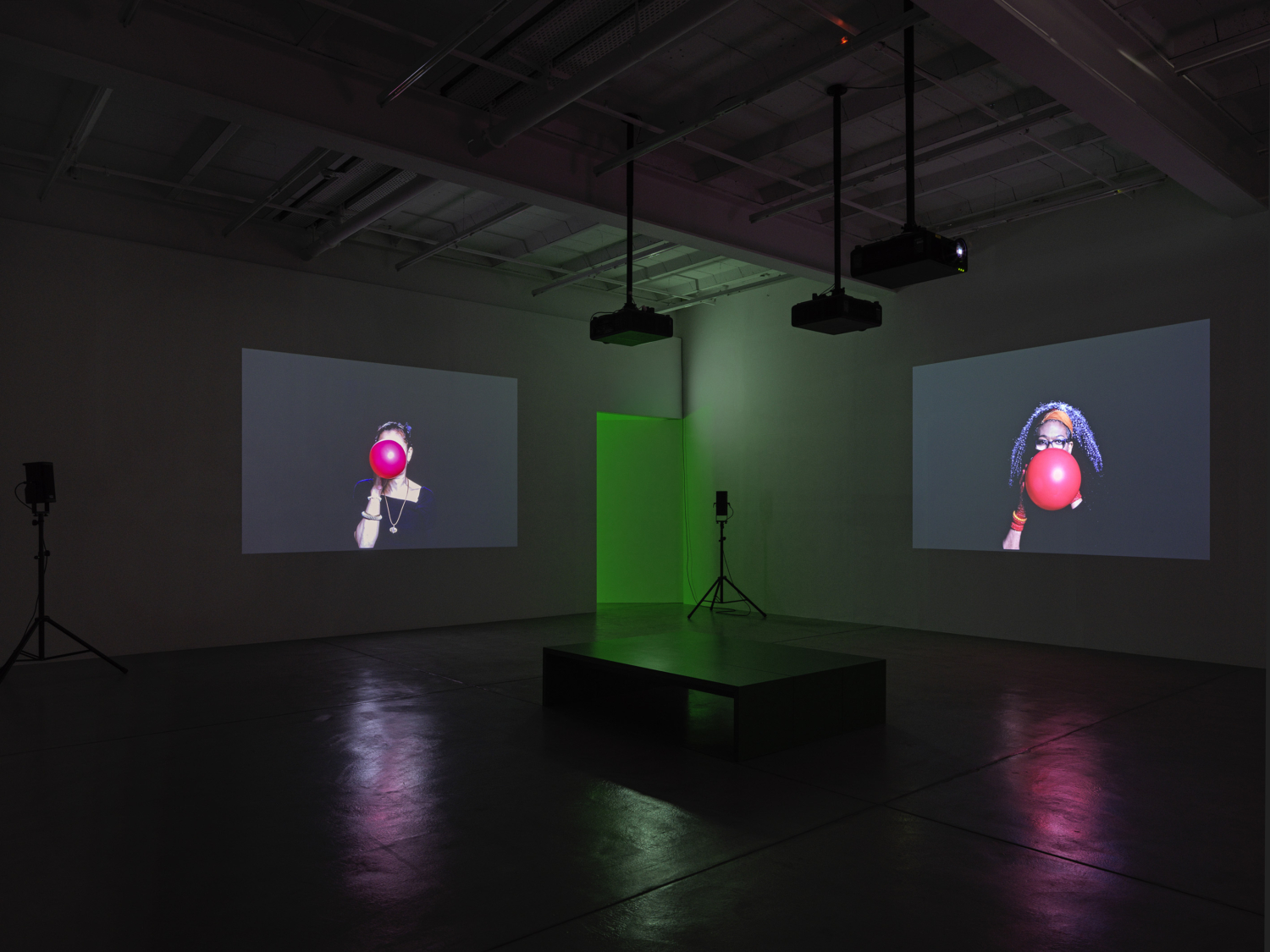
Air: Breathing as a Political and Collective Act – Belinda Kazeem-Kamiński In the rear room of the gallery, Belinda Kazeem-Kamiński (*1980, Vienna) presents her three-channel video installation Respire (Liverpool) (2023), created for the Liverpool Biennial. This work places breathing at its center, exploring its physical, symbolic, and political dimensions. In Respire (Liverpool), the three projections depict people of color breathing into a red balloon. With each breath, the balloon inflates and deflates, creating a rhythmic interplay between inhalation and exhalation. The installation is accompanied at intervals by sound fragments from Keep On Keepin’ On (for Nile), a collaborative piece developed with sound artist Bassano Bonelli. This sonic landscape amplifies the meditative and emotional impact of the breathing sequences, while pauses and silences in the music emphasize breath as both a vulnerable and resilient process. Breathing is framed as an ambiguous practice in this work. It refers to individual breath as a life-sustaining act, the collective act of shared breathing as a form of liberation and resilience, and breathing as a method for processing and releasing bodily trauma. In a historical context, Kazeem-Kamiński draws attention to the deep scars of colonial violence, particularly Liverpool’s role as a former hub of the transatlantic slave trade. Here, breathing becomes a vehicle for making oppression and trauma visible while simultaneously articulating resilience and collective strength. The artist describes breathing as an act that is not equally accessible to all. Experiences of suffocation and liberation echo the structural inequalities imposed on marginalized communities worldwide. In this work, breath is experienced not only as a physical process but also as a metaphorical space for memory, resistance, and transformation. Properly utilized, breath has the potential to release trauma stored in the body, offering a path to collective healing and strength, reshaping shared histories into sources of empowerment. Breathing thus becomes the nexus between individual and collective bodies and the histories they carry—especially the histories of Black communities. In an adjacent room, the green neon piece A breathing (2024) adds thematic depth to Respire (Liverpool). Initially conceived as part of the video installation, it was excluded due to its intense luminosity. The neon work quotes African American writer Christina Sharpe: “a multitude of Black persons gathered, a breathing.” This phrase underscores the collective dimension of breathing as a community-forming and politically charged act. The luminous intensity of the neon piece reinforces the message of the video installation: breathing becomes a symbolic act of self-empowerment and spatial occupation, particularly within the context of liberation struggles in the African diaspora. The three artistic positions in the exhibition converge into a dense, transdisciplinary dialogue operating on sonic, material, and performative levels. Earth, water, and air are experienced not only as physical elements but also as carriers of histories, conflicts, and possibilities. The exhibition serves as a statement on the interconnectedness of art, activism, and memory culture. It challenges viewers to interrogate the power structures underlying these fundamental elements and to rethink the roles of body and community in engaging with them.
|
|
Installation view Respire (Liverpool) Keep On Keepin' On (for Nile) © Belinda Kazeem-Kamiński, Galerie Eva Presenhuber, Maag Areal, Zurich, 2024, Courtesy the artists and Galerie Eva Presenhuber, Zurich / Vienna, Photo: Stefan Altenburger Photography, Zürich
|
|
|
|
|
|
|