David Claerbout at Konschthal Esch
|
|
|
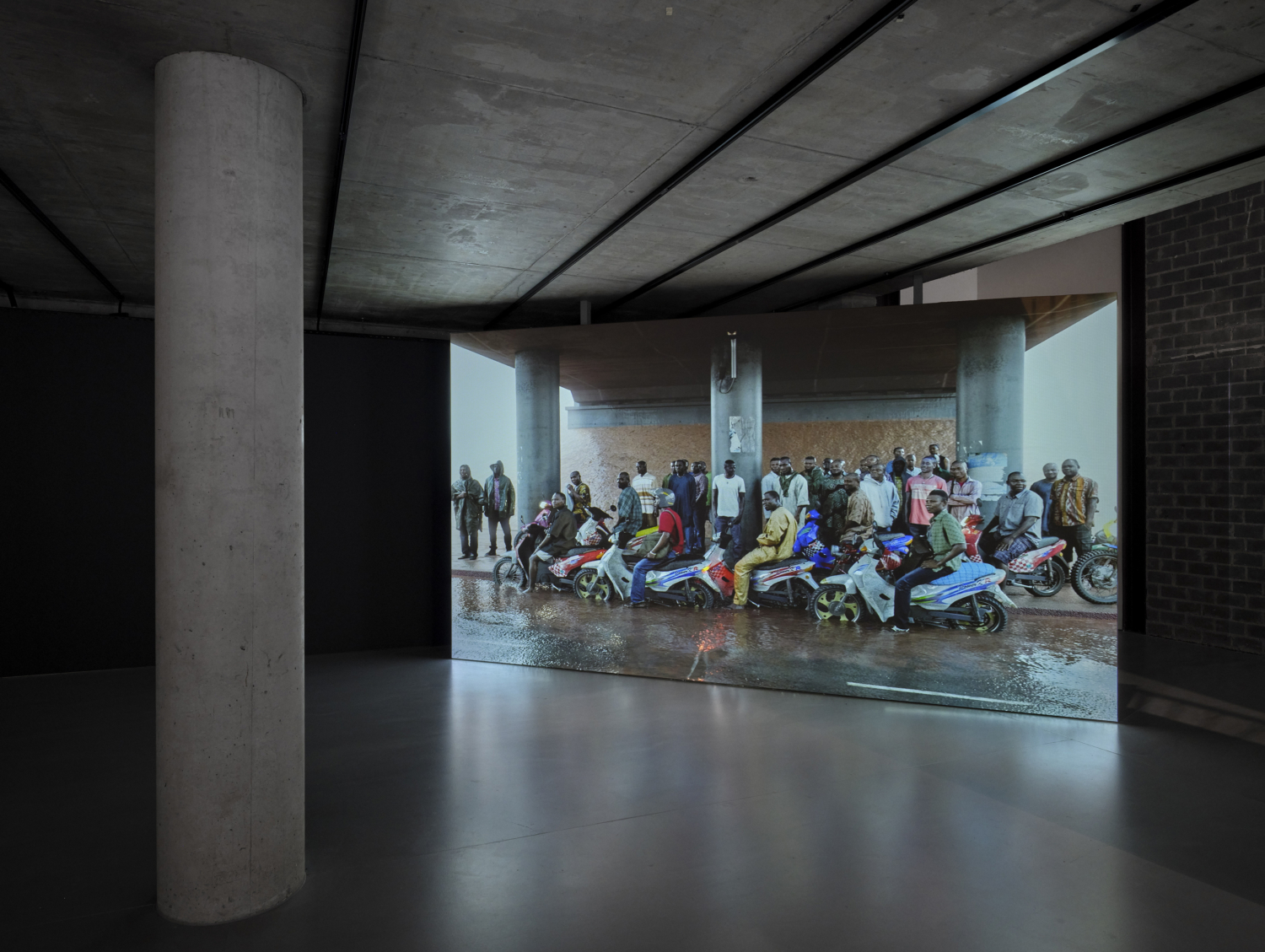
Train journeys never lie: as you arrive towards Esch, you’ll start noticing discarded steel plants and their rusted blast furnaces. If the landscape can provide insight into a local collective consciousness, then these infrastructural beasts from the past are the signs of some industrial understanding of a landscape there to be processed, transformed, carved. A fitting point of entry, as David Claerbout’s oeuvre precisely deals with all of this: the merging of time, infrastructure, landscape and cognition. The real introduction is the exhibition’s first floor, articulating the key ways in which imagery—found or created—is maneuvered by the artist. In the first room, Oil workers (from the Shell company of Nigeria) returning home from work, caught in torrential rain (2013), is a video based on a simple JPG file grabbed online showing oil workers taking shelter under a bridge during a rainstorm. Playing on the contrast between the storm’s agitation and the calmness of the scene, Claerbout digitally creates the movement of a camera, slowly turning around the group. The steady movement becomes a voyage inside an array of fluxes: natural, like water and atmospheric depressions, social, like the displacement of workers, but also of digital circulation, the JPG file compressing information, eschewing quality for the sake of moving more freely. The slowness of the video accumulates those layers of criticality to ammas gently, which makes the artist’s putting-in-motion the one of global capital, its extractivist logics viciously sealing industrial pollution to climate change and exploitation of labor.
|
|
Installation view: David Claerbout, Oil workers (from the Shell company of Nigeria) returning home from work, caught in torrential rain, 2013, Konschthal Esch. Photo Credit: Christof Weber
|
|
|
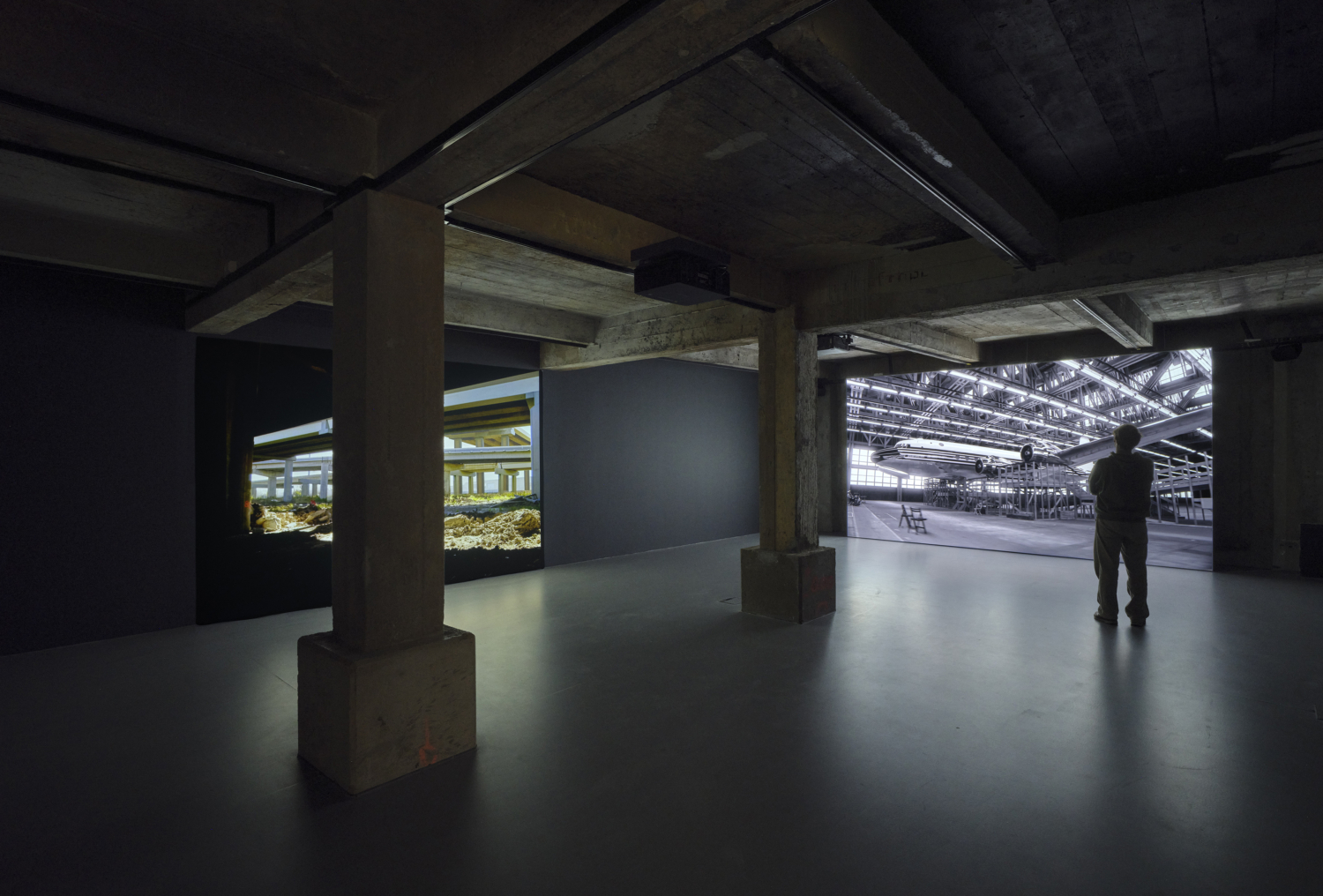
Found in the next room and similarly merging found material and digital reconstruction, Aircraft (F.A.L) (2015-2021) is a video centered around the motif of a mid-century aircraft parked (or rather, displayed, as the docking device borrows as much to an industrial system as to a museal display) inside a massive industrial hangar which seems to extend without end. In comparison to Oil workers, the work is more clearly a video, as the rotating movement of the camera is accompanied by the walk of a guard. It is the site that is more ambiguous: the dimmed-out lightening of the space strangely recalling simulated environments, the century-old plane too shiny for its historical stature, the infinite length of the hangar.. This ambiguity is the result of the work’s process, as Claerbout digitally added the plane to altered footage of a real hangar. Observing the aircraft with this suspicion shapes a feeling of distance that we all know already too well: it reminded me of the reassuring spectacularization of museal work, thinking, for instance, about the dinosaurs in the Natural History Museums, coerced to persist as heaps of bones to give a sense of what they used to be. The cold sound—and sole audio of the work—of the guard’s footsteps further insist on the institutional considerations of the artist, or museumification as an act of stuffing. A thought that links Claerbout to other famous compatriots inside a legacy of a specific “Belgium” institutional critique and interest for period rooms of museums, for instance thinking of Marcel Broodhaert's Musée d’Art Moderne – Département des Aigles (1968-1972).
|
|
Installation view: David Claerbout, The Stack, 2002 (left) and Aircraft (F.A.L), 2015-2021 (right), Konschthal Esch. Photo Credit: Christof Weber
|
|
|
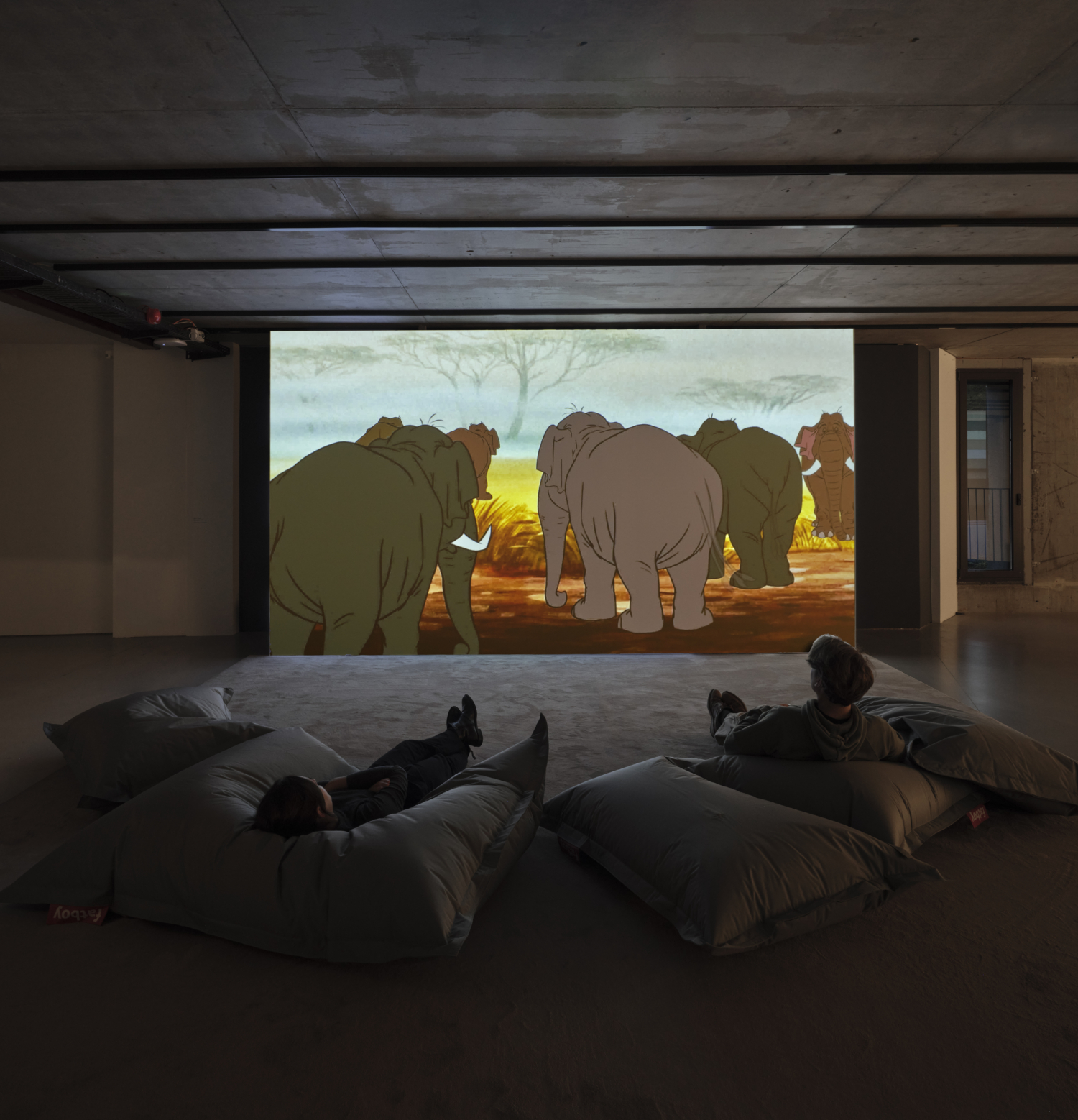
The exhibition, curated by Christian Mosar, Konschthal Esch’s director, assisted by Charlotte Masse, together with the guest curator Ory Dessau, makes a point to insist on Claerbout’s effort to locate the “spectacular” not as an outside feature but rather as inscribed inside logics of projection, a constitutive aspect of our relationship with technology. The artist’s older works—smaller, technologically of another time and produced with more modest means—are, paradoxically, shown on the more spacious inner floors of the institution. A contrast aligned with Claerbout’s reluctance to the impressiveness of technology. The slow rhythm in the works therefore often shapes the contrary effect of a kind of zooming out, giving visibility to distance and the impulse to compress it. Claerbout’s best known work, The pure necessity (2016), makes such a case. The animated movie shows different scenes where animals unmistakingly sourced from Disney’s The Jungle Book (1967) seem to utterly annoy themselves going about their business. In this sequel, there’s no humans—except from a last appearance—, an absence that purposely leaves the animals mute, without purpose. Their joylessness comes as another take on spectacle: if it wasn’t for their role inside a human orchestrated musical, or, in other words, if it wasn’t for endorsing a human attitude, animals are left without a voice. Spectacle is exploitative, as the story of the work itself says: to get reference images to give the animators for the animal’s attitude, Claerbout asked his crew to film caged animals from Antwerp’s zoo. The video locks itself in this mirroring feeling, the one of ourselves looking at our desire for spectacle, strongly echoing John Berger’s 1977 essay Why Look at Animals?, which frames the zoo as the site where we look at the marginality of animals, and theirs reflecting our own.
|
|
Installation view: David Claerbout, The pure necessity, 2016, Konschthal Esch. Photo Credit: Christof Weber
|
|
|
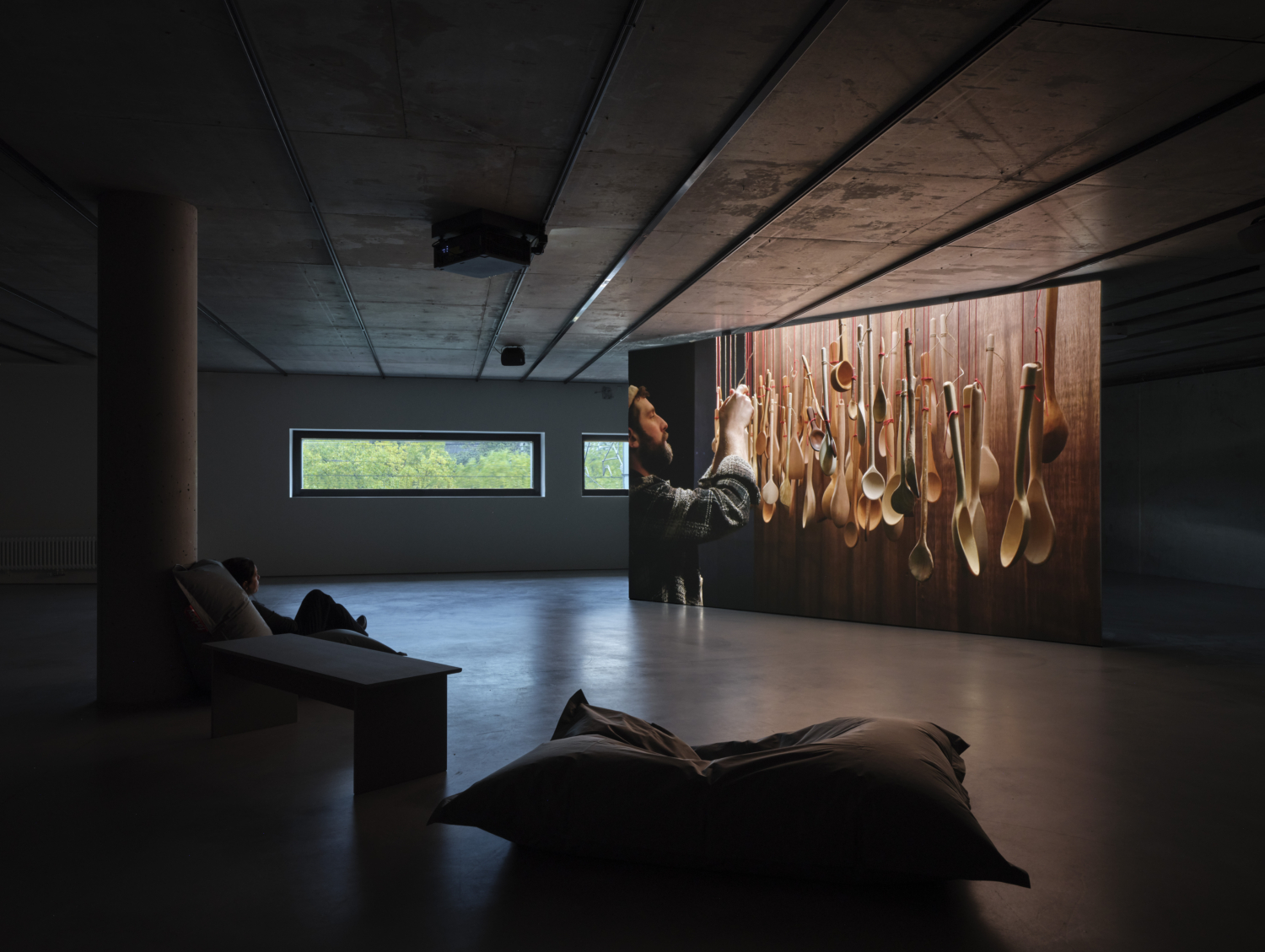
Pumped up by technological progress, spectacle manifests today as a fetichized return to nature. Best exemplified today by the use of AI and its paradox as a tool used to simulate nature at exorbitant energy costs. Co-produced by Konschthal Esch and being the most recent work of the exhibition, The woodcarver and the forest (2025) shows a solitary woodcarver spending his days inside a neo-brutalist villa, surrounded by a forest. All alone, his sole activity is carving wooden spoons out of the nearby trees. The video, combining camera work in physical locations as well as computer work and based on images prompted with generative AI, hypnotic in its meditative silence, does leave you wondering where Claerbout’s “trick” happens. It kicks in later: getting to the next floor, the room just atop showed the same display with seemingly the same video, although a slight but telling difference. In this version, the part of the forest just in front of the house appears more sparse, slightly but already touched, some trees lying down, soon to be transformed into logs. The solemnity of the work gives it a tale’s feeling, and the story becomes clear: the woodcarver will do as many spoons as the forest allows, his task finished only when the forest is cleared. What initially looked like the unproductiveness of a Sisyphus suddenly appears closer to the extractive logic of global capitalism—in today’s times, we can’t afford for the sole reward of a moral.
|
|
Installation view: David Claerbout, The woodcarver and the forest, 2025, Konschthal Esch. Photo Credit: Christof Weber
|
|
|
Taking full advantage of Konschthal Esch’s layered space, the exhibition cleverly functions to back Claerbout’s efforts in understanding the “spectacle” as a projection mechanism. An attention to exhibition-making that felt like a potent remedy against dire talk of “replacement”. In times when AI-powered image-making becomes utterly frictionless in light of its optimization, what matters more than ever is context, concept, and how we navigate it. Cleabout’s accuracy of translating a mental idea into exercises of attention with the help of technological tools doesn’t only feel like the feat of an artist’s virtuosity; it also comes as the necessity to exfiltrate criticality from the technological trap of spectacle. Or, said differently, to dislocate spectacle from what lays at its base, that is, our need to compress distance to a point of indistinguishable proximity, and to advocate for the only true return to ourselves through the acknowledgment of all that lies outside of us.
|
|
|
|
|
|
|