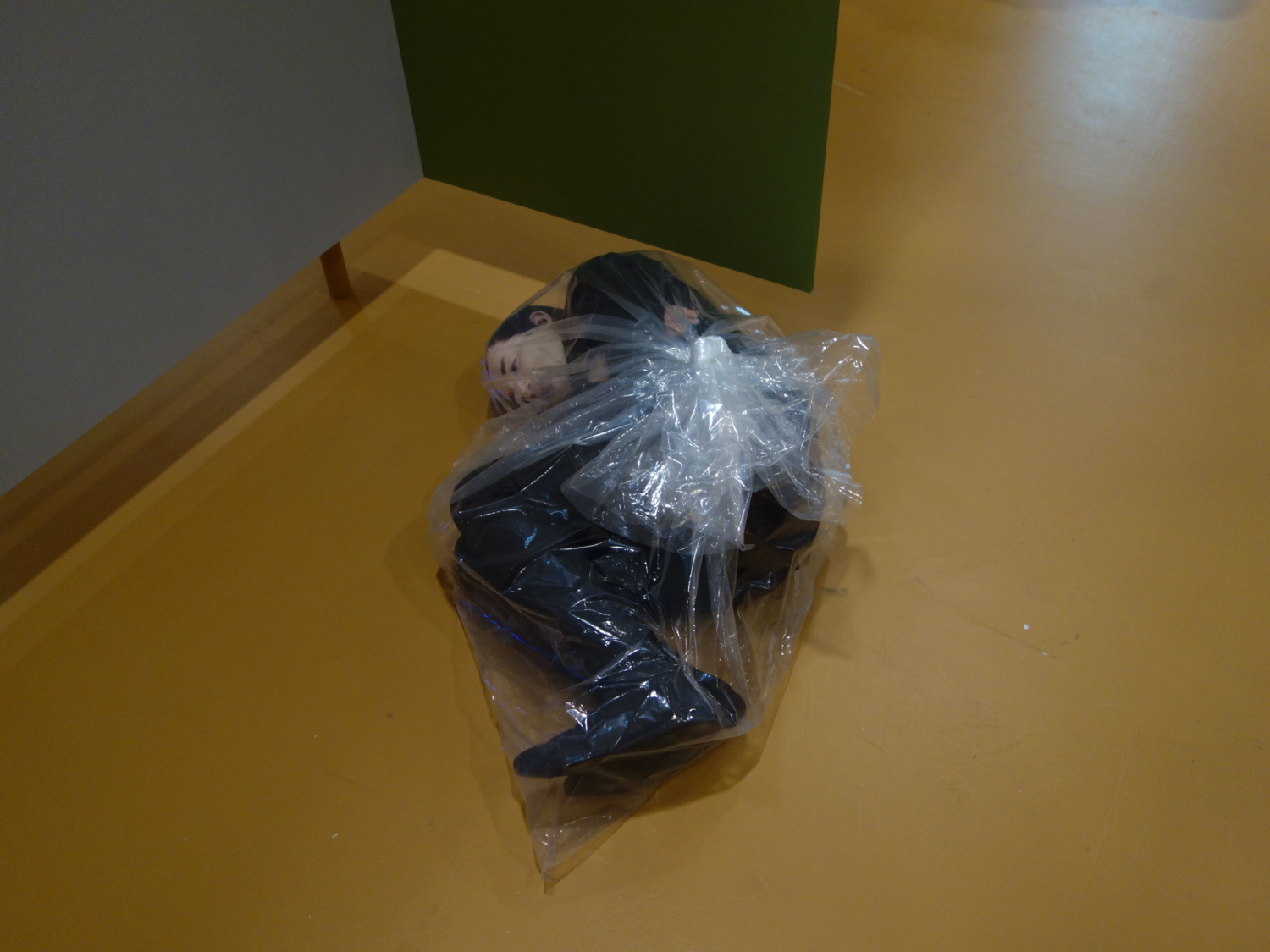
Josh Kline, Unemployed Journalist (Dave) (2018) as part of “Global Fascism” at Haus der Kulturen der Welt (see below for my review). Credits: PROVENCE.
|
|
|
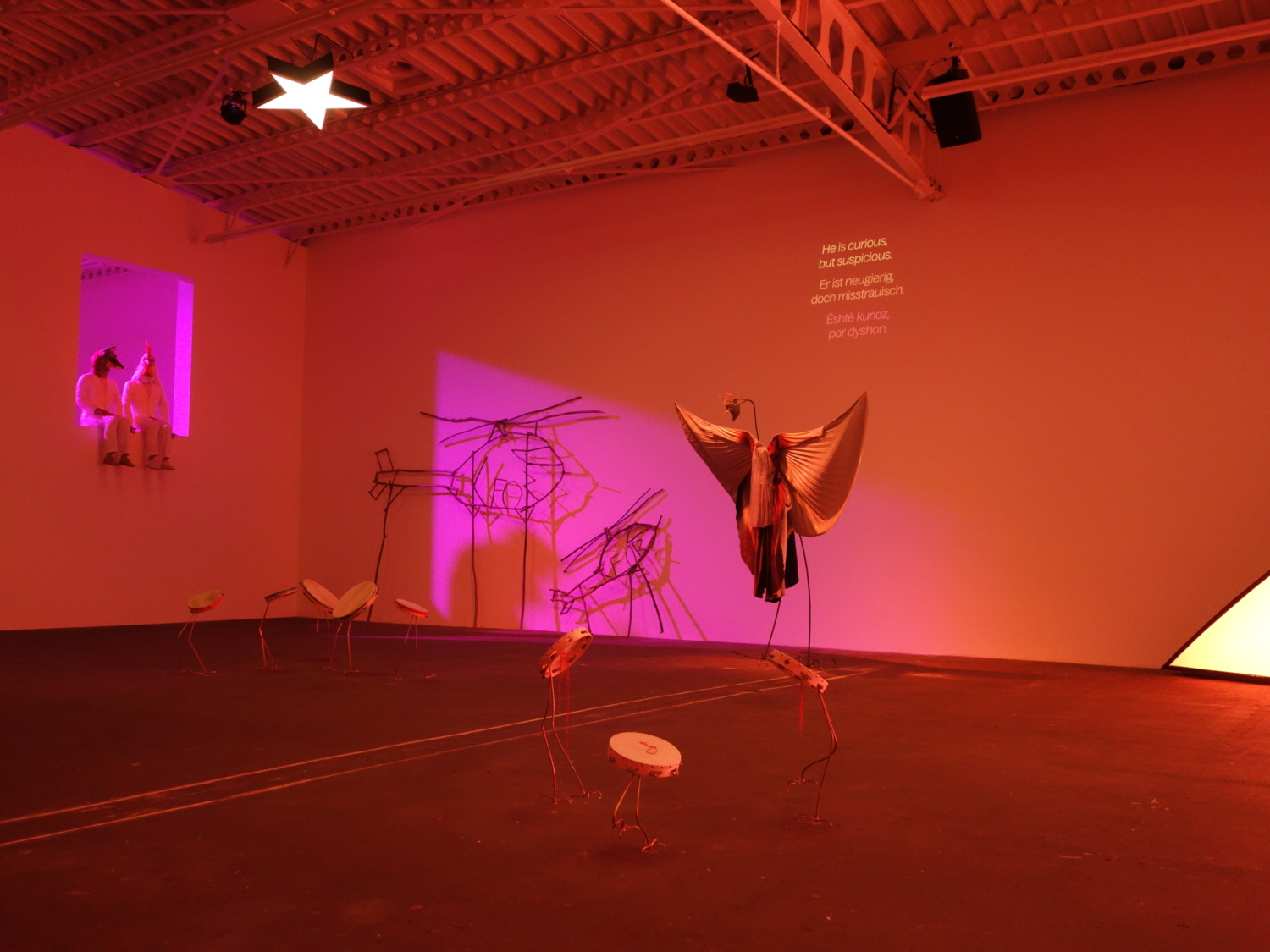
Berlin Art Week officially opened at Hamburger Bahnhof with Petrit Halijaj’s An Opera Out of Time, his first major institutional presentation in the city where he lives. The project is the artist’s desire to conceive a full-fledged opera drawing on Syrigana, his first one, presented then in Kosovo. The work revolved around the local legend that Adam and Eve came to the namesake village—a place of high symbolic value as it is divided in two parts, with ethnic Albanians in one, ethnic Serbs in the other—to get married. In Berlin, the main biblical protagonists are recast as another couple, Fox and Rooster. The performers’ costumes inhabit the museum space, freed from their bodies, and the opera’s libretto is projected as surtitles in the main room of the exhibition. There, a choreography of lights and calibrated dramaturgy perform the opera while shaping what I felt as an opposing effect between dramatic presence and bodily absence: the evacuation of human actors together with emptied out costume destabilizes a stable relationship of speech-with-body. A complication at the core of Halijaj’s practice, and one that is often signaled by the presence of birds. Chanting animal if there is one, birds flutter happily throughout his oeuvre since he tracked down stuffed animals from the collection of Priština’s Kosovo Natural History Museum while it was decaying in the 1990s (1), a rescue of altered memory—the specimens were ruined by years of neglect and rot. One could therefore see how this (biblical?) dramaturgy of rescued and resuscitated presences naturally drove the work towards the art form of the opera. But to the unease of the liveness injected into the animals by their stuffing, the figures here appear with a similar passiveness: aren’t Adam and Eve painfully silent? Doesn’t the fox’s ruse usually manifest itself alongside his muteness? Halijaj makes a point of building his works around those sways, issues of integration that echo his focus on oral history and the intricacies of locating a personal narration inside a larger collective one, especially in the context of the history of an Albanian cultural identity which was much recently marked by fractures and reformations. This touching exhibition—which clearly benefited from the privileged relationship between the curator, Dr. Catherine Nichols, and the artist after their initial collaboration for Manifesta in 2022—would luckily stay with me for the entirety of my Berlin trip.
|
|
Exhibition view: Petrit Halijaj, An Opera Out of Time, Hamburger Bahnhof, 11.09.2025-31.05.2026. Credits: PROVENCE.
|
|
|
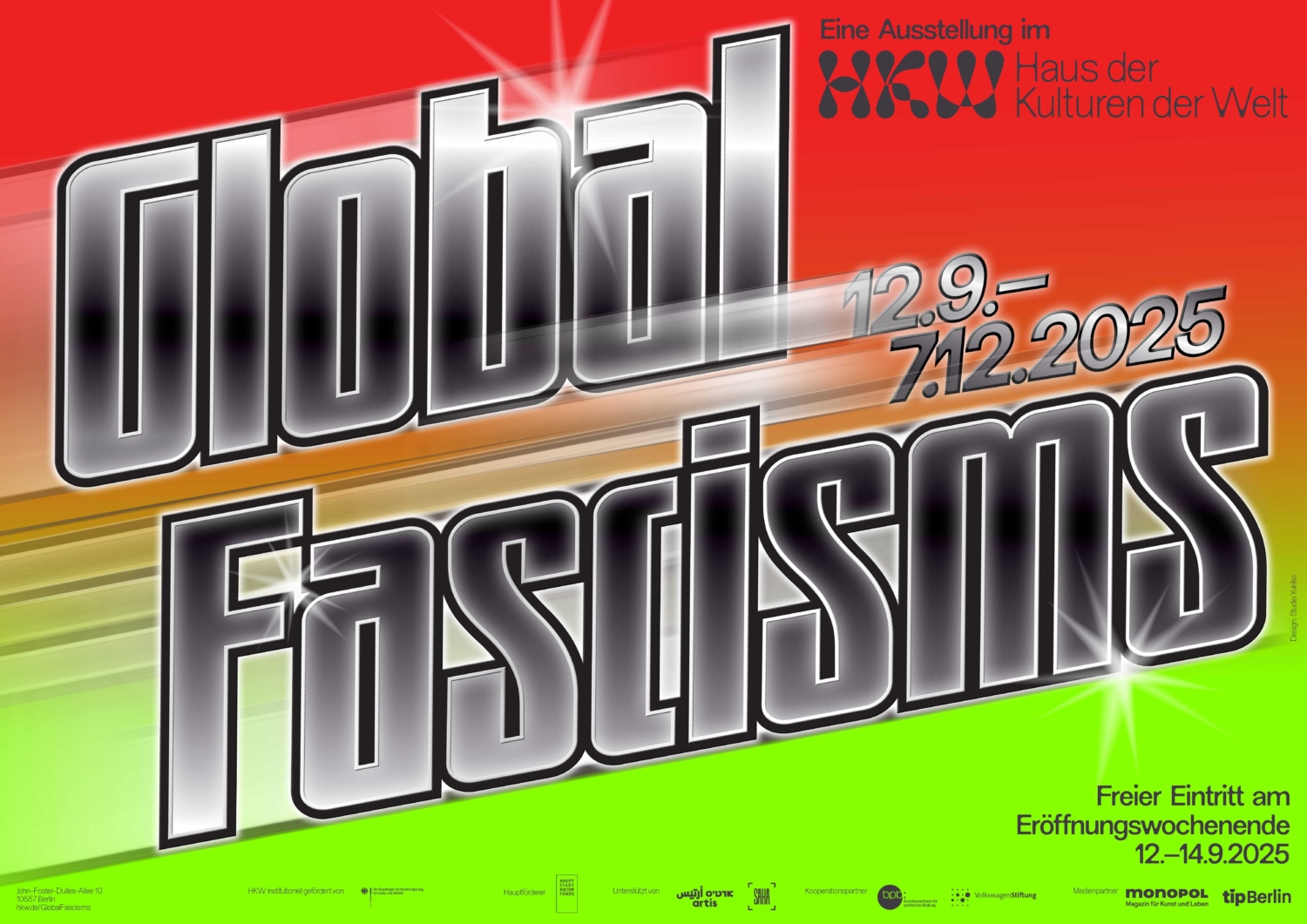
Still with Larios’ Unlucky Thirteen in mind, writing about my press visit to Haus der Kulturen der Welt (HKW) and their new “Global Fascism” exhibition causes me to consider the institution’s own positionality rather than the show itself. But this is mainly out of necessity, since our press visit preceded the official opening, which means we found ourselves during installs’ highest peak, with technical crews hurrying to install the last works and the sounds of working platforms surrounding our dozed-off group of writers carrying all the day’s press kits. Unfinished Global Fascism, so to speak. In the booklet, HKW critically examines what constitutes the aesthetic, social and political dynamics of fascism, questioning its “appeal and ideological mechanisms.” An interest in the mechanics of a discourse and its increasing attractiveness, or so I thought, would lead the show towards the language of advertising, together with some tolerated corrupted moves or some slightly cynical tone. The visual communication of the show encouraged this feeling: with a typography reminding me of a video-game/sci-fi language inspired from the 1980s (think here of Blade Runner (1982)), it felt as if Berlin was getting back to the cynicism of a post-internet vibe and, possibly, a touch of self-depreciation, something I would have felt as welcomed.
|
|
Announcement for “Global Fascism” designed by Studio Yukiko. Credits: Haus der Kulturen der Welt and Studio Yukiko.
|
|
|
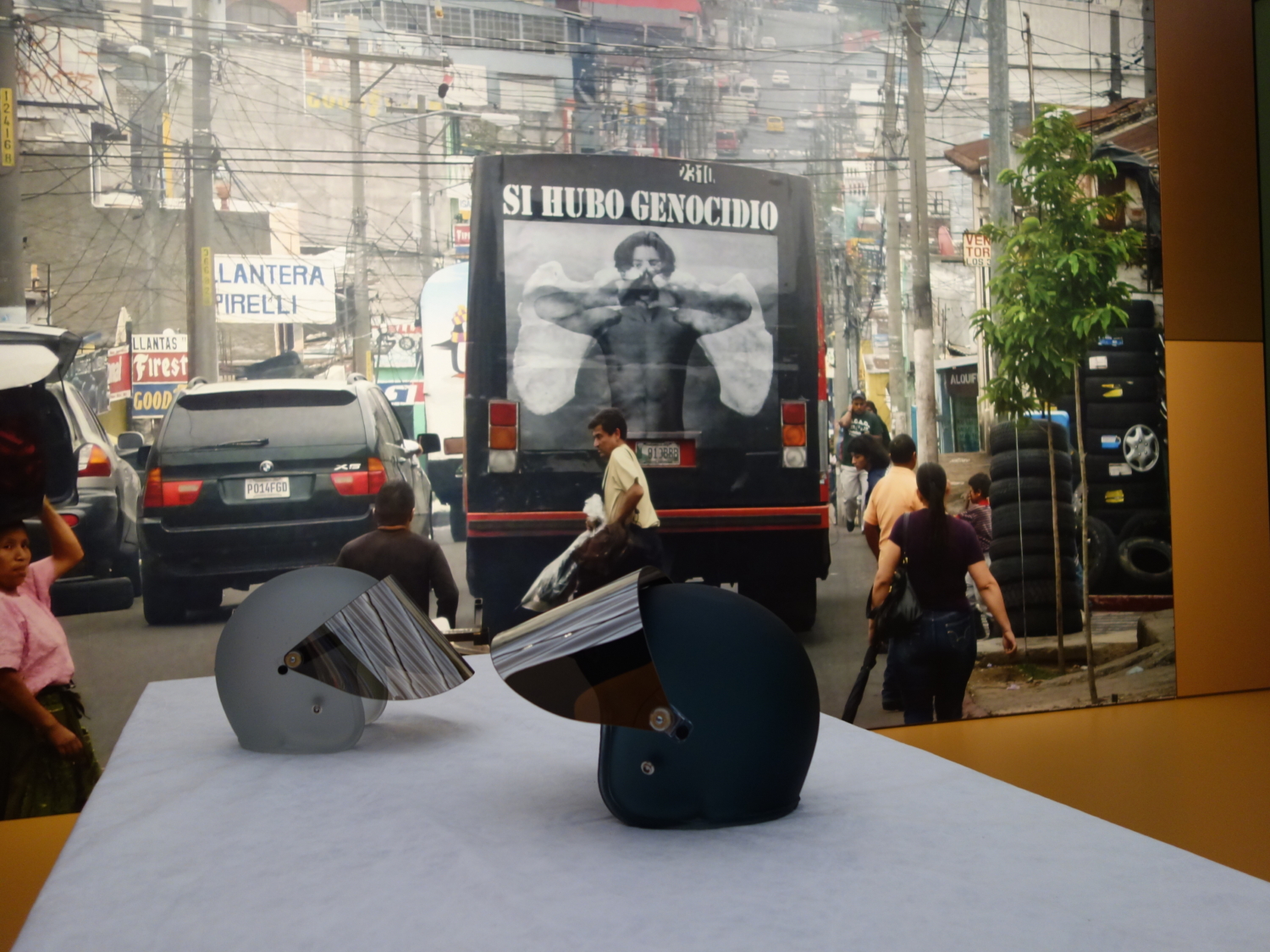
Being framed by this corrupted positionality—the premise lodged in fascism’s appeal, rather than, say, focusing on a potential concept of emancipation such as the Biennale’s focus on the “fugitive”—, the exhibition touched the Stockholm syndrome at the core of fascist tendencies—a shared expertise with late stage capitalism—, i.e. the capacity to make us want what in reality oppresses us. The global concern drove the institution towards manifold new waves of fascist thinking by mapping out several of their emulsions throughout the world. The curatorial essay, for instance, mentions the Russian aggression in Ukraine, Hindu nationalism in India, Trump and the development of AI, the manosphere, in Germany: the rise of the AfD and the second world war, and, unsurprisingly, an equilibrated take on “targeted hate that has been unleashed, from anti-Semitism to Islamophobia.” What feels like a euphemism, to talk again about Germany’s institutions’ incapacity to explicitly name the growing discourse of hate and genocidal ethnic-cleansing coming from the Israeli government. In the end, the exhibition took a more classical route, leaving the promises of an initial corrupted discourse to end with a safer institutional collegiality. Interestingly enough, the argument for this cautious choice was framed as a form of institutional responsibility: since we’re all confronted with the language of hate and its appeal on daily media, HKW preferred the path of presenting strategies of resistance and subversion. Very well, but why then approach the exhibition with such a frontal title and a corrosive design? Leaving aside institutional positionality, the exhibition presented high-quality works from around the world and led to some powerful associations. For instance, Daniel Hernández-Salazar’s The Traveler (2013), an imposing photograph on wallpaper showing his well-known motif of the angel whose wings are digitally manipulated images of the exhumed shoulder blades of an unidentified victim of Guatemala’s civil war that lasted from 1960 to 1996. In front, two sleek police helmets (Impis I - XIII (2008)) by Robin Rhode were shown visors, looking like golf caps to play on the course of our new repressive age and its seductiveness.
|
|
Daniel Hernández-Salazar, The Traveler (2013) and Robin Rhode, Impis I-XIII (2008).
|
|
|
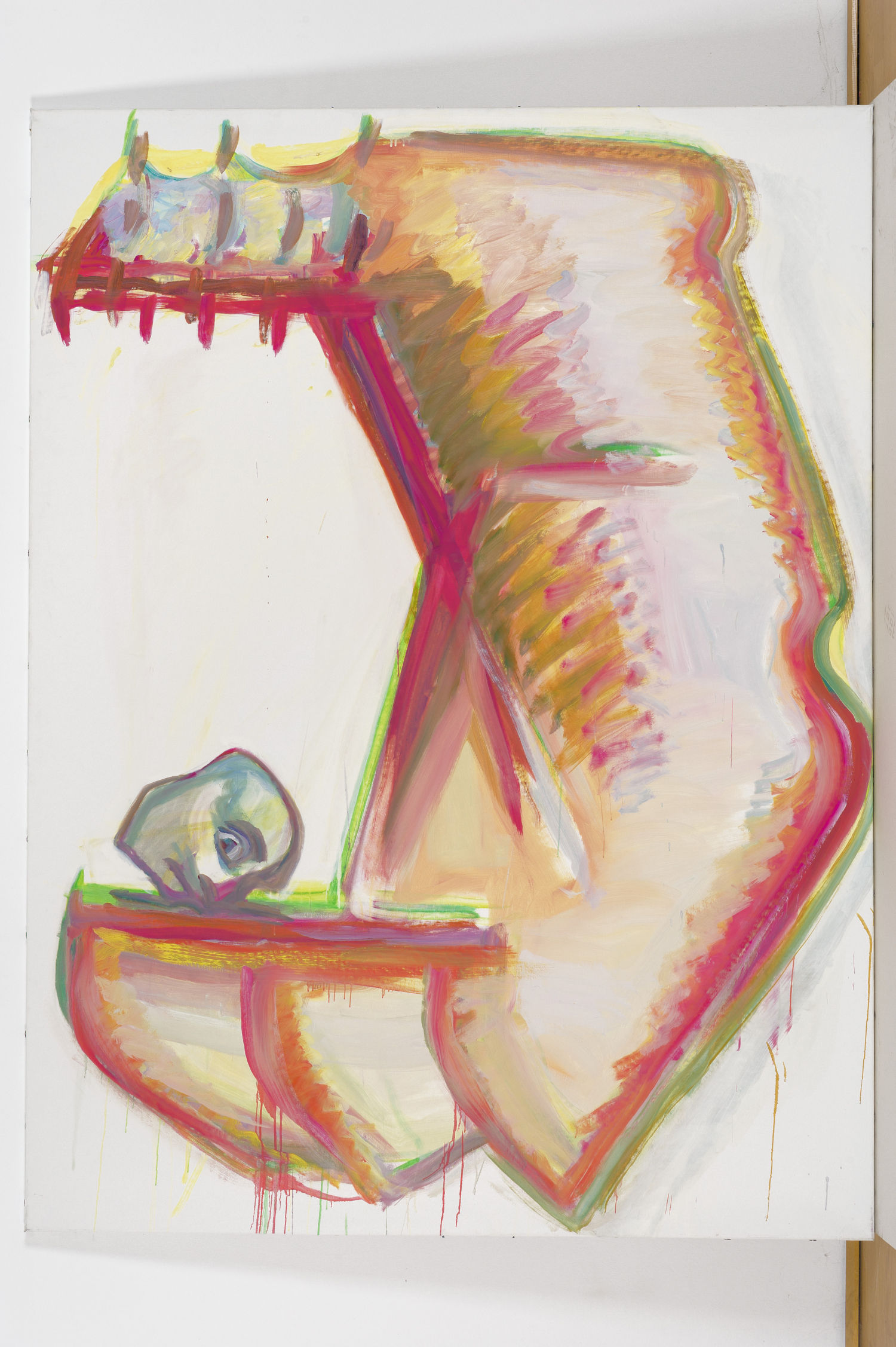
This part of the exhibition—located in one of the smaller side rooms of the HKW—felt like the more successful one, with a careful selection of works insisting on oppression’s effect on the body. On one side next to Rhode and Salazar was presented É o que sobra (What is Left Over) from the series Fotopoemação (Photopoemaction) (1974), a three-part photograph by Anna Maria Maiolino explicitly crafted under Brazil’s military censorship showing different parts of her body threatened to be cut by a menacing pair of scissors, the personal body under threat transformed into the social one. On the other side was shown a series of prints of papers by Sliman Mansour, the co-founder of the League of Palestinian Artists. The strong symbolic charge of the works acted as a commemoration of the Palestinian struggle—women cuddling olive groves or offering oranges as allegories for Palestinian land—, joining Roee Rosen’s The Gaza War Tattoos as the works explicitly linked to the ongoing horrors in Gaza. In the adjacent rooms, and rather convincingly, a Maria Lassnig painting gave the full force of recluded introspection. The imposing beheaded figure—the painting is 2m high—stands as a beacon of what fascism does to bodies, its first goal always being to gain control over them. But also those inner disruptions are expressions of faith that strongly connect us to other bodies being hurt.
|
|
Maria Lassnig, Scaffold of the Elites / The Elite Is Always in Danger (1995), oil on canvas, 200.6 x 150.2 cm. Maria Lassnig Stiftung. Courtesy Capitain Petzel, Berlin. Credits: The photographer and Haus der Kulturen der Welt.
|
|
|
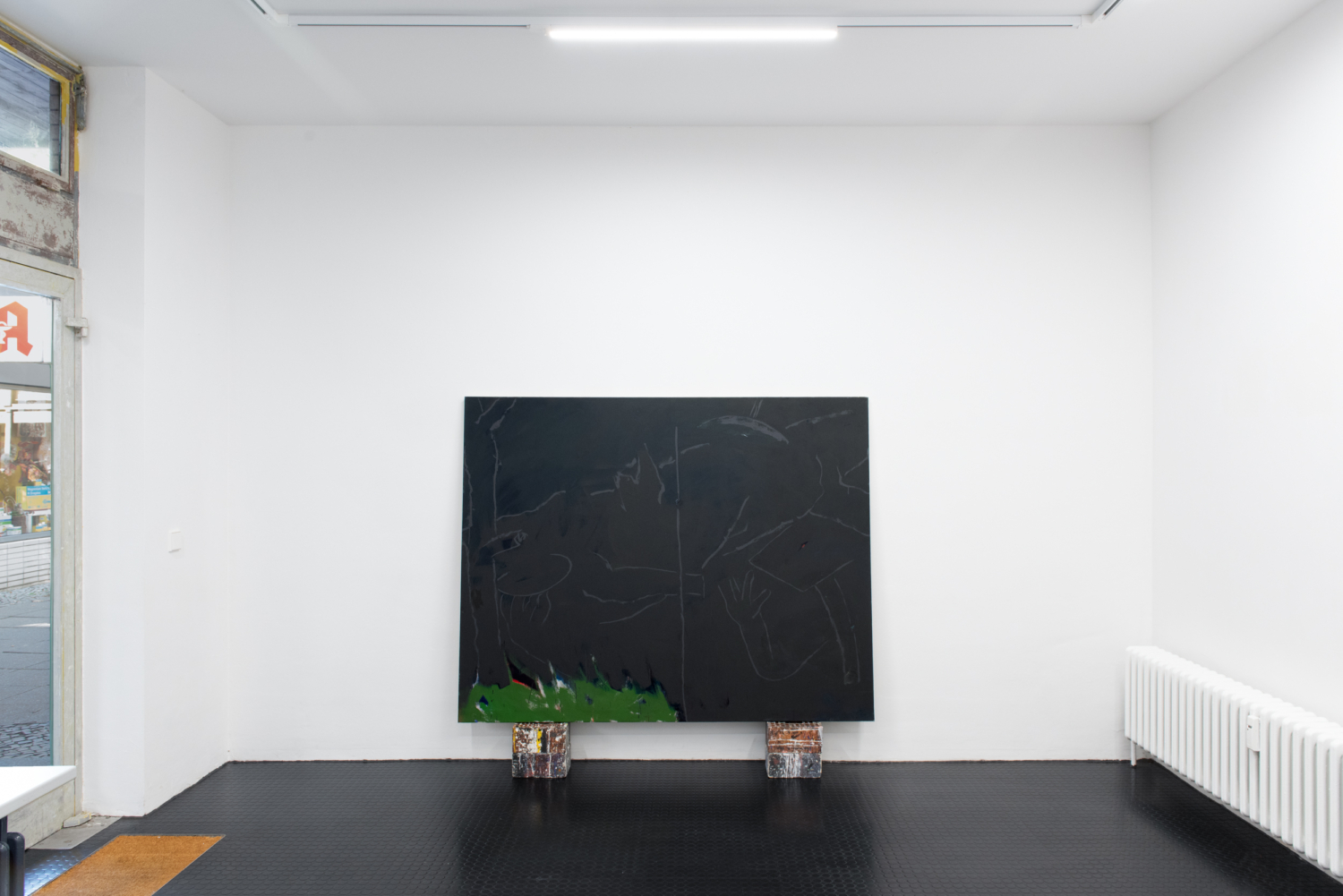
I felt relief leaving the institutional minefield to head to some fresh smaller-scale shows. Over at Galerie Isabella Bortolozzi, Marc Kokopeli showed his delirious South Park-y characters stuck in aquariums, talk show playsets for the end of the world. Flora Klein upcycled past panels for new paintings presented at Galerie Lars Friedrich, infusing an intriguing narrative of technological progress in her ongoing exploration of abstract painting—with led stripes partitioning canvases as hoods of electric cars. At Galerie Thomas Schulte, Julian Irlinger dived into post-war modernism, presenting sculptures alongside the animated movie commissioned by Portikus from his previous exhibition. It offered an exhilarating take on the cyclicality of the times and what felt like a German cultural necessity to define one’s own urban landscape as kids playing Meccano—the childish sentiment coming from the movie’s 1960s Pink Panther aesthetics. Irina Jasnowski Pascual’s show at Galerie Noah Klink digged into the optical mechanisms of the periscopes to place vibrating postcards of Lufthansa airplanes into one’s line of sight, sculptures built with discarded materials that extended this consideration of urban space with a stronger focus on the oscillating rationality of perspective. Galerie Buchholz was showing a reinvigorating exhibition of Robert Colescott, the Black American painter confronted with matters of past and racial identity when confronted with Egyptian art during his stay in the country in the 1960s. The show focused on this series of works done in Cairo at the time, celebrating the 100th anniversary of the artist’s birth. GROTTO, the small exhibition space in the Hansaviertel, was opening a show by Galli, a German painter born in 1944 and mostly associated with Neo-Expressionism. One painting, shown on the floor, just laid on a pair of bricks—a typical painter’s studio move—was an exhilarating sight of fractious bodily deconstruction. Away from the self-referential impasse probed by other figures of the movement, the work came back to me with the exhilarating force of a painterly practice forged in freedom and discipline.
|
|
Exhibition view: Galli, Pazienza, GROTTO, 13.09—25.10.25. Credits: Studio Replica.
|
|
|
Galli being much of a Berlin artist, her show made me remember how the city could still hold this capacity to articulate chaos and sort it out powerfully. On the last night, heading back to the hotel and getting out at Zoologischer Garten, I stopped at Curry 36 to fetch a last currywurst—the sole sausage will still cost you a mere 2.90 EUR—, with the simple thought that, from Berlin or anywhere else, we can only accordingly talk about chaos when we acknowledge it first about ourselves.
|
|
(1) The building was eventually restored and reopened in 2003, re-emerging not as a natural history museum but as an ethnographic one devoted to Albanian culture.
|
|
|
|
|
|
|