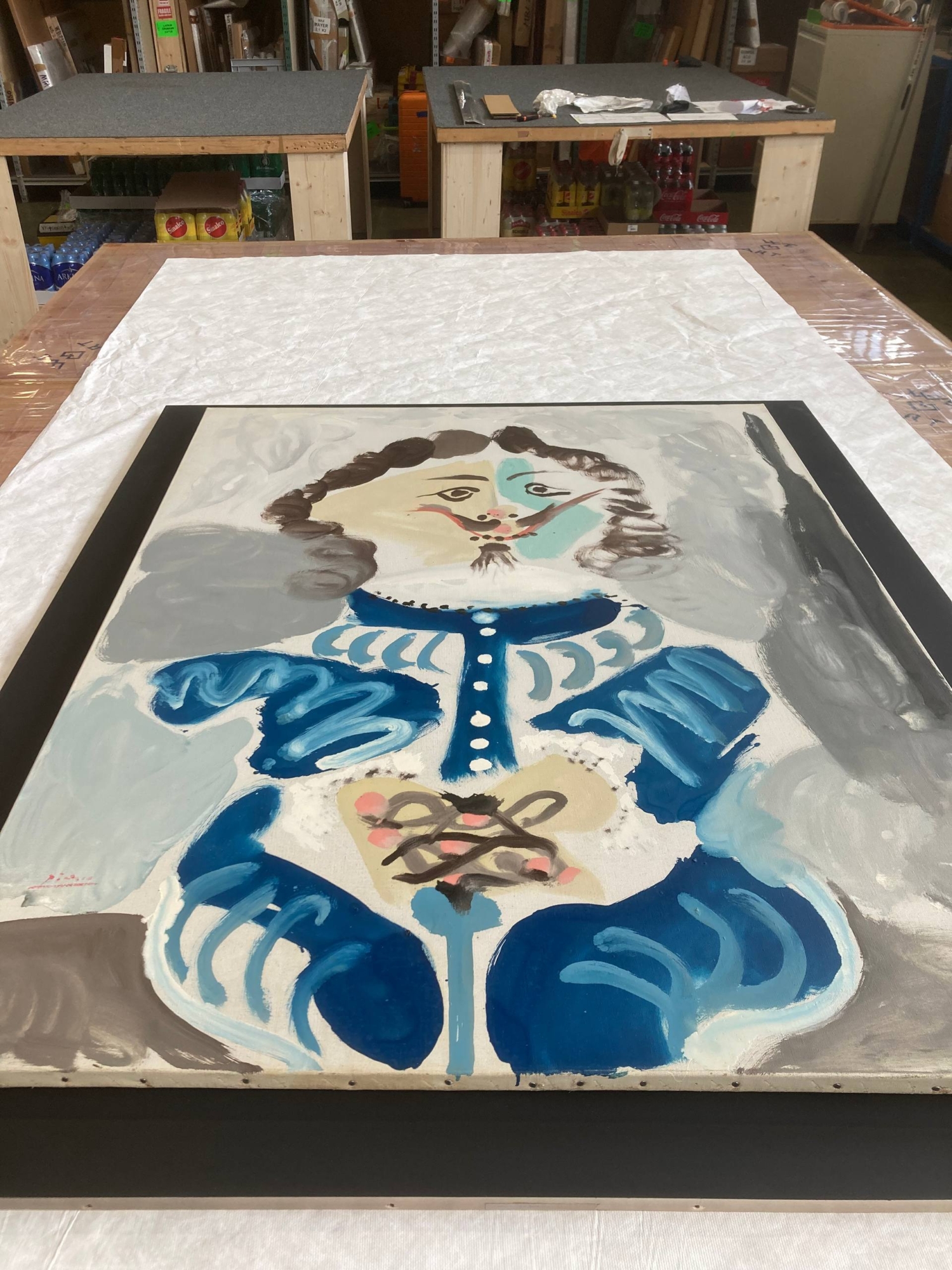
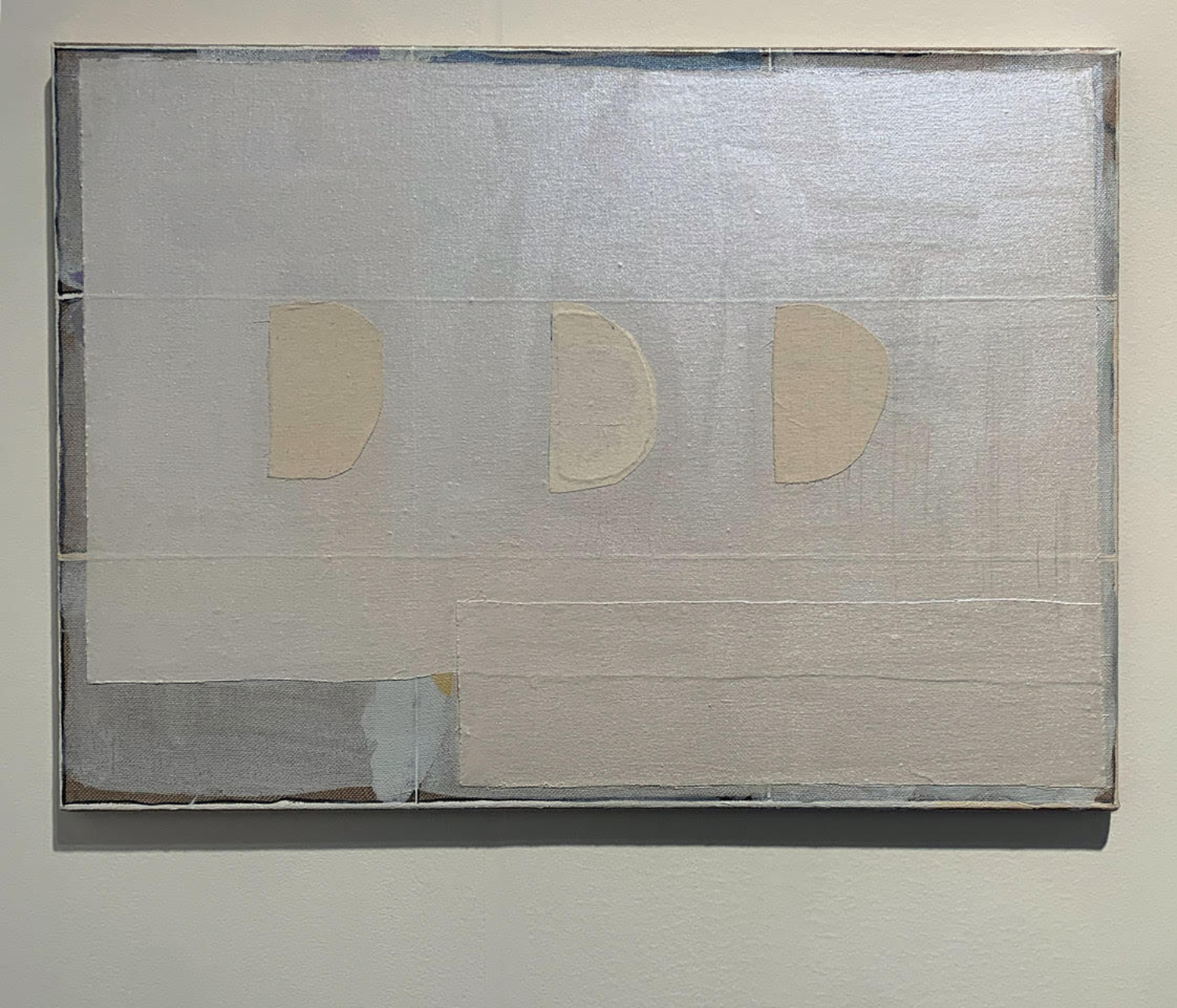
Picasso? Photo by Anonymous.
|
|
|
Last time I did this, I was a day late. This time I’m way too late. Most of my friends had already left by the time I arrived in Basel. I’m handed an artist VIP access pass that someone else no longer needs, and I reflexively pull the “plus one” card it offers from the machine every time I enter the fairground, even though I can’t pass that on to anyone else.
The challenge is to pretend that this is, in some way, the same as my last trip. And indeed, the specific lens through which PROVENCE seems to like to view things—and which I, too, can never quite avoid—is the one focused on the gathering, one through which Venice and Basel can be compared.
Central subjects here include animals ranging from eerie to cute, a distant past reminiscent of fairy tales and legends, and something one might call ASMR art. You can’t say that post-net is alive, but it is also here. Other pieces are mostly discussed by their prices rather than any other measure or affiliation. When art becomes very expensive, it also becomes fundamental, not radical, but rather basic, meaning all of it and everyone. The particular universality here is very Swiss (market is the unifying relation, unsurprisingly), which means even the fundamental art comes without any ethereal sounds. This is, after all, an art fair, not an exhibition, and soothing or unsettling patterns and delicate, repeating structures are constants that everyone seems to understand, and to have feelings about, one way or the other. I think of numbers and sequences whose names I cannot write, universal laws and forms that appear at both micro and macro levels, in the brain and in the world around it. The works in the Unlimited section have titles that include terms like heaven and earth, their size corresponding to their unlimited metaphysical claim. Correspondences, similarities, and patterns are even more recurring as a theme than animals. Rarely is anything about contrasts or contradictions, signs, and how they differ from what they signify. Or a break with expectations. At other times, the space the Unlimited section offers might have provoked artists to become increasingly pop and playfully banal: the larger the artwork got, the more flaccid and anti-monumental it became. That’s not the case here. Instead, grand themes are explored on a grand scale.
|
|
Warehouse Artefacts: Thomas Bangalter, Julian Charrière and Rampa. Photo by Anke Dyes.
|
|
|
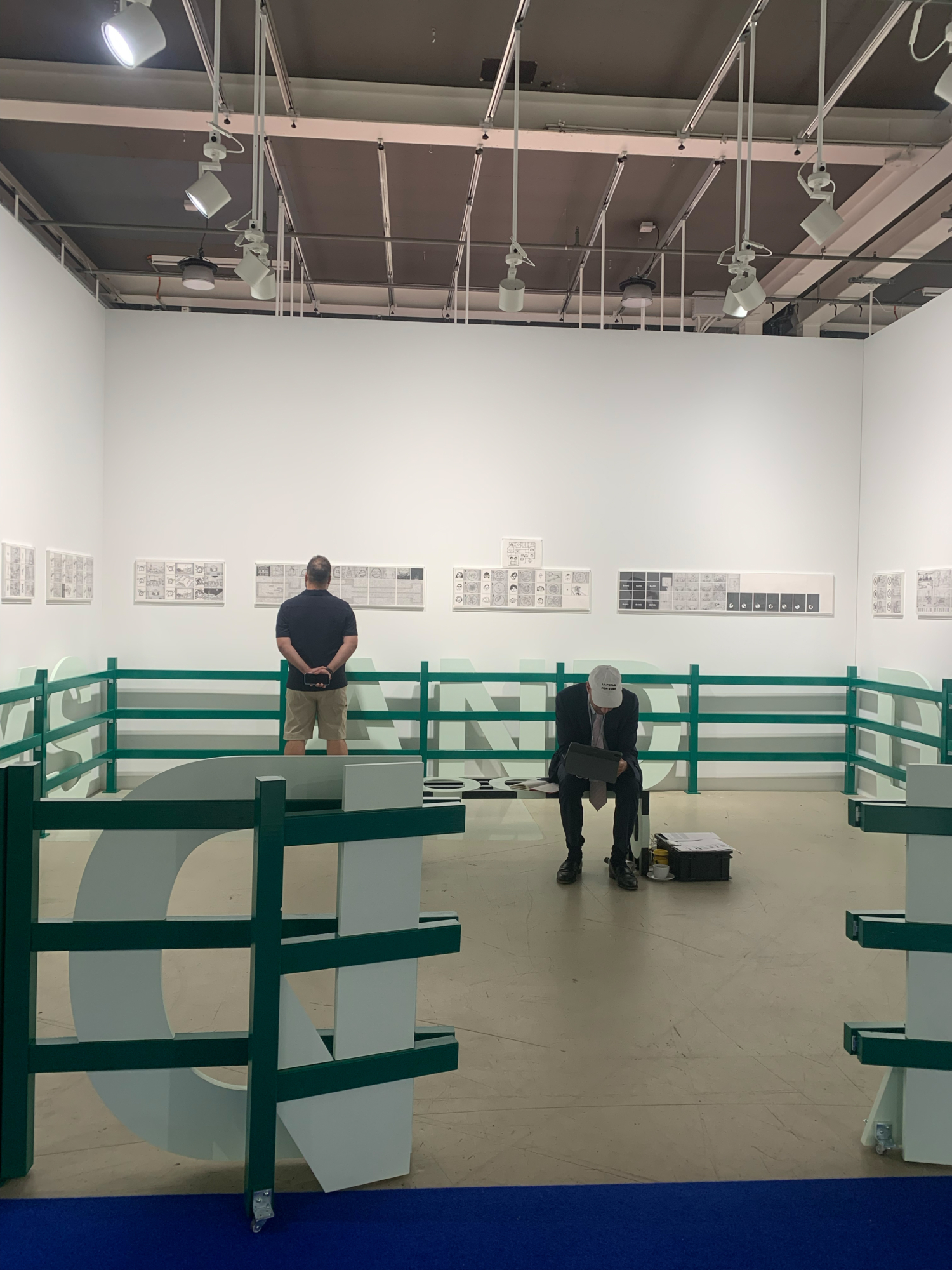
I can tell I’m late because everyone is already pretty tired. Sick art dealers hug me hello, assuring me it’s not COVID, just exhaustion. I’d guess it’s both. I can also tell because the way things are handled seems quite relaxed. After his shift at the booth, Lars Friedrich parks his dress shoes in Nuri Koerfer’s throne with donkey heads which flirts with being a piece of furniture as well as a figurative sculpture; City Galerie isn’t rehanging a work by Helena Huneke that apparently didn’t stay on the wall, and it leans casually on the floor, adding to the both urgent and fragile aesthetics of the works on show. I actually quite like this state of affairs shortly after the rush of VIP days, when it doesn’t matter as much anymore. The booth becomes a bit like a living room, an office, a studio. Somewhere else, it’s also a playpen, in which, I assume, the gallerist Noah Klink is sitting. The installation works with a literalness it shares with many others at the fair; language is a cage and a playing field, with clearly defined boundaries. The installation engages with the fair’s setting of galleries as open cubes, but rather than art without a fourth wall, it is enclosed by four fences. Sebastian Jefford’s space seems like a commentary on the art fair situation, and on the work of those tasked with presenting the art here, in that very language, for days and days. Others close off their galleries from the hallways and passers-by, as in the case of Felix Gaudlitz, who, with Kobby Adi’s sculpture, designs a kind of art as another world—for one must enter through the door of a dark wall that seals off the booth from the audience and is itself a sculpture; a different kind of conceptual work, more storytelling, less semiotics.
|
|
Installation by Sebastian Jefford, Galerie Noah Klink, Art Basel Statements. Photo by Anke Dyes.
|
|
|
In many other places, both on the fairgrounds and throughout the city, a principle of similarity and correspondence runs through artworks and exhibitions —not always as illustration, but often as a kind of proxy relationship, where one thing stands for another and looks somewhat similar to it at the same time. At the Fondation Beyeler, too, things are organized by similarities this year. As we enter, I tell the friend with whom I’m attending the reception on Friday evening, who took me along, that he’s welcome to leave me standing there, which he does immediately. At the barbecue in the garden, things proceed without any fussiness, in a way that I think only very wealthy Protestants can manage. The better-dressed guests take off their satin pumps, carry them in one hand, their drinks in the other, and walk barefoot through the garden to catch a glimpse of the spectacular sunset.
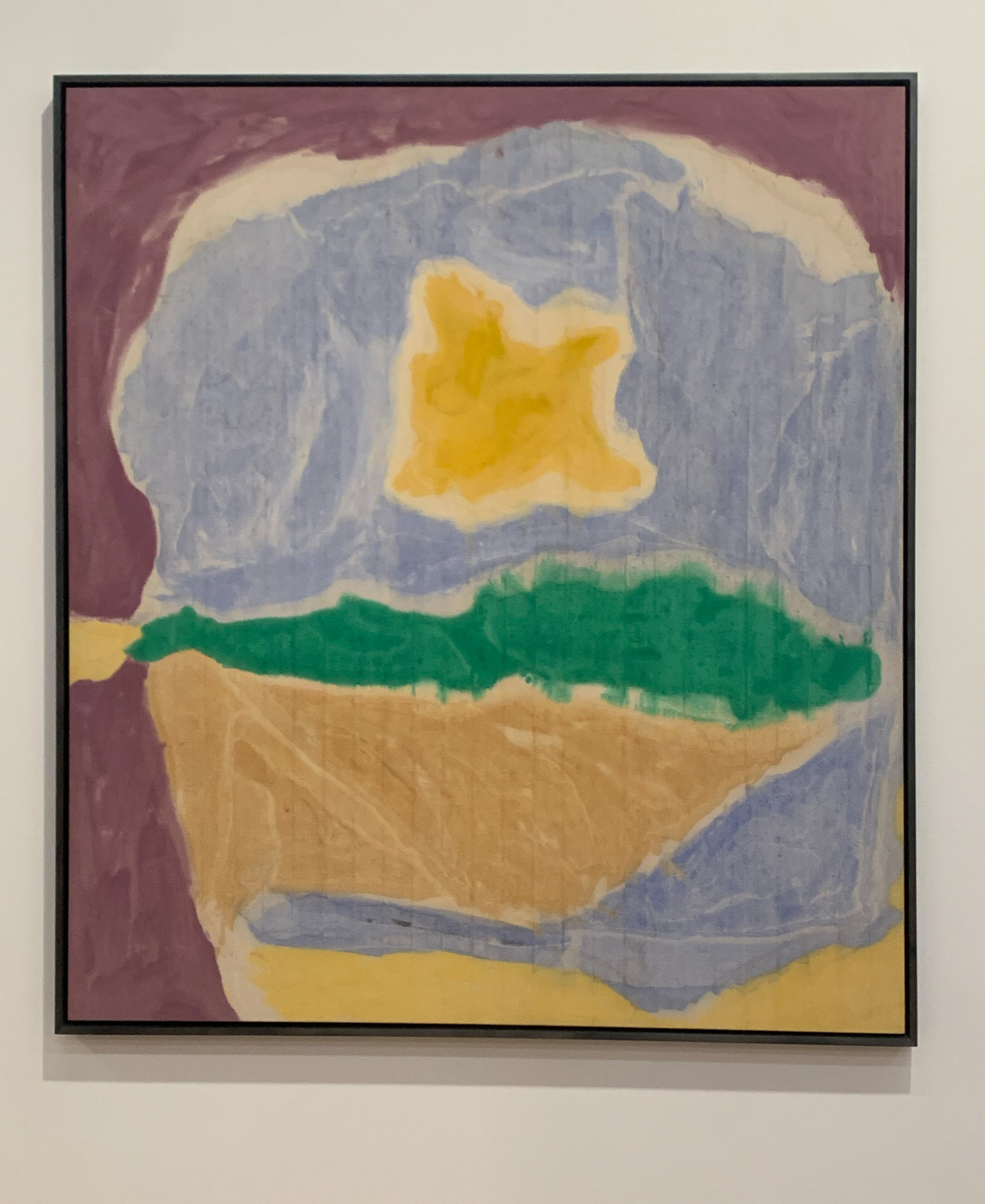
The pairings of major artists in the current collection’s exhibition do not always do them justice. Some of these combinations emphasize one aspect of the work beyond all others, reducing Sarah Morris to superficiality and Piet Mondrian to esotericism. I still enjoyed seeing these paintings quite a bit, and this art can withstand a lot anyway. But sorting by if not equivalents, then by formal similarities, reminds me of the conceptual move of sorting one’s diary alphabetically before publishing. A rigorously enforced and unsentimental treatment of the material, that might be necessary in the case of the diary, to distance oneself and to open the writing up for a use beyond one’s own individual reflection (as Sheila Heti did last year). What I’m missing here, though, is a unique perspective, a synthesis—something an Excel spreadsheet can’t do, but perhaps only a good curator can.
|
|
Helen Frankenthaler: Yolk, 1963, Kunstmuseum Basel. Photo by Anke Dyes.
|
|
|
The next day, I walk in circles through the air-conditioned halls of the exhibition spaces on the fairground and beyond, spot a painting or two by friends of mine, and hope they are making good money. I’m puzzled by gallery names like “Pitted Dates” and “Final Hot Desert”. In the city where I live, galleries are now also named after things, feelings, or material states, and it strikes me as part of this trend toward literalism, even though the more traditional family names of the gallery owners are, after all, also quite direct.
I head to the Swiss Art Awards and rediscover things I already know from the Basel Social Club, which each year expands the entire fair spectacle into a different repurposed space in the city. Despite strong branding and its own merch shop, this year’s office building—and especially its basements—tells its own story, provides a context for the intervention, and interesting places to hang art. Some of the performances at the Social Club take on this narrative directly, focusing on working conditions in offices like İlknur Bahadır. She cleans the art exhibition in a costume between Cousin Itt and Mierle Laderman Ukeles, while playing sentimental music through a speaker on her cleaning cart. The house-as-theme of this exhibition is the otherwise mostly missing second layer, through which the art world becomes legible as a workplace, and art fairs as the administration of art. And yet, my gallerist friends seem uninterested in the stories my art handler friends tell me, of the artworks that never leave Basel even if they do change hands, and how it is noticeably a weaker year, because people get fewer shifts re-hanging booths that have sold out.
|
|
Marieta Chirulescu, Untitled, 2025. Photo by Anke Dyes.
|
|
|
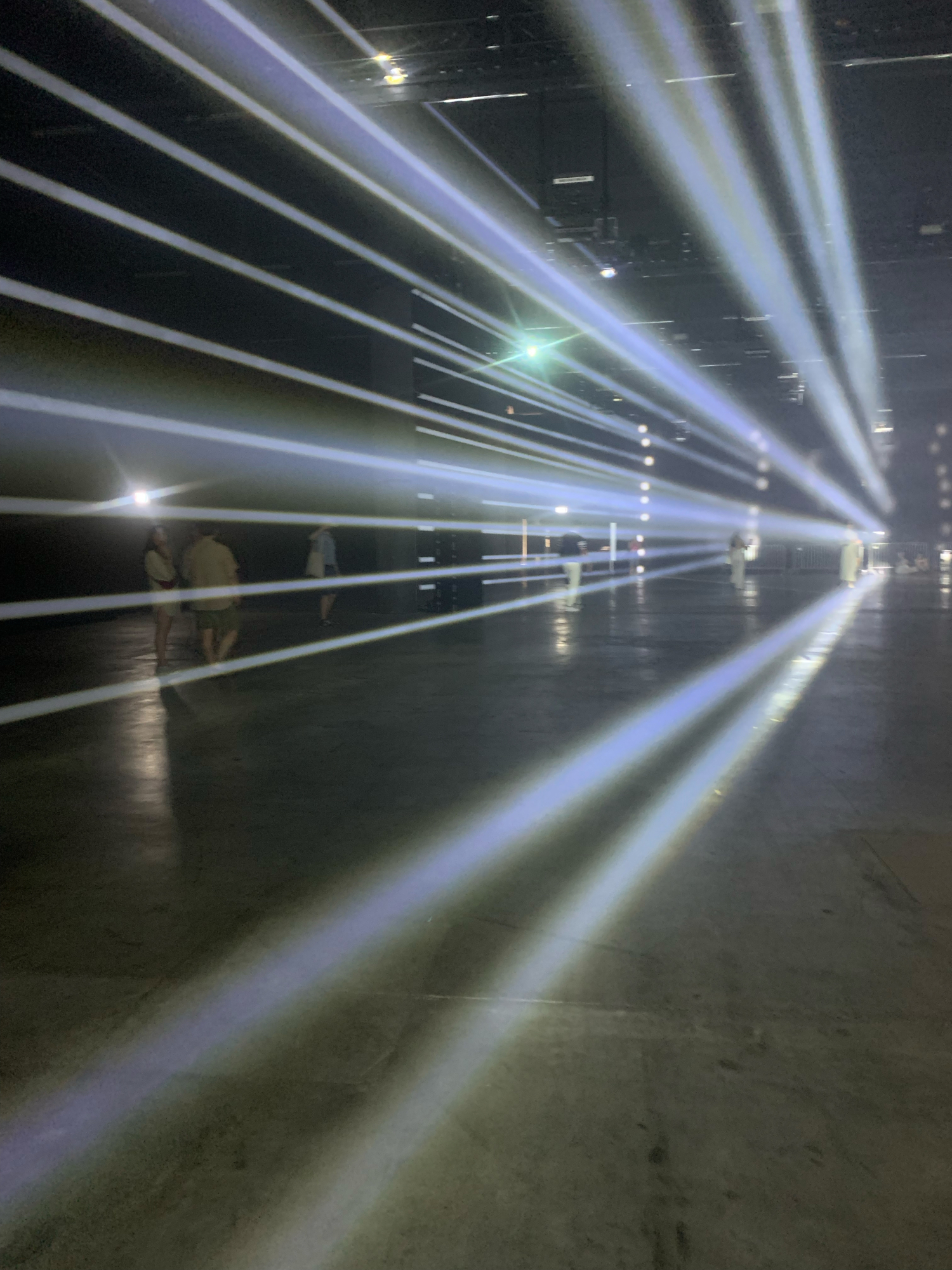
At the Swiss Art Awards, I linger briefly at the Texte zum Nachdenken library, the charmingly clunky name of a project exploring artists’ writing and its place in art. Before leaving the fairgrounds, and only because I happen to wander there, I end up at the immersive experience by Thomas Bangalter, Julian Charrière, and Rampa, which brings the club into the museum, or rather the exhibition hall. It is very silly, as immersive experiences often are. There is a futuristic yet ancient tape recorder installed in a giant glass box in the middle with megaphones attached to it, which clearly do not produce the excellent sound we hear. I take a bunch of pictures and videos and regret being here by myself, so I can’t film someone caged by or escaping the light-architecture the installation creates. More illustration, more things that are a symbol of something as well as a part of something.
The other immersive experience to be had in Basel, of course, is that it’s been over 36 degrees Celsius the whole time. Many people take a dip in the Rhine, which is already coated with a film of sunscreen. For a moment, I feel sorry for the performance artists. Maybe because I remember that in one of my past lives, I also performed in the “miscellaneous program” of the Liste fair. We were an artist group, wearing mascot costumes that we meant to be critical, running around the yard at the Warteck Brewery. Due to the costume my vision was 90% blind spot. “Hey Fruity!” someone shouted, as I navigated the crowded fair, even though I clearly was a drop of blood and not a strawberry. Meanwhile, my colleague was wearing a phone costume that, for copyright reasons, had the name “Black Beny” printed on it; symbolism that was probably clear to everyone.
|
|
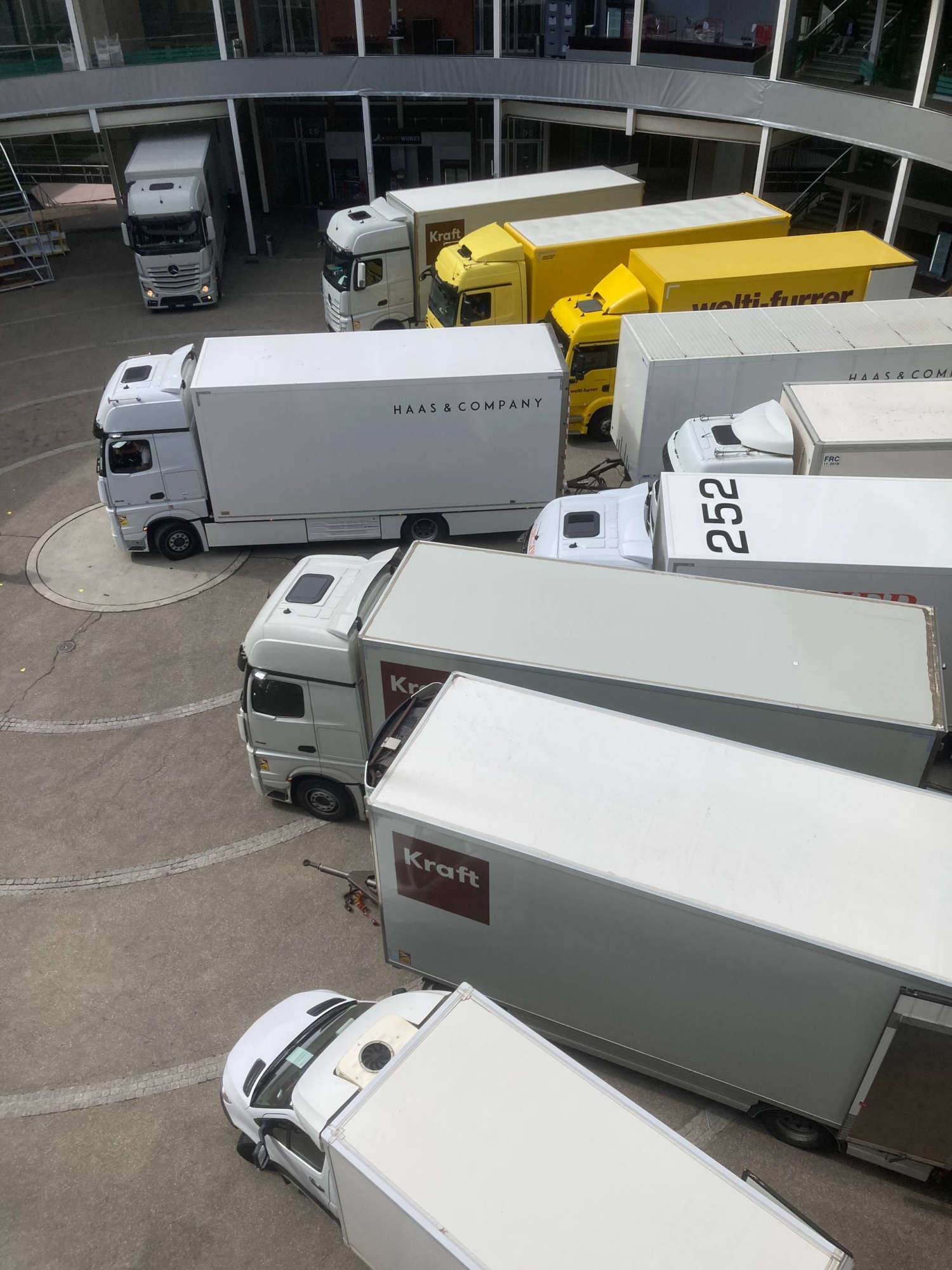
After the fair. Photo by Roman Graneist.
|
|
|
|
|
|
|